Branding in Quebec: what Bill 96's French language rules actually require
The direct answer
Since June 2025, Quebec's amended Charter of the French Language requires that any trademark visible from outside a business, on signage a passerby can read, be accompanied by French text that is markedly predominant, unless the mark is a recognised trademark registered under the Canadian Trademarks Act with no French version on file. Recognised but unregistered common law marks lost part of that protection in the final rules, so an unregistered name displayed outdoors in Quebec generally needs a French descriptor, slogan, or generic term alongside it. The safest sequence for a business entering Quebec: register the trademark federally first, then design the signage around the French predominance rule rather than after a dispute arrives.
Five conclusions
The argument, compressed.
- Since June 2025, a trademark visible from outside a Quebec business needs French text that is markedly predominant, unless the mark is registered federally with no French version on file.
- The final regulation restored an exception for unregistered common law marks in narrower form than the original bill proposed. Registration status changes what a business can legally display outdoors.
- Product packaging and public signage are governed by related but separately worded rules. A compliant sign does not automatically mean compliant packaging.
- Markedly predominant has a defined visual test: the French text must be at least twice the size of any other language, or the version in another language must be entirely absent from the same visual field.
- Entering Quebec after the brand identity is finished is the expensive order. Checking the language rule before the sign is fabricated costs nothing; correcting an installed sign costs the full production again.
Working framework · 5 decisions
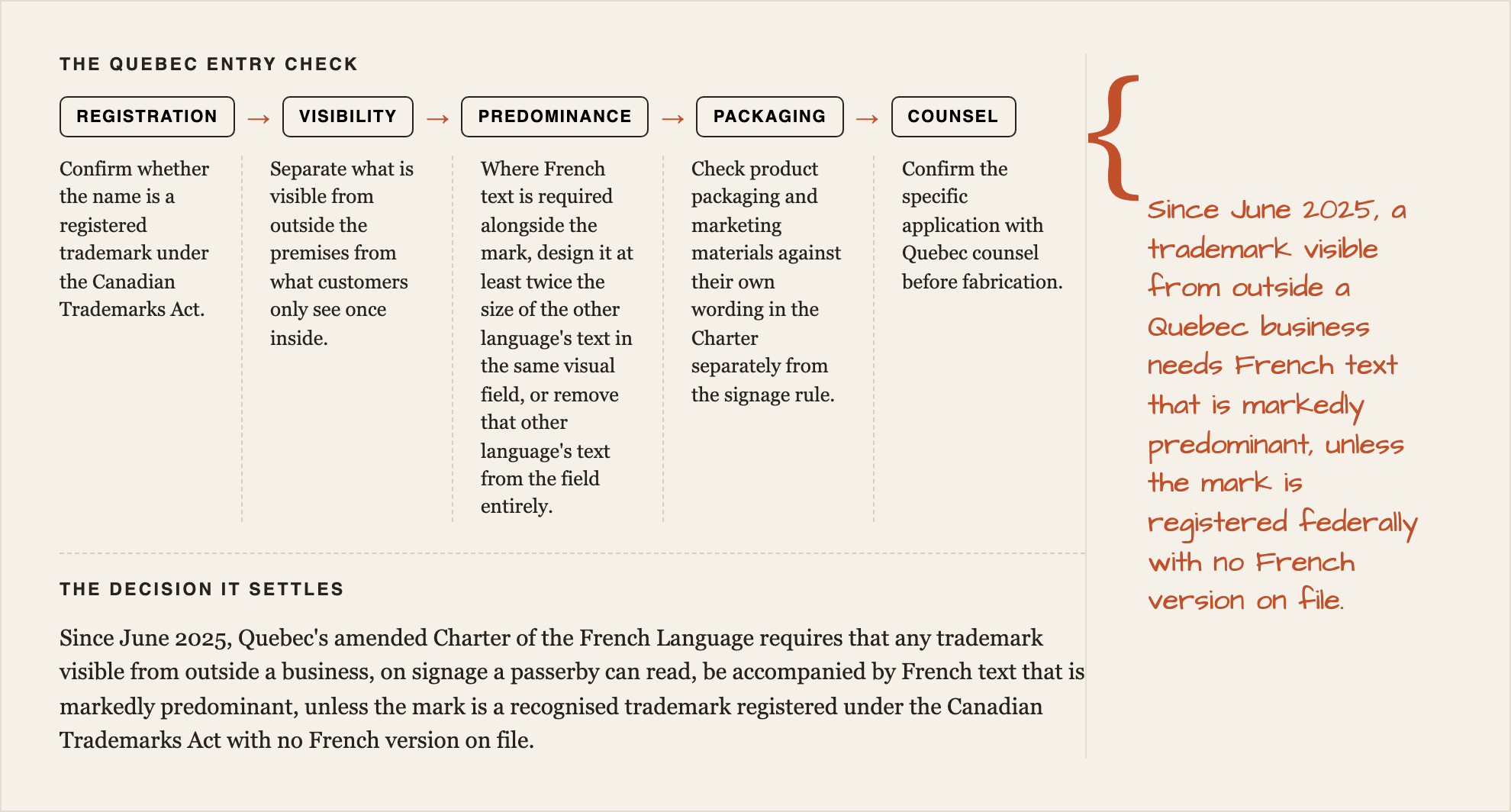
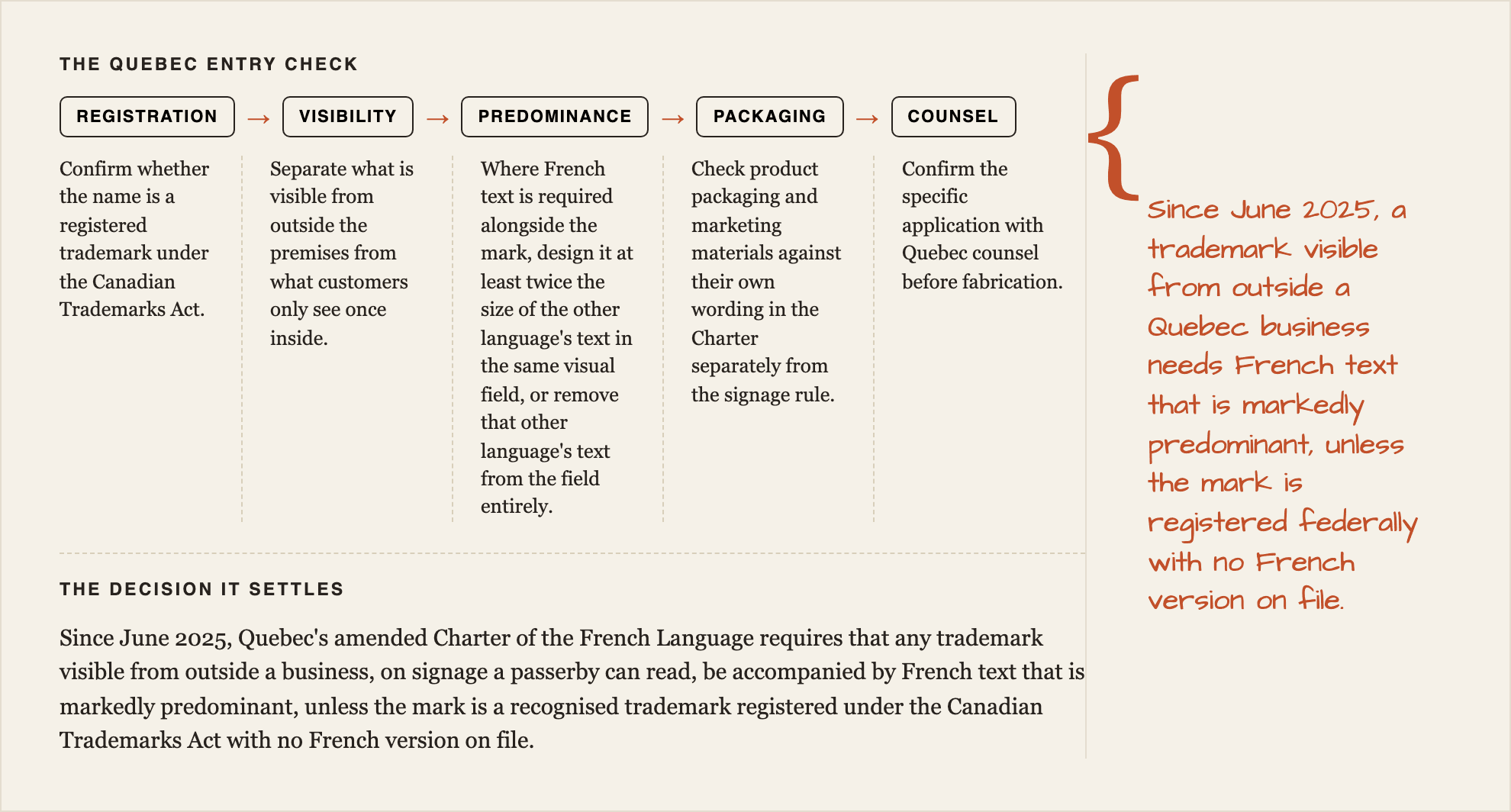
The Quebec entry check
Five checks, run before a Quebec location opens or a Quebec facing site launches, settle whether the existing brand identity can travel as it stands or needs a French language layer designed alongside it.
Decision 01 / 05
Registration
Confirm whether the name is a registered trademark under the Canadian Trademarks Act. A registered mark with no French version on file keeps broader signage rights than an unregistered one.
What Bill 96 actually changed
Bill 96 amended Quebec's Charter of the French Language, and the final regulation took effect in June 2025 after a period of public consultation that visibly softened the original proposal. The declared purpose is to reinforce French as the language of commerce in the province, and the amendment reaches further into brand identity than the original 1977 Charter did: trademarks, not just general commercial signage, now sit inside its scope.
The part that concerns a brand strategist most is signage visible from outside a premises. Under the amended Charter, a trademark shown on that kind of signage must be accompanied by French text that is markedly predominant, unless the mark qualifies for the recognised trademark exception. That exception exists specifically so that established brand names, the kind that took years to build recognition, are not automatically forced into translation.
The exception is narrower than it first sounds, and narrower than the original 2022 bill's harshest critics expected once the walked back final regulation landed. Registration status decides most of what a business can display, which makes a trademark search the first genuinely useful step before any Quebec specific design work begins.
The core question
Is the mark a registered trademark with no French version on file. That single fact decides most of what Quebec signage law allows.
The recognised trademark exception, and where it narrowed
The original draft of Bill 96 would have limited the recognised trademark exception to marks registered under the federal Trademarks Act, cutting out well known but unregistered common law marks entirely. Quebec's government walked that specific change back in the final Regulation respecting the language of commerce and business: recognised trademarks, whether registered or not, can still appear on products and packaging without a French translation, provided no French version of the mark appears on the trademark register.
Signage read from outside a business is treated separately and more strictly than packaging. A trademark shown on public facing signage must be accompanied by French text that is markedly predominant in that visual field, even when the mark itself qualifies as recognised. The exception protects the mark from forced translation; it does not remove the requirement to add French context beside it outdoors.
This distinction between packaging rules and outdoor signage rules is the detail founders miss most often, because both get summarised in press coverage as one Bill 96. A business can be fully compliant on its product labels and still be in breach the day its storefront sign goes up without the French text sized correctly.
What markedly predominant actually means
Markedly predominant is not a vague standard left to interpretation on a case by case basis; the regulation gives it a visual test. French text meets the requirement when it is at least twice the size of any other language present in the same visual field, or when the other language is absent from that field altogether, leaving French alone with the mark.
This is a design decision as much as a legal one. A trademark rendered in a fixed logo lockup, at a fixed proportion between mark and tagline, may need a genuinely new outdoor signage variant rather than a resized version of the existing file, because the French requirement changes the proportions the original lockup was built around.
Treating this as a signage production detail, decided the week the sign gets ordered, is how businesses end up refabricating. Treating it as a brand system decision, made once and documented in the guidelines the way any other locked proportion is, means every future location opens compliant on the first install.
- Check the exact lockup: does the French addition need to sit beside the mark, above it, or in a separate panel to hit the sizing rule?
- Decide the French wording once, centrally, rather than leaving each location's sign vendor to improvise a translation.
- Document the compliant version in the brand guidelines as a named variant, the same way a favicon or a dark mode lockup is documented.
Packaging is a separate question from signage
A business that ships product into Quebec from elsewhere in Canada, or from the United States, often assumes its existing packaging is a marketing detail rather than a Quebec compliance question. The Charter's packaging provisions run alongside the signage provisions rather than inside them, with their own specific requirements for what must appear in French on a package regardless of what the outdoor sign shows.
This split matters operationally. A retailer's Quebec storefront can pass a signage review while product on its own shelves fails a packaging review, because the two checks are conducted against different sections of the same amended Charter, often by different people inside the business.
The practical fix is treating Quebec entry as one review covering both surfaces, run before the first shipment or the first lease is signed, rather than as two separate fires to put out after a complaint arrives.
The cost of finding this out after the sign is installed
A brand identity is expensive to change once it is fabricated: printed signage, moulded storefront lettering, packaging already run in production quantity. None of that cost changes because the trigger for the redo was a language law rather than a strategic rebrand; the sign still has to come down and go back up.
The founders most exposed are the ones expanding into Quebec as one location among several, where the brand system was designed for the rest of Canada or for the United States first and Quebec was assumed to be a straightforward translation exercise. The predominance rule, the packaging split, and the registration dependent exception are not translation questions; they are structural questions about how the identity system is built.
Checking this before the Quebec location is designed, not after the sign order is placed, is the entire difference in cost. A brand strategist and Quebec counsel, working from the same Quebec entry checklist, catch the sizing and registration questions in a design review. A dispute after installation catches them in a refabrication invoice.
Before you use it
Questions that can change the recommendation.
Does Bill 96 force every business in Quebec to translate its brand name into French?
No. A registered trademark with no French version on file can generally keep its name as registered, though outdoor signage still needs accompanying French text sized to the markedly predominant rule. What the law targets is the language surrounding the mark, not automatically the mark itself, and registration status is the deciding fact.
Is an unregistered brand name protected under the recognised trademark exception?
Partially, and less than a registered mark. The final regulation kept a recognised trademark exception for common law marks, whether registered or not, but the outdoor signage predominance rule still applies where it did not previously, so an unregistered mark carries more exposure than a registered one on public facing signage specifically.
Does the French language rule apply to a website, or only to physical signage?
The Charter's commercial language provisions reach further than physical signage and cover areas including product labelling, packaging, and certain commercial documents; a Quebec facing website and digital storefront should be reviewed against the same Charter obligations rather than assumed to be exempt because the current essay focuses on physical signage and packaging.
When did the Bill 96 signage and trademark rules take effect?
The final version of the Regulation respecting the language of commerce and business, which settled the trademark and signage questions discussed here, took effect on June 1, 2025, after Quebec's government revised the original 2022 bill's stricter draft language in response to consultation.
Should a business hire a lawyer before finalising Quebec signage, or is a brand strategist enough?
Both, in sequence. A brand strategist can identify where the current identity system likely fails the predominance test and design a compliant variant; confirming the specific legal application, especially the registration status and the packaging provisions, needs Quebec counsel before fabrication, not after a complaint.
Research record
What this guide draws from.
Each source note describes what the reference supports. Platform guidance, research findings and Branding Tatva's practical suggestions have different scopes.
- Bill 96: New Rules for the Use of Trademarks on Commercial Signage and Product Packaging
Stikeman Elliott
Law firm analysis of the trademark and signage provisions in the final Bill 96 regulation.
- Quebec Publishes Final Language Rules: Softens Stance on Trademarks
Fasken
Coverage of how the final regulation walked back the original bill's stricter registered only trademark exception.
- Bill 96 and the Use of Non French Trademarks on Public Signage in Quebec: An Update
Cassels Brock
Detail on the markedly predominant visual test and the outdoor signage specific requirements.
- Quebec's Bill 96 and trademark implications for businesses
Legal 500 (Fillmore Riley)
Overview of the registered versus recognised trademark distinction under the amended Charter.
- Everything you need to know about Quebec's Law 14 (Bill 96)
Canadian Federation of Independent Business
Small business focused summary of the Charter amendments and their practical compliance timeline.