How to reposition an established service business without losing recognition
The direct answer
Reposition an established service business by changing the market meaning before changing every visible asset. Audit what customers currently recognise, which associations help or hinder growth, and which names, phrases, colours, symbols, service rituals, and proof already carry memory. Define the new customer situation and strategic choice, preserve useful recognition cues, build a clear bridge from the old meaning to the new one, phase the rollout across touchpoints, and measure both understanding and recognition after launch.
Five conclusions
The argument, compressed.
- Repositioning changes what the business should mean; rebranding changes how that meaning is expressed.
- Recognition is an asset to audit before the design process, never a constraint to discover after launch.
- Preserve familiar cues that are unique, known, and still compatible with the new direction.
- A transition message should connect the business customers knew with the reason it is changing now.
- Measure recognition, understanding, lead quality, and buying situation association separately after launch.
Working framework · 5 decisions
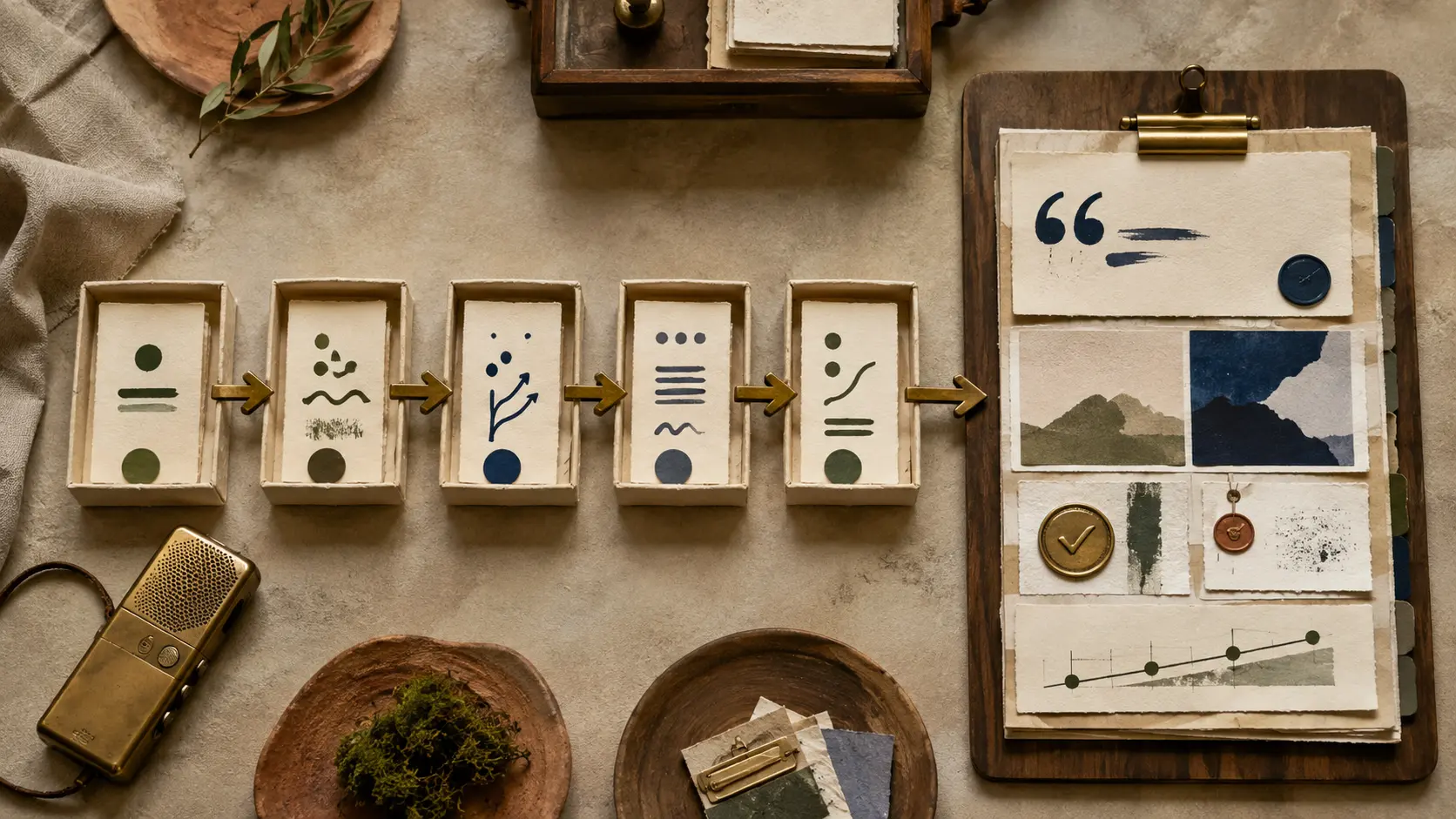
The recognition bridge
Five decisions let an established business cross into a sharper position without setting fire to the road behind it.
Decision 01 / 05
Baseline
Measure what customers recognise, remember, value, misunderstand, and use to find the business today.
Repositioning is not the same as rebranding
Repositioning changes how the business should be understood relative to customers, buying situations, and alternatives. Rebranding changes the identity and communication system used to express that meaning.
An established service business may need repositioning because its current reputation is too narrow, too broad, too dated, too dependent on the founder, or attached to work the business no longer wants to lead with. A new logo cannot resolve those strategic tensions by itself.
Begin with the meaning. Decide what the business should become easier to choose for, which comparison should change, and which evidence makes the movement credible. Then decide how much identity change the new position genuinely requires.
Change hierarchy
Change the market meaning first, the offer and experience second, and the visible identity only as far as the new direction requires.
Why an established business carries more repositioning risk
A new business has little memory to lose. An established business may already own a name, colour, founder association, phrase, referral shorthand, service ritual, or reputation that helps customers recognise and trust it.
Those assets can feel ordinary inside the company because the team sees them every day. Customers encounter them far less often. What feels tired internally may still be the cue that lets a buyer locate the brand in a crowded comparison.
Research on service rebranding has found that customer evaluation can fall after a brand name change, with the relationship between the new brand and the service influencing the size of the decline. The lesson is not to avoid change entirely. The lesson is to understand what the customer must relearn.
Recognition cost
Every removed cue creates a memory task for the customer. Make that task only when the strategic gain is worth the relearning.
Confirm that repositioning is the real need
Some businesses call for repositioning when the underlying problem is weak execution. The position may already be relevant, yet the website buries it, the proof is thin, the service menu has expanded without hierarchy, or the customer experience contradicts the promise.
Other businesses have a genuine strategic problem. The market associates them with an old category, lower value work, one legacy service, one founder, one geography, or one customer stage. Growth requires a different comparison or buying situation.
Separate meaning problems from expression problems before commissioning a new identity.
- Meaning problem: customers understand the business, but the current association limits future growth.
- Expression problem: the desired position exists, but touchpoints communicate it inconsistently.
- Offer problem: the promise has changed, while delivery and packaging still reflect the old model.
- Proof problem: the new direction is claimed without evidence that makes it believable.
- Recognition problem: frequent visual or verbal changes have already weakened familiar cues.
Build a recognition and association baseline
Before changing anything, record what the market currently retrieves. Ask customers, recent prospects, lost opportunities, partners, and internal teams what comes to mind first, how they describe the business, when they would recommend it, and which cues help them recognise it.
Separate awareness from association. A person may recognise the name while attaching it to the wrong service or an outdated level of value. Another may understand the expertise but fail to recognise the visual identity without the name.
Use a mixed evidence set: interviews, unaided recall questions, website search terms, branded search, direct traffic, referral language, proposal feedback, win loss notes, customer service transcripts, and distinctive asset testing where practical.
- Which name or shorthand do customers naturally use?
- Which service or problem is mentioned first?
- Which phrases are repeated without prompting?
- Which visual or verbal cues are correctly attributed to the business?
- Which current associations support the future position?
- Which associations create the strongest commercial constraint?
Define the core shift in one sentence
Write the movement as an old to new decision. For example: from a generalist creative supplier to the brand systems partner for established service businesses entering a more complex growth stage.
The sentence should identify the customer situation, the new comparison, the distinctive choice, and the evidence that makes the move believable. Avoid describing the shift only through tone, aesthetics, or ambition.
A strong core shift preserves truth from the existing business while changing the emphasis. It should feel like a sharpened interpretation of accumulated capability, not a costume placed over the same offer.
Continuity clue
The safest repositioning reveals a future that customers can trace back through the business's real history.
Inventory the assets that already carry recognition
List every recurring identifier: brand name, founder name, logo shape, colour, typography, symbol, sonic cue, motion pattern, photography style, tagline, service names, presentation format, signature question, onboarding ritual, and recurring piece of proof.
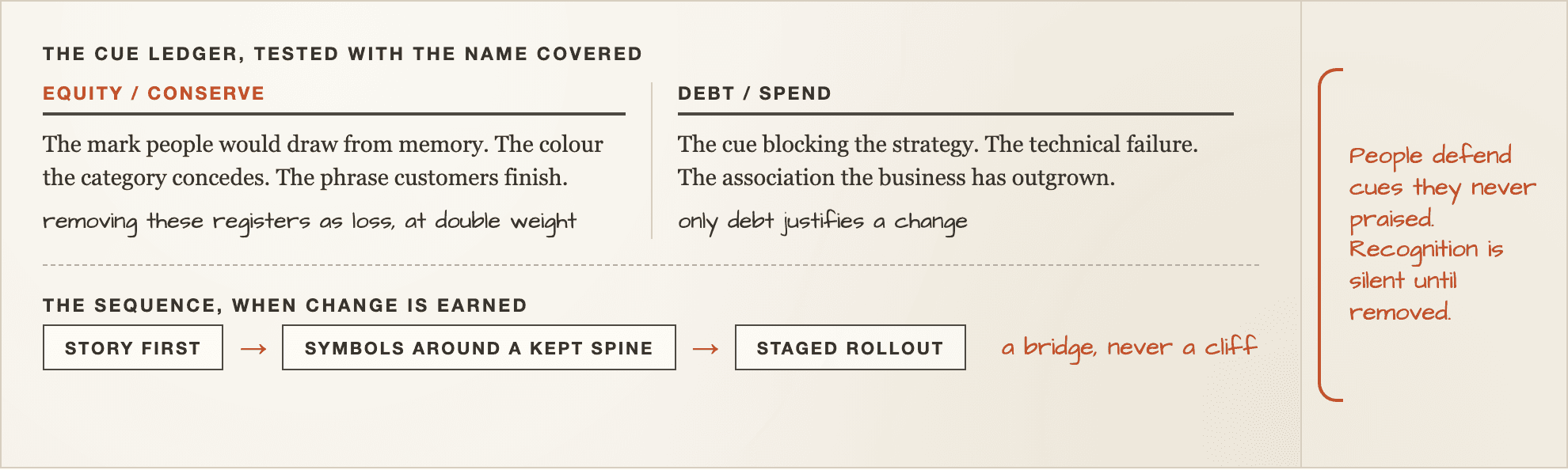
Judge each asset by recognition, uniqueness, compatibility, and future usefulness. An asset may be well known but strongly tied to the old position. Another may be strategically suitable but too weak to carry recognition on its own.
Ehrenberg-Bass Institute guidance emphasises that distinctive assets should be assessed by what buyers have stored in memory, rather than by internal preference. Preserve the assets that are both usable and compatible, then build new cues in waves instead of replacing the entire palette at once.
- Preserve: recognised, unique, and compatible with the new position.
- Evolve: recognised but visually or verbally needs controlled adaptation.
- Bridge: tied to the old meaning but useful during transition.
- Retire: harmful, confusing, legally constrained, or incompatible with the future.
- Build: strategically valuable but not yet recognised.
Preserve familiarity without preserving the old limitation
Continuity does not require freezing the identity. It requires choosing which familiar anchors will help customers identify the business while the meaning changes.
A name can remain while the category descriptor changes. A colour can remain while the visual system gains more range. A founder association can remain as proof while the service model becomes less founder dependent. A legacy phrase can become a transition cue before a new memory line takes over.
Logo research suggests that familiarity and perceived appropriateness influence response to change. This supports an evolutionary principle: the new identity should feel recognisably related to the brand and suitable for the position it is being asked to carry.
Evolution rule
Keep enough of the old pattern that customers can identify the source, and change enough of the system that they can learn the new meaning.
Build a transition narrative customers can follow
The transition narrative explains why the business is changing, what has remained true, what will become better or clearer, and how customers will experience the difference.
Avoid presenting the repositioning as an internal design celebration. Customers need less detail about the new typeface and more clarity about whether the service, people, access, commitments, and outcomes they value will remain dependable.
A useful bridge message follows four beats: what the business has learned, which customer need now deserves sharper focus, what is changing in response, and which familiar strengths will continue.
- What customer or market change made the old position insufficient?
- Which capability has become more central through real experience?
- What will customers understand or receive more clearly now?
- Which people, standards, values, and useful assets remain?
- What action, if any, should existing customers take?
Align the offer and service experience before launch
A repositioning becomes credible when the offer, sales process, onboarding, delivery, and proof already behave like the new position. Launching the language first creates a gap that customers will discover during the next interaction.
Review the service menu, package names, pricing logic, proposal structure, discovery questions, handoffs, reporting, and customer success rhythm. Remove elements that drag the business back into the old comparison.
Create proof for the movement. Reframe existing case studies around the new customer situation, publish the method behind the change, and show how recent work already supports the position.
- Which service should lead after the repositioning?
- Which legacy offer should be reduced, renamed, or retired?
- What new evidence is required before the claim can lead?
- Which customer experience moments must visibly express the new choice?
- Which internal behaviours could quietly return the business to its old position?
Phase the rollout rather than changing every cue overnight
A phased rollout gives the market repeated opportunities to connect old and new. Begin with touchpoints rich in context where the shift can be explained: customer conversations, proposals, the website, email, presentations, and owned content.
Use dual cues during the bridge period. A familiar name, colour, symbol, founder signature, or phrase can anchor a new descriptor and message. Over time, the new association receives more prominence while temporary explanation recedes.
Coordinate the sequence so customers do not encounter several contradictory versions. Prepare redirects, profiles, directories, sales collateral, email signatures, contracts, invoices, social channels, referral partners, and search listings before the public announcement.
Rollout principle
A repositioning is not one reveal. It is a period of structured repetition in which the old cue teaches the new association.
Test understanding and recognition before launch
Show the proposed position and identity system to people with different levels of familiarity: long standing customers, recent prospects, category buyers, partners, and people who know the old brand only lightly.
Test without overexplaining. Ask what kind of business this appears to be, who it is for, what feels familiar, what seems to have changed, and which provider the assets bring to mind.
A strong test distinguishes liking from function. People may prefer a dramatic new direction while recognising it less accurately. Others may prefer the familiar version while understanding the new position less clearly. The decision should balance strategic fit, recognition, and the cost of relearning.
- Can people identify the business before the name is revealed?
- Do they understand the new category or customer situation?
- Which old associations remain strongest?
- Which new association appears without explanation?
- Does the identity feel appropriate for the new position?
- Which cue creates confusion with a competitor or legacy offer?
Measure the repositioning after launch
Track whether the market is learning the intended association without losing the ability to recognise the business. These are separate outcomes and should be reported separately.
Recognition can be measured through unaided and aided brand or asset questions. Understanding can be measured through open text descriptions, category placement, buying situation association, sales call language, and the reasons prospects give for enquiring.
Commercial evidence appears through lead quality, service mix, win rate in the desired category, proposal objections, referral language, branded search, direct traffic, and repeat customer confidence. Compare matched periods and record other changes that may affect interpretation.
- Brand name and distinctive asset recognition
- Correct category and buying situation association
- Share of enquiries for the newly prioritised service
- Lead quality and disqualification reasons
- Win rate against the intended alternative set
- Customer retention and repeat engagement confidence
- Language customers use to describe the business
Common repositioning failures
The first failure is changing every visible cue before the strategic shift is clear. The second is preserving every legacy offer, which forces the new position to share the stage with the old one. The third is announcing a new promise before the service experience can support it.
Another failure is treating existing customers as an obstacle to future growth. Their language, memory, and trust reveal which equity deserves protection. The goal is not to let the past veto the future, but to use real recognition as raw material.
Finally, businesses often stop after launch. A new association requires repetition. Without a sustained content, proof, sales, and experience plan, the market remembers the reveal more easily than the reason for the change.
- Identity first change with no positioning decision
- Radical asset replacement without recognition evidence
- New message layered over an unchanged service menu
- No transition narrative for customers or partners
- One launch campaign followed by inconsistent execution
- Success measured only through internal enthusiasm or visual preference
A recognition safe repositioning plan over ninety days
During the first 30 days, diagnose the current position, interview customers and prospects, map alternatives, audit touchpoints, and measure existing recognition cues. Define the core shift and the assets that should be preserved, evolved, bridged, retired, or built.
During days 31 to 60, align the offer, proof, message hierarchy, transition narrative, and identity system. Prototype the website, proposal, sales story, and one customer journey. Test understanding and recognition with familiar and less familiar audiences.
During days 61 to 90, complete the rollout map, prepare every operational touchpoint, brief partners and customers, launch the owned channels, and begin a repeated content and proof sequence. Record the baseline and schedule matched measurement rather than judging the work from launch week reactions.
Before you use it
Questions that can change the recommendation.
What is brand repositioning?
Brand repositioning changes how a business should be understood relative to customers, buying situations, categories, and alternatives. It may lead to a rebrand, but the strategic meaning should be decided before the identity changes.
Can a business reposition without changing its logo?
Yes. A business can change its audience emphasis, category frame, offer hierarchy, message, proof, or customer experience while keeping the logo. Change the identity only where the existing system cannot credibly carry the new position.
How do you rebrand without losing recognition?
Measure current recognition, preserve familiar and unique assets that still fit the future, evolve rather than replace useful cues, explain the transition, phase the rollout, and track both recognition and new position understanding after launch.
Should an established service business change its name?
Change the name only when it creates a material strategic, legal, architectural, reputational, or expansion constraint. A name change carries extra relearning cost, so the gain should be stronger than the value of the recognition being surrendered.
How long does brand repositioning take?
The strategic and design work may take several months, while market learning takes longer. Plan for a transition period in which familiar cues repeatedly connect the existing business with the new meaning.
How do you know whether repositioning worked?
Measure whether people still recognise the business, whether they connect it with the intended category and buying situations, whether lead quality and service mix shift, and whether customers use the new language without prompting.
Research record
What this guide draws from.
These sources establish the research principles used in this guide. Branding Tatva's framework is the practical application of that evidence to service businesses and founders leading their own brands.
- Consumer reaction to service rebranding
Journal of Retailing and Consumer Services
A study of 320 customers across eight service rebranding cases found that evaluations can decline after a name change, while proximity between the new brand and the service can reduce the decline.
- Brands of Distinction
Ehrenberg-Bass Institute for Marketing Science
Explains fame and uniqueness as distinctive asset qualities, recommends measuring what buyers have stored in memory, and warns against discarding useful identity assets without evidence.
- The Four Commandments: future proofing a brand's identity
Ehrenberg-Bass Institute for Marketing Science
Argues for a high evidence threshold before changing established distinctive assets and for building assets in focused waves.
- The impact of logo change on brand loyalty with the mediating role of brand attitude
Management & Sustainability: An Arab Review
Research using 468 consumers found that perceived appropriateness and familiarity of a changed logo can support favourable brand attitudes and loyalty.
- Sport rebranding: the effect of different degrees of sport logo redesign on brand attitude and purchase intention
International Journal of Sports Marketing and Sponsorship
An experimental study found more radical logo changes and colour changes produced more negative attitudes, illustrating the recognition and acceptance risk of unnecessary visual rupture.