Brand audit checklist: what to review before a rebrand
The direct answer
A brand audit reviews the foundation, message, visual system, customer journey, and memory cues of a business before new design or content begins. The goal is to locate the exact breaks between what the business intends, what it expresses, and what customers experience.
Five conclusions
The argument, compressed.
- An audit begins with the business decision that triggered the review.
- The strongest findings identify a specific break rather than a vague feeling.
- Positioning, message, design, and experience should be reviewed together.
- Touchpoints deserve priority according to customer influence and business risk.
- A rebrand brief should emerge from evidence collected during the audit.
Working framework · 5 decisions
The brand audit in five layers
The audit follows the brand from internal intention to customer memory, revealing where the signal weakens.
Decision 01 / 05
Foundation
Review audience, category, offer structure, and positioning.
What a brand audit is
A brand audit is a structured comparison between intention, expression, and experience. It asks what the business wants to mean, what its touchpoints currently communicate, and what a customer is likely to conclude after moving through them.
The process belongs before a rebrand because visual change can conceal the location of the real problem. A new identity may improve presentation while positioning stays vague, proof stays scattered, and the customer journey keeps producing mixed signals.
A useful audit ends with priorities. It shows which problems affect understanding, trust, recognition, or delivery, and which changes can safely wait.
Begin with the audit question
Every audit needs a reason. The business may be entering a new market, attracting the wrong enquiries, preparing a new offer, merging several services, or seeing weak recognition despite regular activity.
Write the trigger as a question. Why do qualified prospects misunderstand the service? Where does the promise change between the website and sales call? Which parts of the identity still belong to an earlier stage of the business?
A clear question prevents the audit from becoming a collection of preferences. It gives every observation a decision to support.
Audit rule
Record evidence before recommendations. A design opinion becomes useful only after the business consequence is clear.
1. Audit the brand foundation
Review the category, audience, offer structure, competitor frame, and central position. Look for gaps between the internal explanation and the customer facing one.
Interview the founder or leadership team separately before comparing answers. Different versions of the audience or promise often reveal the first fracture. Then compare those answers with the homepage, proposals, sales material, and current service menu.
The foundation is healthy when the business can state who it serves best, which situation it changes, why its method differs, and which proof supports the claim.
- Is the category clear within the first screen?
- Does the audience definition describe a real buying situation?
- Can the core offer be explained without listing every capability?
- Does the stated difference change the customer experience?
- Do the strongest proof points support the central position?
2. Audit the messaging system
Collect the language a customer encounters across the website, social profiles, proposals, emails, sales calls, onboarding, and delivery documents. Place the opening lines beside each other.
Look for message drift. One channel may lead with expertise, another with affordability, and another with personal attention. Each claim can be valid while the combination leaves no single idea to remember.
Review hierarchy as carefully as wording. The right message placed too late still behaves like a weak message.
- Does every channel describe the same category?
- Which promise receives the most emphasis?
- Is proof located near the claim it supports?
- Can customers repeat the message in their own language?
- Does the tone stay recognisable across formal and informal moments?
3. Audit the visual identity
A visual audit looks beyond logo consistency. It examines whether colour, type, image direction, layout, motion, symbols, and repeated shapes create a recognisable system.
Capture real touchpoints at the sizes customers see them. A logo may work on a presentation and disappear inside a mobile profile. A colour palette may feel coherent in a brand guide and become generic when photography enters the feed.
Distinguish between variation and drift. A flexible identity can change mood while keeping recognisable assets. Drift occurs when every channel rebuilds the brand from zero.
- Which visual cues belong clearly to this brand?
- Do key assets survive at mobile size?
- Is imagery guided by a repeatable point of view?
- Can several formats vary while still feeling related?
- Which visual choices create confusion with competitors?
4. Audit the customer journey
Map the journey from first discovery through enquiry, decision, onboarding, delivery, and follow up. Record what the customer sees, does, expects, and feels at each stage.
The promise should become more concrete as the journey progresses. If the website promises clarity while the proposal introduces complexity, or the sales call promises care while onboarding feels abrupt, experience rewrites the message.
Pay attention to transitions. Most friction lives between owners, channels, or stages rather than inside one polished touchpoint.
Experience test
Read the final line of one touchpoint beside the first line of the next. The seam reveals whether the journey feels continuous.
5. Audit brand memory
Memory is the final compression of the whole system. After several interactions, what idea, phrase, colour, symbol, or feeling remains available?
Ask customers, collaborators, and people with light familiarity to describe the business without looking at the website. Compare the words they use with the position the business intends to own.
The gap can reveal a missing cue, an overcomplicated message, weak repetition, or a position that customers experience differently from the way leadership describes it.
Score findings by consequence
Group findings by their effect on clarity, credibility, recognition, and experience. Then score each one by customer influence, business risk, and effort.
A spelling inconsistency and an unclear category label both count as inconsistencies. Their consequences differ sharply. The audit should protect the team from spending equal energy on unequal problems.
Turn the highest priority findings into a sequence. Foundation decisions come before message architecture. Message architecture comes before large scale copy. Distinctive assets come before a library of templates.
Turn the audit into a rebrand brief
The final brief should explain what must change, what deserves protection, and which evidence will show improvement. It should also name constraints such as audience familiarity, legacy assets, technical systems, and rollout capacity.
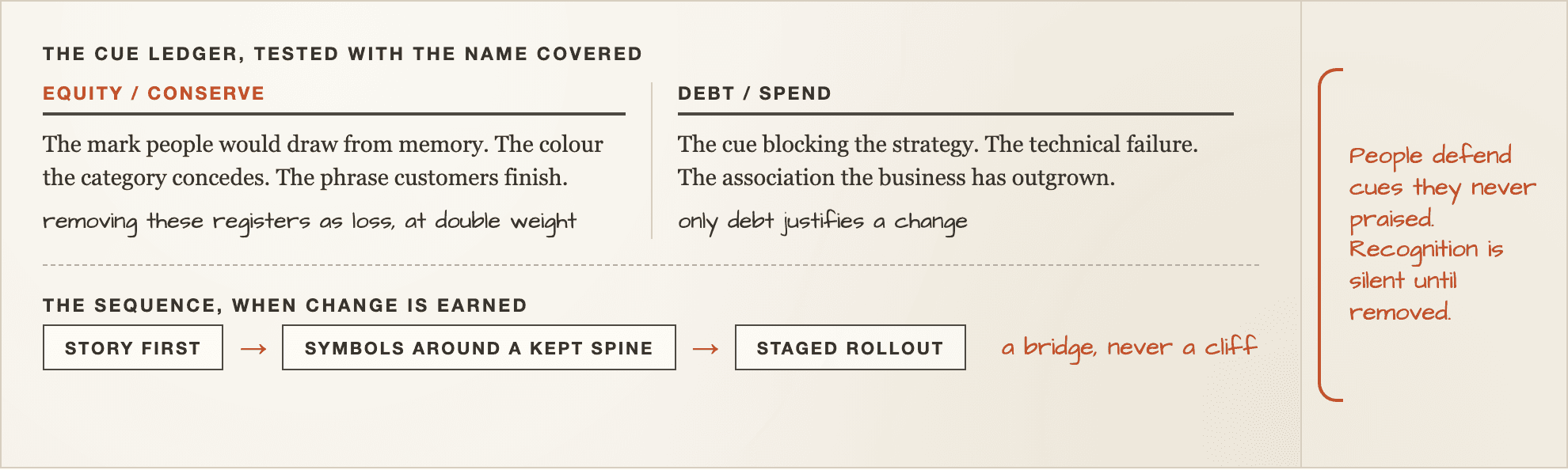
Preserve equity deliberately. Familiar language, colours, symbols, or service names may already carry recognition. A rebrand gains strength by knowing what to keep as clearly as what to replace.
The brief becomes the bridge from diagnosis to creation. Every later concept should answer an identified need rather than a taste preference.
Before you use it
Questions that can change the recommendation.
What should a brand audit include?
A brand audit should include positioning, audience, offers, messaging, visual identity, customer touchpoints, competitor context, proof, and the cues customers are likely to remember.
How long does a brand audit take?
The length depends on the number of touchpoints, people involved, and depth of research. A focused small business audit may take several working days, while a complex organisation can require several weeks.
Should a brand audit happen before a rebrand?
Yes. The audit identifies the real brief, protects existing equity, and helps the rebrand solve the highest consequence problems first.
Can a business conduct its own brand audit?
A business can complete a useful first review with a clear framework. Outside perspective becomes valuable where internal familiarity makes contradictions difficult to see.
What is the outcome of a brand audit?
The outcome should be an evidence based diagnosis, a priority map, and a clear brief for positioning, messaging, identity, or experience work.