The UK fake reviews law: what the DMCC Act asks of any business that shows reviews
The direct answer
Since 6 April 2025, the Digital Markets, Competition and Consumers Act 2024 has made fake reviews, concealed incentivised reviews and false or misleading review information banned practices in the UK. A business must avoid writing or commissioning fake reviews, and any business that publishes consumer reviews or star ratings, including on its own website, must take reasonable and proportionate steps to prevent and remove banned content. The Competition and Markets Authority says publishers should have a published policy that prohibits fake reviews and states their approach to incentivised reviews, carry out a risk assessment, and have processes to detect, investigate and act on suspect reviews. The CMA can now decide breaches itself and fine a business up to 10% of global turnover. An incentivised review stays lawful when the incentive is made clear.
Five conclusions
The argument, compressed.
- Fake reviews, concealed incentivised reviews and misleading review information became banned practices in the UK on 6 April 2025.
- The duty reaches any trader that publishes reviews or ratings, including on its own website or social accounts.
- Publishers need a published policy, a risk assessment, and a process to detect, investigate and remove banned content.
- An incentive for a review is allowed when it is disclosed; hiding it is the breach.
- The CMA can fine a business up to 10% of global turnover for breaking consumer protection law.
Working framework · 5 decisions
The genuine review check
Five checks for any business that shows reviews, star ratings or testimonials. What is proportionate depends on how many reviews you publish and where they come from.
Decision 01 / 05
Source
Know where each review came from: a named customer, a platform feed, or a testimonial sent by email. Keep the original.
What changed in April 2025
The Digital Markets, Competition and Consumers Act 2024 brought a new consumer protection regime into force on 6 April 2025. Several practices relating to reviews became banned practices, which means they are automatically unfair: submitting or commissioning fake reviews, publishing incentivised reviews without making the incentive clear, and publishing false or misleading review information such as an overall rating built on fake reviews.
The Act also changed who enforces. The CMA can now decide for itself whether consumer law has been broken and can fine a business up to 10% of its global turnover, where before it had to go to court.
The short version
Keep every review genuine, show every incentive, publish a policy, and be able to say how a fake would be caught.
Who counts as a publisher
The CMA's guidance applies to any trader who publishes consumer reviews or consumer review information from any source. That includes reviews first collected by someone else, and it covers websites, social media, marketplaces, review sites and print.
A clinic that embeds its Google rating, a consultant with a testimonials page and a shop with product reviews are all publishers. Agreeing that a third party will monitor reviews leaves the business responsible for its own steps.
What the steps look like depends on scale. The CMA lists the factors: the incentive people have to post fake content in your sector, where the reviews come from, how the site promotes them, and the effect on the traders reviewed. A small firm with twenty emailed testimonials needs a far lighter process than a marketplace.
Incentives, selection and star ratings
Asking for reviews is allowed. Rewarding them is allowed when the reward is visible on the review. The breach is concealment: a review given for a free stay, a discount or a gift that reads as though it were unprompted.
Review information is covered too. An average rating, a review count or a "rated excellent" line is aggregated information, and it becomes false or misleading when it rests on fake reviews or leaves a distorted picture.
Regulated professions add their own layer. UK health advertising also answers to the CAP Code on testimonials, and some professional bodies restrict them further, so check the rules for your profession as well.
Why this favours a brand built on evidence
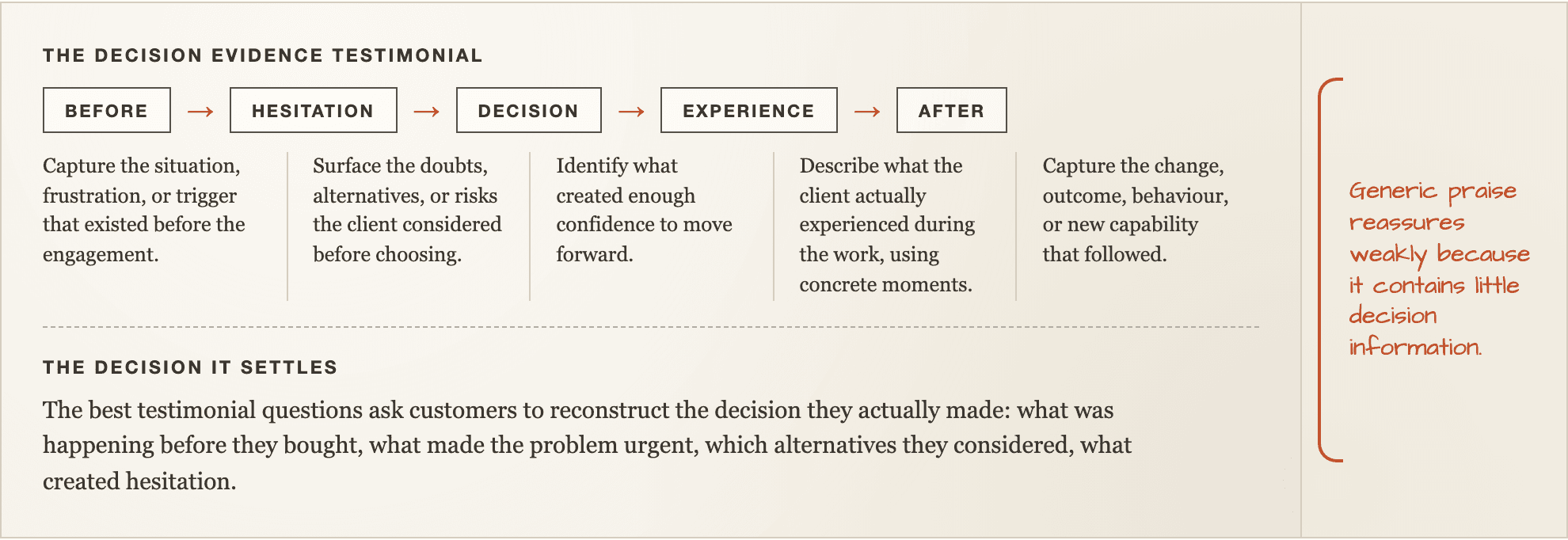
Reviews became a growth tactic because volume was cheap. The new regime makes volume expensive and provenance valuable. A business that can show where each testimonial came from, and says so on the page, now has something its competitors must work to copy.
Fewer, attributable accounts from the kind of client the business wants more of do more for recognition than a wall of five star fragments. They also tell a referred client exactly who the business is for.
Before you use it
Questions that can change the recommendation.
Are fake reviews illegal in the UK?
Yes. Since 6 April 2025 the Digital Markets, Competition and Consumers Act 2024 has made fake reviews, concealed incentivised reviews and false or misleading review information banned practices. Writing or commissioning a fake review is prohibited, and businesses that publish reviews must take reasonable and proportionate steps to prevent and remove them.
Can I offer a discount in return for a review?
An incentivised review is lawful when the incentive is made clear to readers. Concealing that a review was given in exchange for money, a discount or a gift is a banned practice.
Does the law apply to testimonials on my own website?
Yes. The CMA's guidance applies to any trader that publishes consumer reviews or review information from any source, in any format it operates, including its own website and social media.
What is the penalty for fake reviews in the UK?
Under the consumer regime in force since April 2025, the CMA can decide that consumer protection law has been broken and fine a business up to 10% of its global turnover.
What does brand strategy cost in the UK?
At Branding Tatva the Foundation engagement starts at £1,950 for UK clients. Its published scope includes discovery and positioning, audience definition, a core visual identity, starter brand guidelines and launch messaging direction. Legal advice is outside the scope: the business remains responsible for its review practices, and the CMA's guidance or a solicitor resolves uncertain cases.
Research record
What this guide draws from.
Each source note describes what the reference supports. Platform guidance, research findings and Branding Tatva's practical suggestions have different scopes.
- Short guide for businesses: publishing consumer reviews and complying with consumer protection law
Competition and Markets Authority
Who the guidance applies to, the published policy, the risk assessment and the processes publishers need.
- Fake reviews (CMA208)
Competition and Markets Authority
- CMA to boost consumer and business confidence as new consumer protection regime comes into force
Competition and Markets Authority
The regime in force from 6 April 2025 and fines of up to 10% of global turnover.