Made in Britain, British brand, Union flag: what a UK brand may claim about where it comes from
The direct answer
Under the CAP Code, claims about a product's country of origin, a company's location or a brand's heritage must avoid materially misleading consumers or misleading by omission (rules 3.1 and 3.3), and objective claims need documentary evidence (rule 3.7). A marketer should avoid implying a product is made, manufactured or built in Britain if it is made elsewhere, and should avoid implying a UK base through a .co.uk domain, prices in pounds, a Union flag or GB lettering when the business operates from another country; since April 2025 rule 3.4.2 also requires ads with prices to carry the marketer's identity, trading name and business address. Flags and emblems may appear in ads, provided they cause no serious offence and imply neither official endorsement nor a false origin. Heritage claims are judged on the facts: the ASA accepted British brand since 1903 for Vauxhall because the company was founded in Britain and still has its headquarters, staff and some manufacturing there, even though a French group owns it and the advertised model was built abroad.
Five conclusions
The argument, compressed.
- Made, manufactured or built in Britain is an objective claim and needs evidence that it is true.
- A .co.uk domain and prices in pounds are fine, but the ad must make the operating country clear if it is elsewhere.
- Since April 2025, ads with prices must carry the marketer's identity, trading name and business address.
- Flags and emblems may appear, provided they imply neither official endorsement nor a false origin.
- Heritage claims are judged on facts: founding, headquarters, staff and manufacturing count; ownership alone decides little.
Working framework · 5 decisions
The provenance check
Five checks for any name, line, flag or image that tells a customer where you are from.
Decision 01 / 05
Made
Every made in, manufactured in or built in claim is true of the product as sold, with records to show it.
Why origin is a claim, and who is reading it
CAP's advice starts from the customer: people may want to buy from UK based companies or UK made products to support the economy, or for the environmental cost of importing. Because that preference shapes a purchase, anything that signals origin, location or heritage is treated as a claim under rules 3.1 and 3.3, and objective claims need documentary evidence under rule 3.7.
The 2025 update matters for small businesses. Rule 3.4.2 now requires that marketing with prices carries the marketer's identity, including a trading name if different, the business address, including a service address if different, and any business email address. Leaving them out is a material omission.
The short version
Say where the product is made and where the company sits, make both easy to find, and let the flag follow the facts rather than lead them.
The .co.uk shop run from abroad
The ASA's rulings cluster around one pattern. A shoe retailer with a .co.uk domain and a pound sterling option, processing orders from China, gave the overall impression of a UK base and was misleading (Wilfredandalice.co.uk, 2018). A battery shop with a uk domain, the Royal Mail logo, pounds and UK based advisors was ruled misleading for the same reason (2014). A trainer retailer that left customers unable to find a return address in China was ruled against because the need to return goods abroad was significant information left out (95Max.co.uk, 2018).
The 2022 Partex ruling adds the emblem layer: a Germany based parts seller with a .co.uk domain, pounds, a British flag and the letters GB on its product pages, with its address only in the privacy policy, misleadingly omitted its location. CAP's own summary is fair: nothing is wrong with a .co.uk domain or pounds, as long as the marketing otherwise makes the operating country sufficiently clear.
Flags, emblems and heritage
CAP's flags and emblems advice allows national flags in ads provided they cause no serious or widespread offence and mislead nobody. Two traps recur. Implying official recognition: a Scottish flag in a debt advice ad suggested a government scheme (2009), and passports in front of a Union flag suggested an official passport office (2015). Implying origin: a Union flag beside a product name and as a page background implied UK manufacture or distribution for a product sold from Israel (DS Marketing, 2012).
Heritage claims are judged on the record. British brand since 1903 for the Vauxhall Corsa was upheld as fair in 2021: the company was established in the UK, began manufacturing there in 1903, still had headquarters, offices, staff and some manufacturing in the UK, and the brand was sold only in the UK, even though a French group owned it and the Corsa itself was built abroad. CAP adds that products now made in the UK but originally produced elsewhere should be careful with original and genuine.
- Stronger ground: "Designed in Sheffield, made in Portugal."
- Stronger ground: "Founded in Leeds in 1987. Head office and workshop still in Leeds."
- Riskier ground: A Union flag icon beside a product assembled overseas.
- Riskier ground: "British made" on a page where the operating address is only in the privacy policy.
Provenance as a brand asset
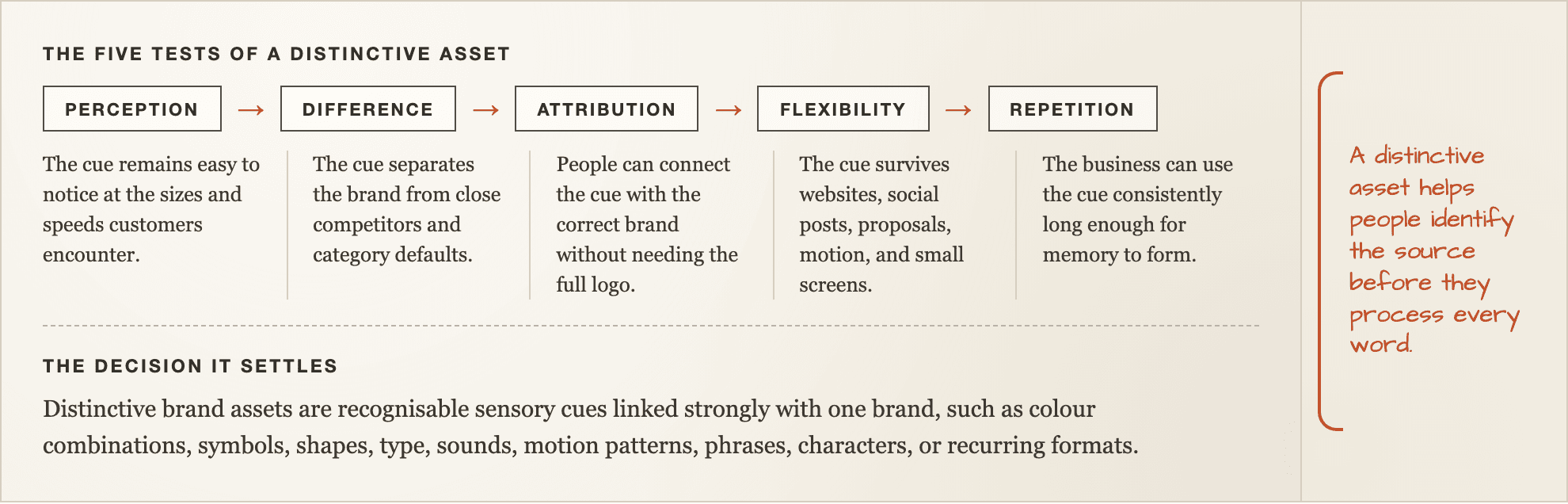
Origin works as a distinctive asset precisely because it is hard to fake and easy to check. A brand that says exactly where its things are designed, made and shipped from, and names the town rather than the country, owns a story competitors cannot copy by adding a flag.
The ASA's rulings read as a list of shortcuts: the domain, the currency, the flag, the logo of a national carrier. Each one borrowed trust that the business had yet to earn. The honest version is slower and holds.
Before you use it
Questions that can change the recommendation.
Can I use a .co.uk domain if my business is based outside the UK?
Yes. CAP says nothing is wrong with a .co.uk domain or prices in pounds, provided the marketing otherwise makes the operating country sufficiently clear and ads with prices carry the business address. The ASA has ruled against sites where the domain and currency implied a UK base that was absent.
Can I put the Union flag on my packaging or website?
Flags may appear in ads provided they cause no serious offence and imply neither official endorsement nor a false country of origin. A flag beside a product name has been ruled misleading where the product was made and distributed from abroad.
Can I say British brand if a foreign company owns us?
It depends on the facts. The ASA accepted British brand since 1903 for Vauxhall, owned by a French group, because the company was founded in Britain and kept its headquarters, staff and some manufacturing there, and sold the brand only in the UK.
What must an ad with a price now include about the company?
Since April 2025, CAP Code rule 3.4.2 requires the marketer's identity, including any different trading name, the business address, including any different service address, and any business email address, unless already apparent from the context.
What does brand strategy cost in the UK?
At Branding Tatva the Foundation engagement starts at £1,950 for UK clients. Its published scope includes discovery and positioning, audience definition, a core visual identity, starter brand guidelines and launch messaging direction. Legal review of origin claims is outside the scope.
Research record
What this guide draws from.
Each source note describes what the reference supports. Platform guidance, research findings and Branding Tatva's practical suggestions have different scopes.
- Country of origin and location claims
Committee of Advertising Practice
AdviceOnline updated 29 April 2025. Rules 3.1, 3.3, 3.4.2 and 3.7, and the Wilfredandalice, UK Battery Shop, 95Max, Partex, Vauxhall and DS Marketing rulings.
- Flags and emblems
Committee of Advertising Practice