A company name is not a trademark: what UK founders confuse before it costs them
The direct answer
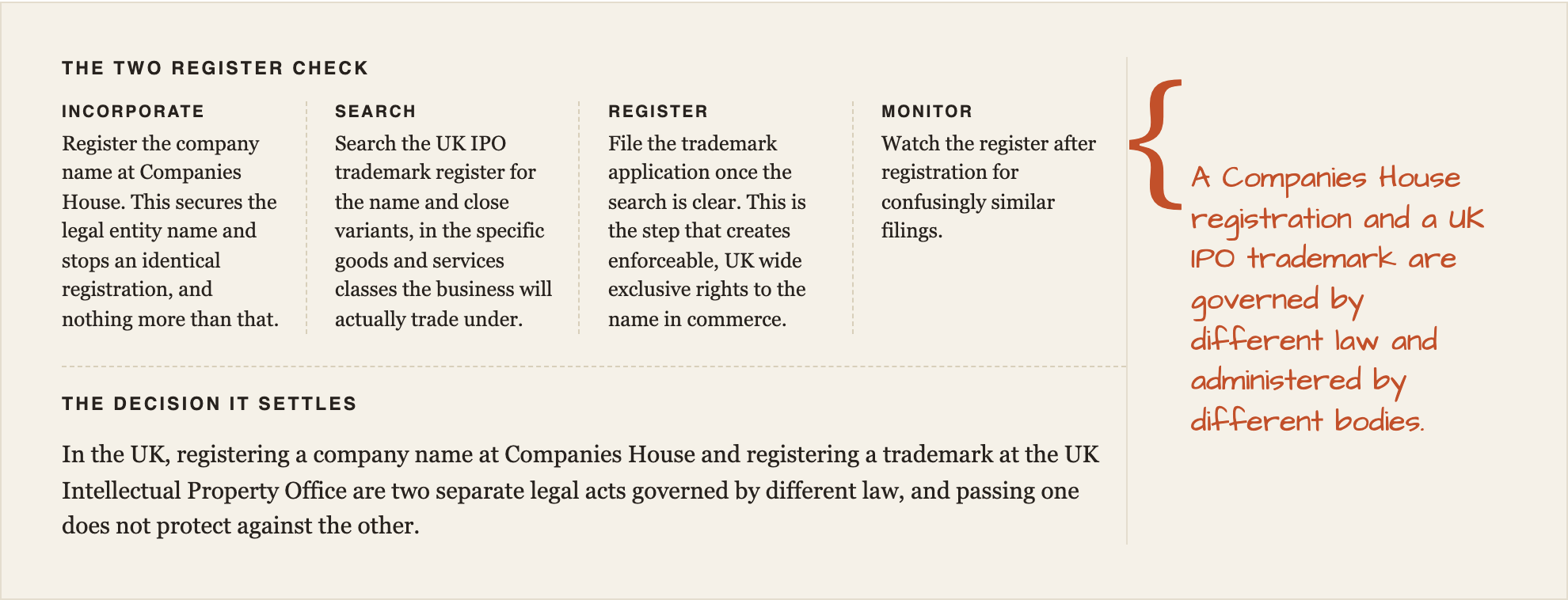
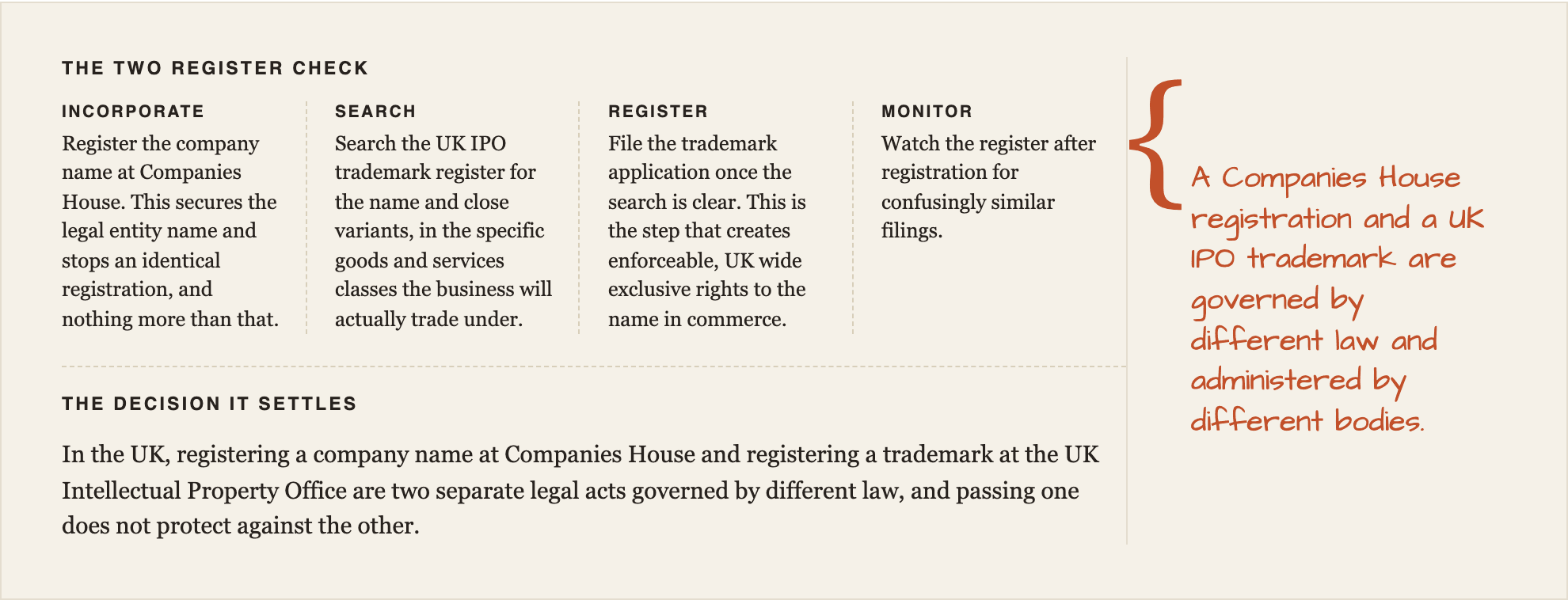
In the UK, registering a company name at Companies House and registering a trademark at the UK Intellectual Property Office are two separate legal acts governed by different law, and passing one does not protect against the other. A Companies House registration stops another company from taking the identical legal name; it does not stop a competitor trading under a similar name or registering it as a trademark, and it offers no defence if the name already infringes someone else's registered mark. Genuine ownership of a brand name in UK commerce comes from a UK IPO trademark, searched and cleared before launch, not from the incorporation certificate.
Five conclusions
The argument, compressed.
- A Companies House registration and a UK IPO trademark are governed by different law and administered by different bodies. One does not create or protect the other.
- Companies House stops an identical legal name being registered again. It does not stop a competitor trading under a similar name, and it will register a name that already infringes a live trademark.
- A registered trademark under the Trade Marks Act 1994 grants exclusive UK wide rights to use a sign for specific goods and services, which is what actually stops a copycat.
- A UK IPO trademark search before launch is the cheap version of this problem. A dispute after the brand is built, printed, and live is the expensive version of the same problem.
- The founders most exposed are the ones who read incorporation as permission. It is registration of a legal entity name, not a clearance search against existing brands.
Working framework · 4 decisions
The two register check
Four steps, run in this order before a name is finalised, separate what Companies House actually confirms from what a brand strategy needs confirmed.
Decision 01 / 04
Incorporate
Register the company name at Companies House. This secures the legal entity name and stops an identical registration, and nothing more than that.
Two systems, one common founder assumption
A Companies House registration gives a business the right to use a specific name as its company's legal name on the UK register. A trademark gives its owner the exclusive right to use a sign, a word, a logo, or a combination, in connection with specific goods or services across the whole of the UK. These are administered by two completely separate government bodies, under two completely separate pieces of law, and the founder who assumes clearing one clears the other is working from a false premise that eventually gets tested.
Companies House checks new registrations against existing company names for exact or near identical matches only. It has no visibility into, and makes no attempt to check against, the UK trademark register. A company can be incorporated today with a name that already infringes a live, registered trademark, and Companies House will issue the certificate regardless, because checking for that is simply not its function.
That gap is where founders get hurt. The incorporation certificate feels like official confirmation that the name is theirs to use. It confirms only that the specific legal entity name is unique on one register, among companies, which is a narrower and less useful fact than it sounds.
What each register actually confirms
Companies House confirms the legal entity name is unique. A trademark confirms the exclusive right to trade under that name.
What a Companies House registration does not stop
Incorporating a company under a given name prevents another company from registering that identical name at Companies House. It does not prevent a competitor from trading under a similar but different name, and it does not prevent that competitor from registering the name as a trademark, potentially before the incorporated company gets around to doing so itself.
This creates a specific and avoidable scenario: a founder incorporates, builds the brand around the name for a year, then discovers a competitor has since registered the identical or a confusingly similar mark as a trademark in the same trading category. The trademark holder now has the stronger legal position, regardless of who incorporated first, because trademark rights and company name registration run on entirely separate timelines and separate legal tests.
The founder's practical exposure is a forced choice between paying to licence the name back, rebranding, or contesting the trademark, all of which cost materially more than the trademark search would have cost before any of this started.
What a trademark actually does
A trade mark is a registered right, governed in the UK by the Trade Marks Act 1994 and administered by the UK Intellectual Property Office, that legally protects a brand's signifiers, its name, logo, or slogan, for the specific goods and services it is registered against. This is the mechanism that grants exclusive commercial use, and it is the one a brand actually needs to be defensible.
Registering a trademark requires searching the existing register first, in the correct classes for the business's actual goods and services, then filing and surviving the opposition period during which existing rights holders can object. This is more work than incorporation, which is exactly why founders skip it and lean on the incorporation certificate as a substitute it was never designed to be.
For a business where the name, logo, or a specific brand element is central to how customers find and remember it, a trademark strategy run before launch reduces the risk of a forced rebrand, a dispute, or a copycat later, at a fraction of what any of those cost after the brand is already built.
- Search the UK IPO register for the exact name and close phonetic or visual variants, before any design work begins.
- Check the specific trade mark classes relevant to the actual goods or services, not just the business's general category.
- File early. A trademark application's priority date is the filing date, not the date the business started trading under the name.
Sequencing the two so neither blocks the other
The order that avoids the expensive version of this problem: search the trademark register before choosing a final name, incorporate the company once the name is confirmed clear, then file the trademark application promptly rather than treating it as a someday task once the business has traction.
Founders often reverse this, incorporating first because it is the step that unblocks opening a bank account and signing a lease, then treating the trademark as optional paperwork once the more urgent operational needs are handled. By the time the trademark gets attention, the name is already on the website, the signage, and the invoices, which raises the cost of finding a conflict at exactly the moment it is most expensive to change course.
Neither registration replaces the other, and a business that has done only one has done half the job of actually owning its name in UK commerce.
Before you use it
Questions that can change the recommendation.
If Companies House registered my company name, can someone else still use it?
Yes, in two specific ways. A competitor can trade under a similar but different name without breaching your Companies House registration, and a competitor can register your name or a close variant as a trademark, which would then give them stronger legal standing than your unregistered use of it, regardless of which company incorporated first.
Do I need a trademark if I only trade locally in the UK?
A UK trademark registration grants exclusive rights across the whole of the UK, not only where the business currently trades, which matters as soon as the business grows into new regions, sells online, or a competitor elsewhere in the UK adopts a similar name. Trading locally reduces the urgency, but it does not remove the exposure entirely, since UK trademark rights are national by default.
How long does UK trademark registration take, and when should I start?
The UK IPO process includes an examination period and a two month opposition window during which existing rights holders can object, and the whole process commonly runs several months from filing to registration. Starting the search and filing before the brand identity is finalised, rather than after launch, is what actually avoids the timeline becoming a problem.
Is a .co.uk domain registration the same as securing the name?
No. A domain registration confirms availability of that specific web address only, through an entirely separate system from both Companies House and the UK IPO, and carries no trademark rights or protection against a similar name being used or registered elsewhere.
What happens if I discover a trademark conflict after I have already launched?
The available options are typically negotiating a licence or coexistence agreement with the rights holder, contesting the conflicting registration where genuine grounds exist, or rebranding, and which of those applies depends on the specific registration dates, classes, and use in each case, which is a question for a trademark specialist rather than a general brand strategy decision.
Research record
What this guide draws from.
Each source note describes what the reference supports. Platform guidance, research findings and Branding Tatva's practical suggestions have different scopes.
- Company Name vs Trademark: Why Companies House Registration Is Not Enough
Trademark Dashboard
Direct comparison of what each UK registration system actually confirms and protects.
- Should I Trademark My Business Name in the UK?
Sprintlaw UK
Founder facing explanation of when a UK trademark becomes necessary beyond incorporation.
- How IPO Trade Mark Registration Works in the UK
Sprintlaw UK
Process detail on UK IPO search, filing, and the opposition period referenced in the framework.
- Search UK IPO Trade Marks Before Registering Your Brand
Sprintlaw UK
Guidance on searching the UK IPO register in the correct goods and services classes before filing.