AEO vs SEO vs GEO: three acronyms, one contest
The direct answer
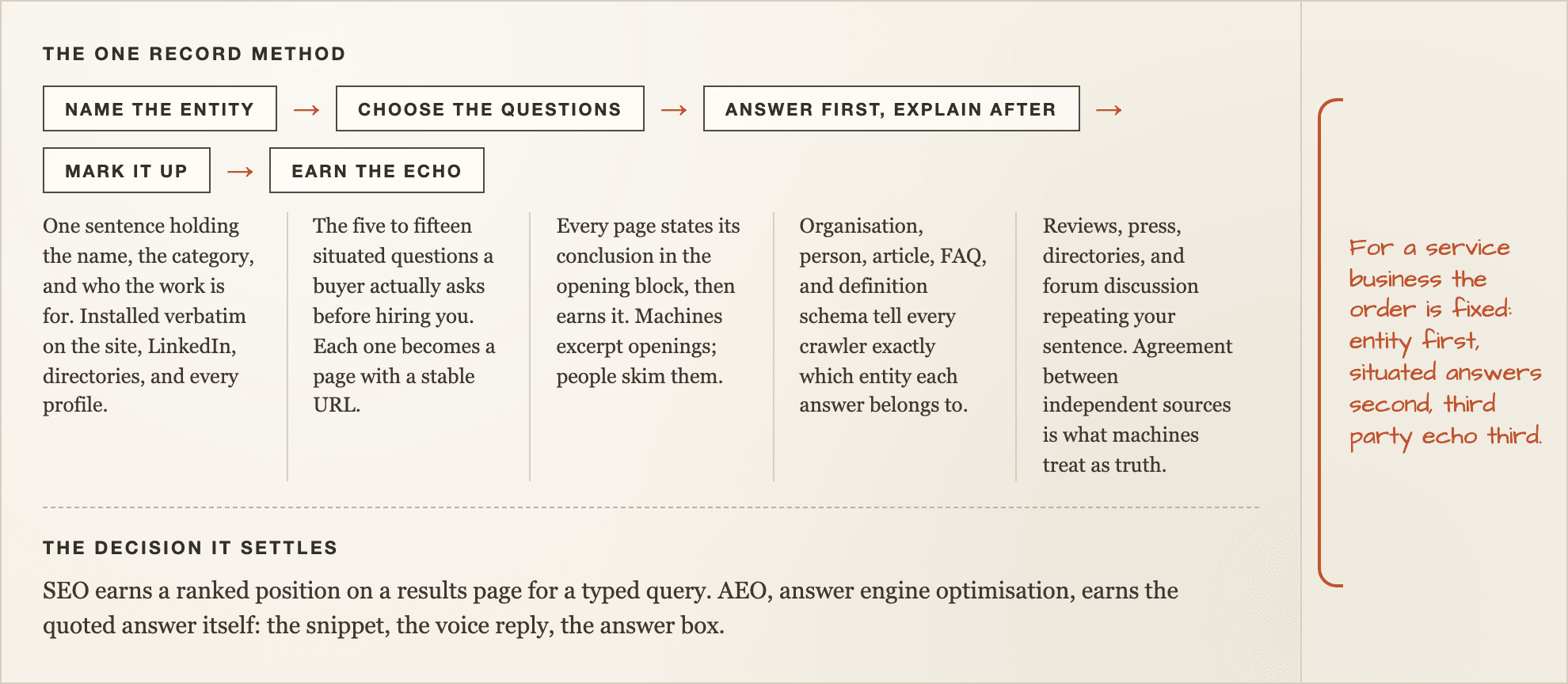
SEO earns a ranked position on a results page for a typed query. AEO, answer engine optimisation, earns the quoted answer itself: the snippet, the voice reply, the answer box. GEO, generative engine optimisation, earns a place inside the responses that assistants like ChatGPT, Gemini, and Perplexity generate. The unit of competition shifts from page to passage to entity, yet all three read the same public record. A business that keeps one consistent entity, publishes direct answers, and earns third party corroboration is doing all three at once.
Five conclusions
The argument, compressed.
- SEO ranks pages, AEO wins the quoted answer, GEO earns a place inside generated responses. Three surfaces, one written record.
- The unit of competition moved: from page, to passage, to entity. Entities are brand work, which is why strategists suddenly matter in search.
- Every tactic that genuinely works on the new surfaces also worked on the old one: direct answers, structured data, corroboration, consistency.
- Chasing three acronyms as three projects triples the cost of one discipline. Build the record once and let each surface read it.
- For a service business the order is fixed: entity first, situated answers second, third party echo third.
Working framework · 5 decisions
The one record method
Every surface, human or machine, reads the same public record of your business. Build that record once, in this order, and SEO, AEO, and GEO are served by the same work.
Decision 01 / 05
Name the entity
One sentence holding the name, the category, and who the work is for. Installed verbatim on the site, LinkedIn, directories, and every profile.
Three acronyms, one anxiety
Somewhere in 2025 the question changed shape. Founders stopped asking how to rank on Google and started asking why ChatGPT recommends a competitor, why Perplexity cites a rival's guide, why the answer box quotes somebody else. The industry answered with acronyms: SEO for the rankings, AEO for the answers, GEO for the generated responses.
The acronyms are useful as names for surfaces. They are misleading as names for disciplines, because they suggest three separate projects with three separate budgets. Agencies have already begun selling them that way.
The claim this guide will defend: there is one discipline underneath, and it is closer to brand strategy than to technical search work. The surfaces differ in how they read. The record they read is shared.
The short version
SEO ranks pages. AEO wins the quoted answer. GEO earns the recommendation inside a generated response. All three read one record.
What each name actually means
Search engine optimisation is the oldest contest: earn a position on a results page for a typed query. The buyer sees a ranked list, clicks a link, and arrives on a page. The page is the unit of competition, and the click is the prize.
Answer engine optimisation targets the surfaces that answer instead of listing: featured snippets, answer boxes, voice assistants, and the direct answers at the top of AI enhanced results. The prize is being the passage that gets quoted. A page can rank fourth and still own the answer, which makes AEO a contest of passages rather than pages.
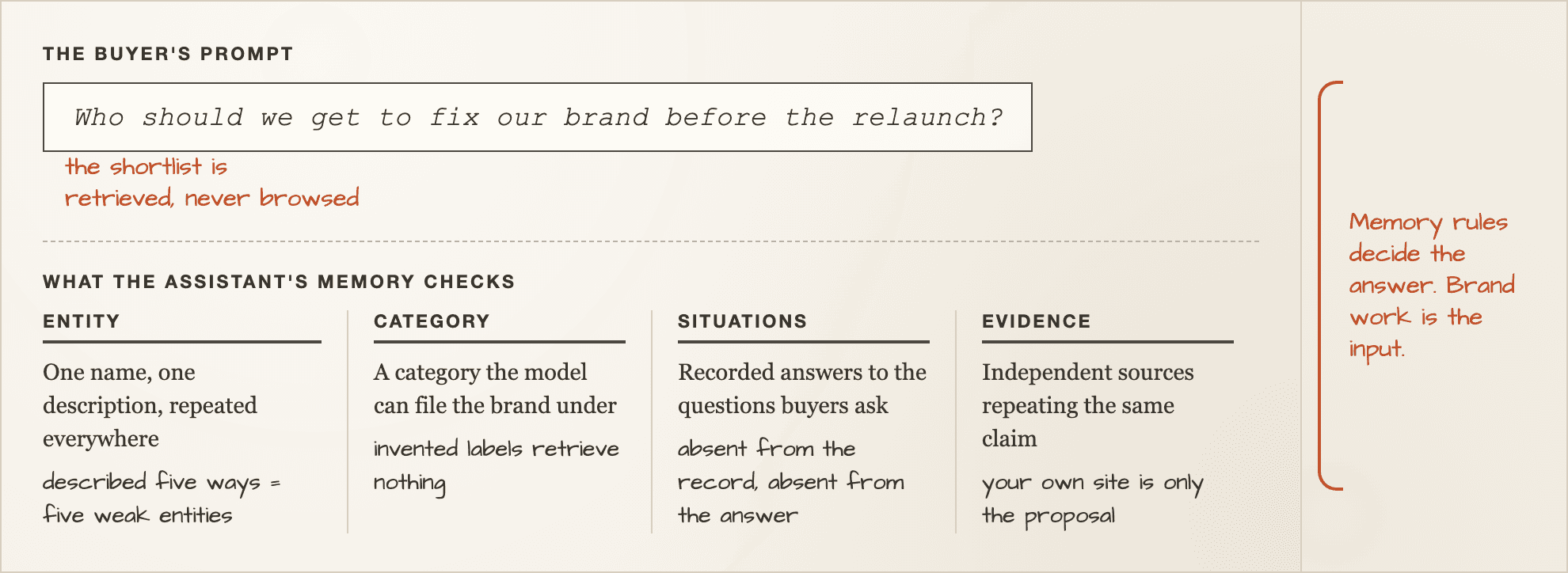
Generative engine optimisation targets assistants that compose responses: ChatGPT, Gemini, Claude, Perplexity, and the AI modes inside the search engines themselves. These systems answer from a blend of trained memory and live retrieval, and they name a small set of brands rather than listing ten links. The unit of competition is the entity: the brand as a thing the model knows, filed under a category, attached to situations.
- SEO: the page competes, measured in rankings and clicks.
- AEO: the passage competes, measured in answers owned.
- GEO: the entity competes, measured in mentions and citations inside generated responses.
The real difference is the unit of competition
Moving from page to passage to entity sounds like jargon until you see what it does to the work. A page can be built in an afternoon. A passage that deserves quoting requires an actual answer, stated plainly enough for a machine to lift. An entity requires years of consistency: the same name, the same category claim, the same description, repeated across every place the business appears until independent sources repeat it too.
That progression quietly moves the contest away from technicians and toward strategists. Rankings could be engineered with links and keywords. Entity strength is built the way reputations are built, and there has never been a shortcut for reputation.
It also explains why the same business can rank well and still be absent from assistant answers. The pages are healthy; the entity is fuzzy. Five descriptions of the business across the web read, to a model, as five weak entities rather than one strong one. The guide on how assistants choose brands covers that failure in detail.
Worth sitting with
Rankings could be engineered. Entity strength is reputation, and reputation has no shortcut. That is good news for anyone doing real work.
How buying behaviour splits across the three surfaces
The surfaces deliver different buyers. Search still delivers the largest volume, arriving mid decision with a query in hand. Answer surfaces deliver fewer clicks, because the answer often satisfies the question on the spot; what they deliver instead is authority, since being the quoted source is a public credential.
Assistant surfaces deliver the fewest visitors and the warmest ones. A buyer who arrives from a recommendation has already been told you are the answer, so the conversation starts later in the decision. Early studies of assistant referred traffic keep finding the same shape: small volume, high intent.
For a service business selling few, large engagements, that shape is close to ideal. Ten visitors carrying a recommendation are worth more than a thousand browsing a list. Which is why the smallest firms, the ones that could never win volume contests, have the most to gain from the entity contest.
Where a small team should spend first
The order is fixed by dependency, and it is the order in the framework above. Entity consistency comes first because every other signal attaches to it; corroboration of a fuzzy entity corroborates noise. Situated answers come second because they are the retrieval keys: buyers phrase prompts as situations, and the brand recorded as the answer to a situation gets retrieved for it.
Corroboration comes third, and it is the slowest, because other people control it. It accumulates at the speed others publish: a client writes up the project, a journalist quotes the founder, a forum thread names the firm. The work is earning those repetitions, then making the repeated sentence easy to say.
What should come last is the thing most teams do first: tooling. Rank trackers, mention monitors, and GEO dashboards measure the record; they never build it. Measurement before substance is how a small budget disappears.
- Week one: write the entity sentence and install it everywhere, verbatim.
- Month one: publish direct answers to the five questions buyers actually ask.
- Quarter one: gather three independent sources repeating the entity sentence in public.
- Ongoing: refresh dates, add answers, and keep every new mention on the same sentence.
What this library practises
The site you are reading runs on this method deliberately. Each guide answers one situated question a founder asks, states its answer in the opening block, carries question and answer markup, and uses the same vocabulary as every other page. The glossary gives each term of that vocabulary a stable URL of its own.
That is availability work wearing an editorial coat: every guide records the practice as the answer to one more buying situation, for human readers and machine readers alike. The acronyms will keep changing. The record compounds regardless of what the surfaces are called this year.
Before you use it
Questions that can change the recommendation.
Is AEO just SEO with a new name?
The overlap is large and the difference is real. Both need crawlable pages, structured data, and technical health. SEO competes for a ranked position; AEO competes to be the quoted answer itself, which rewards direct answers, question markup, and passages written plainly enough to lift. A page can rank well and still lose every answer box on the query.
Does GEO replace SEO?
Search volume remains far larger than assistant volume in 2026, so abandoning search would be premature. The sensible reading is that GEO extends the same record to a new surface. Work that serves GEO, entity consistency, direct answers, corroboration, also strengthens rankings, so the budget question is about sequence rather than replacement.
What does GEO stand for in marketing?
In this context GEO means generative engine optimisation: the practice of making a brand retrievable and quotable by AI assistants such as ChatGPT, Gemini, and Perplexity. It is unrelated to geographic targeting, which older marketing material also abbreviates as geo. The collision of the two abbreviations causes real confusion in briefs, so spell the discipline out once in any document that uses it.
Which matters most for a service business?
Entity strength, because service purchases run on trust and shortlists. A service buyer asks an assistant for two or three names, then verifies them. Appearing in that shortlist depends on being one clearly described entity attached to the buyer's situation, which is brand work. Volume tactics matter more for businesses selling many small transactions.
How do you measure AEO and GEO?
Directly: run the twenty prompts your buyers would run, across the major assistants, monthly, and record which brands get named and which sources get cited. Add referral traffic from assistant domains and the answers owned on your core queries. The sample is small and the signal is honest, and it costs nothing beyond an hour of attention.
Research record
What this guide draws from.
These sources establish the research principles used in this guide. Branding Tatva's framework is the practical application of that evidence to service businesses and founders leading their own brands.
- GEO: Generative Engine Optimization
Aggarwal et al., KDD 2024
The Princeton led study that introduced the term GEO and measured which source attributes raise inclusion in generated answers.
- What is generative engine optimization (GEO)?
Search Engine Land
Industry definition of GEO and its relationship to classical search optimisation.
- SEO panel agrees: brand is the new backlink for AI SEO
Search Engine Journal
Practitioner consensus that brand recognition has become the strongest signal for inclusion in AI generated answers.