Brand awareness vs brand recall: the difference that changes content
The direct answer
Brand awareness shows whether people recognise or know a brand when they encounter it. Brand recall shows whether they can retrieve that brand or its meaning from memory without seeing it first. Awareness can grow through exposure, while recall requires distinctive and consistent memory cues.
Five conclusions
The argument, compressed.
- Awareness and recall describe different levels of memory access.
- Frequent exposure can create familiarity while leaving the central idea unclear.
- Distinctive assets help people recognise the brand before they read every word.
- Consistent message structure gives repeated exposure one idea to strengthen.
- Content should be measured for memory quality as well as distribution.
Working framework · 5 decisions
The path from exposure to memory
Each stage asks more from the brand and more from the customer memory system.
Decision 01 / 05
Exposure
The person has an opportunity to see or hear the brand.
Brand awareness and brand recall
Brand awareness is an umbrella term for how familiar a market is with a brand. It can include aided recognition, unaided recall, category association, and general familiarity.
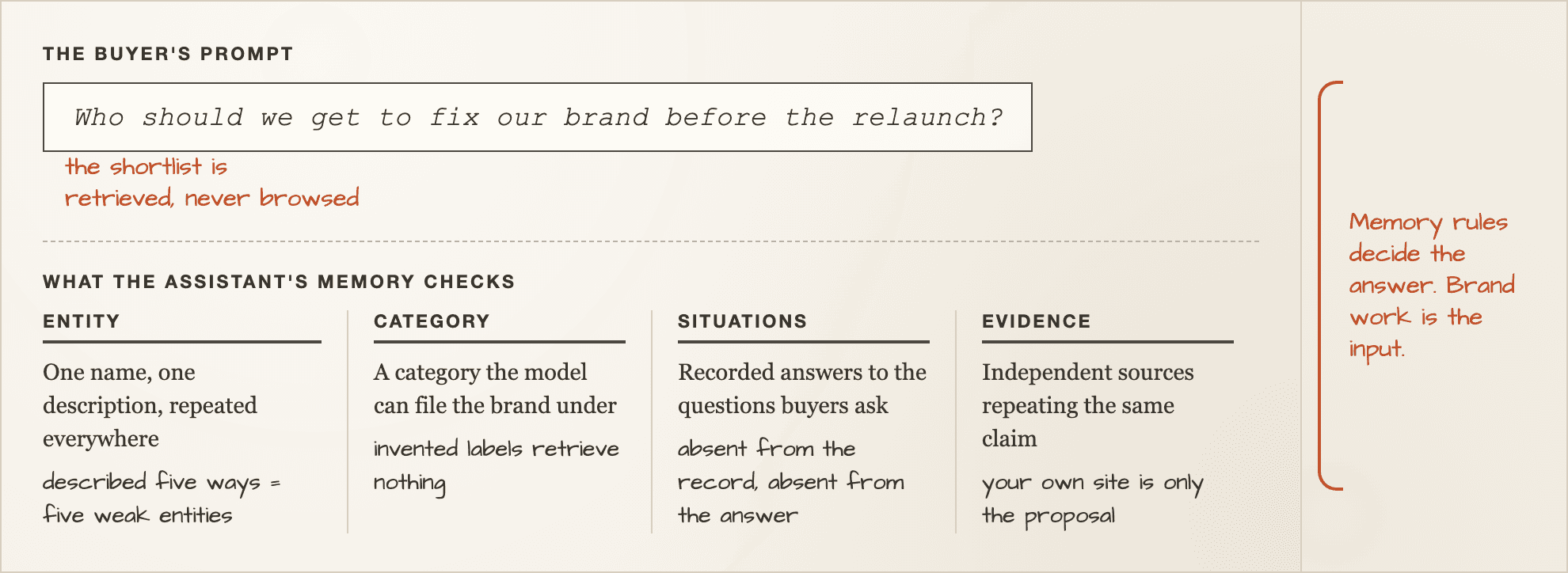
Brand recognition asks whether a person can identify the brand when shown a name, logo, colour, phrase, or other cue. Brand recall asks whether the person can retrieve the brand from memory when given only a category or buying situation.
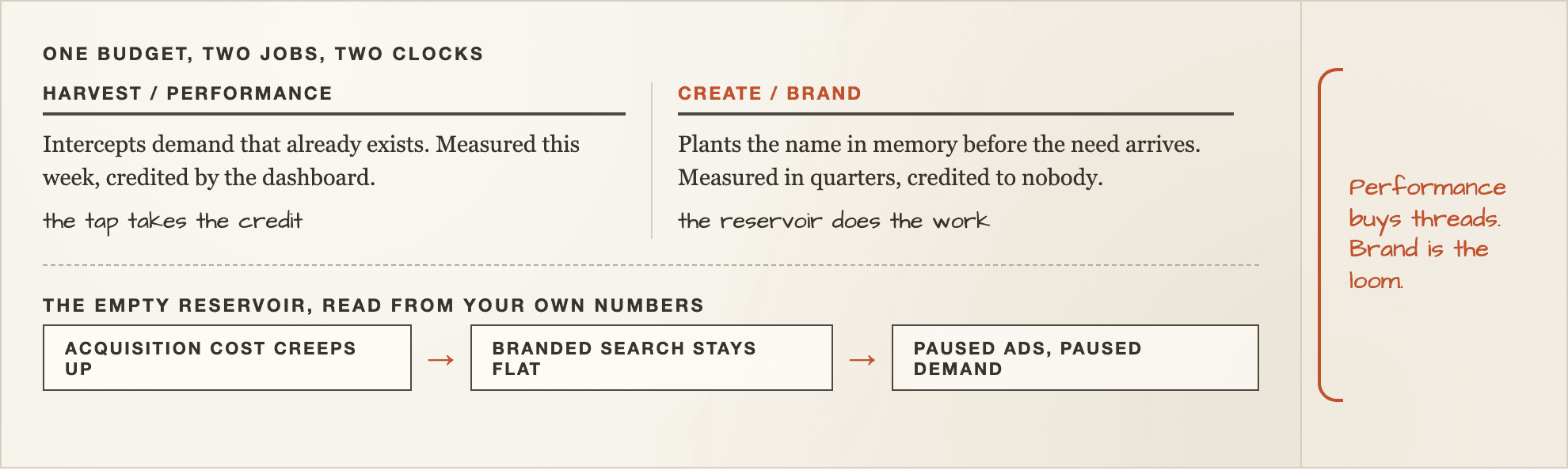
The difference matters because a business can become familiar without becoming mentally available at the moment of choice.
Why visibility can feel busy without building memory
A brand can publish often, appear across several channels, and still leave a weak trace. Exposure creates opportunity. The mind still decides what deserves storage.
When every post introduces a different message, visual language, offer, and tone, each appearance competes with the previous one. Activity rises while recognition has to begin again.
Memory strengthens when repeated exposure points toward a small set of stable associations. The creative expression can vary. The underlying cues and meaning need continuity.
Memory rule
Repetition works when the repeated material is clear enough to recognise and useful enough to retrieve later.
Recognition usually develops before recall
Recognition requires a match between the present cue and something stored in memory. Recall asks the mind to retrieve the cue without that support, so the task is harder.
This creates a practical sequence for newer brands. First, build a coherent set of distinctive assets and repeat them consistently. Then connect those assets with the category and customer situation the brand wants to own.
A recognisable aesthetic without a category association can create admiration without commercial memory. A clear category message without distinctive cues can create understanding that belongs equally to several competitors.
Distinctive assets give memory a handle
Distinctive assets are sensory cues that help people identify the brand. They can include colour combinations, symbols, type, shapes, sounds, characters, motion, phrases, image direction, or recurring formats.
An asset becomes useful through distinctiveness and consistent use. A colour chosen because it feels appropriate may blend into the category. A recurring visual device linked strongly with the brand can shorten recognition time.
Audit assets in context. Place social posts, website screens, proposals, and advertisements together. Cover the name and ask which pieces still feel attributable to the same source.
- Is the cue easy to perceive at real viewing sizes?
- Does the cue differ from close competitors?
- Can the cue work across several formats?
- Has the cue been repeated long enough to become familiar?
- Is the cue connected with the intended category meaning?
Message consistency gives repetition one direction
A brand needs more than a repeated tagline. It needs a stable message architecture: the category, customer tension, promise, difference, proof, and key themes should reinforce one another across touchpoints.
The wording can adapt to context while the central meaning stays stable. A sales call can be conversational, a case study can be detailed, and a social post can be brief. Each should strengthen the same position.
Content planning becomes easier when every idea has a role. Some pieces teach the category. Some name the customer situation. Some demonstrate proof. Some reinforce distinctive language. Together they compound.
How to measure brand recall with limited resources
Small businesses can begin with simple, repeatable research. Ask recent customers how they first described the business to another person. Ask prospects what they remember several days after a call. Ask light familiarity audiences which brands come to mind for a specific situation.
Separate recognition prompts from recall prompts. Showing the logo measures a different memory task from asking someone to name a provider inside a category.
Track the language people use. Repeated phrases can show which associations are becoming available. Large differences between intended and remembered language reveal where the system needs more clarity or repetition.
- Unaided recall: Which brands come to mind for this category?
- Aided recognition: Which of these brands have you seen before?
- Message recall: What do you remember this brand saying?
- Asset attribution: Which brand do you connect with this visual cue?
- Category association: What situation would make you think of this brand?
Build content for memory
Begin with the association the business wants to earn. Then choose a small set of recurring content territories that repeatedly approach that association from different angles.
Keep distinctive assets stable enough to become familiar. Use variation inside a recognisable frame. A recurring series, visual composition, phrase, or editorial structure can create continuity without making every piece identical.
Give proof a recurring role. Claims are easier to remember when customers repeatedly see how the thinking appears in real work, decisions, or examples.
Where awareness still matters
Recall cannot develop without opportunities for exposure. Distribution, search presence, partnerships, public work, and regular publishing all create chances for the memory system to learn the brand.
The distinction changes the goal of that exposure. The question becomes: which association should this appearance strengthen? That question turns visibility from an activity count into a memory programme.
Awareness opens the door. Recognition helps the brand feel familiar. Recall helps it arrive when the customer needs the category.
Before you use it
Questions that can change the recommendation.
What is the difference between brand awareness and brand recall?
Brand awareness describes familiarity with a brand. Brand recall is the ability to retrieve the brand from memory when given a category, need, or buying situation.
Is brand recognition the same as brand recall?
No. Recognition happens when a person identifies a brand after seeing a cue. Recall happens when the person retrieves the brand without seeing the cue first.
How can a small business improve brand recall?
Choose a clear position, repeat a small set of associations, use distinctive assets consistently, connect content with buying situations, and measure which ideas customers remember.
Does posting more improve brand awareness?
More relevant exposure can increase familiarity. Memory quality depends on whether the appearances carry coherent cues, a clear category association, and a message worth retrieving.
What are examples of distinctive brand assets?
Examples include colour combinations, symbols, type styles, shapes, sounds, characters, motion patterns, repeated phrases, image direction, and recurring content formats.