Generative engine optimisation, without the tricks
The direct answer
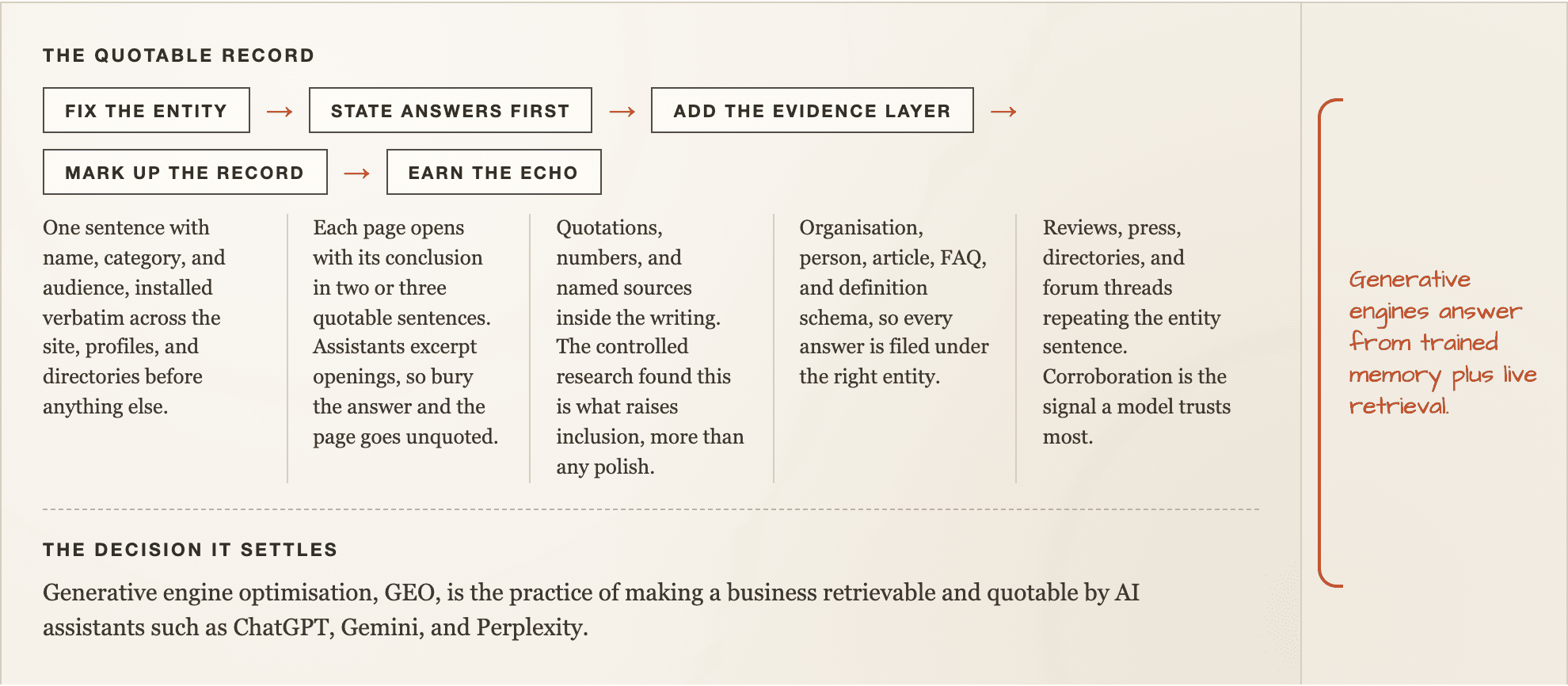
Generative engine optimisation, GEO, is the practice of making a business retrievable and quotable by AI assistants such as ChatGPT, Gemini, and Perplexity. The controlled research on it found that sources adding quotations, statistics, and citations raised their presence in generated answers by around forty percent, while surface polish alone did little. In practice GEO means five moves: one consistent entity description everywhere, direct answers to real buying questions, structured data naming the entity, vocabulary published on stable URLs, and third party corroboration. Tricks decay with every model release; the record compounds.
Five conclusions
The argument, compressed.
- Generative engines answer from trained memory plus live retrieval, so GEO works on both: the long record and the quotable page.
- The controlled study behind the term found quotations, statistics, and citations raised inclusion in answers by roughly forty percent; polish alone moved little.
- You control the entity, the answers, and the markup. Other people control the corroboration, which is why it convinces machines.
- Forum presence matters because assistants read the places categories get discussed: Reddit threads and Quora answers are part of the record now.
- Every trick aimed at the current model dies with the next release. Conditions aimed at memory survive every release.
Working framework · 5 decisions
The quotable record
GEO reduces to making one entity easy to retrieve and its pages easy to quote. Five moves, in dependency order.
Decision 01 / 05
Fix the entity
One sentence with name, category, and audience, installed verbatim across the site, profiles, and directories before anything else.
What generative engine optimisation is
Generative engine optimisation is the practice of making a business retrievable, trustable, and quotable by systems that compose answers: ChatGPT, Gemini, Claude, Perplexity, and the AI modes inside search engines. Where classical search returns ten links, a generative engine returns one response, and it names a small number of brands and sources inside it.
The term entered the literature through a 2024 study by researchers at Princeton and collaborators, who tested which attributes of a source raise its presence in generated answers. The name stuck because it describes a genuinely new surface: a response that is assembled rather than ranked, drawing on the engine's trained memory and whatever it retrieves live.
That dual mechanism is the key to the whole discipline. Trained memory rewards the long record: years of consistent description and third party mention. Live retrieval rewards the quotable page: a direct answer a system can lift today. GEO that works addresses both; GEO that chases one usually decays.
Definition
GEO makes a business easy for AI assistants to retrieve from memory and easy to quote from the page. Both halves are required.
How a generative engine assembles an answer
When a buyer asks an assistant who should reposition their firm before a funding round, the system does something recognisable. It retrieves candidate entities from its trained impression of the world, optionally runs a live search to refresh and verify, then composes a response that names a few brands and cites a few sources.
Each stage has its own gate. Retrieval requires the brand to exist as a clear entity attached to the category and situation in question. Verification requires the live record to agree with the trained impression. Composition requires passages plain enough to quote and safe enough to repeat: hedged, vague, or salesy text gets paraphrased away or dropped.
A business can fail at any gate invisibly. The most common failure is the first one: the brand was never recorded as an answer to the situation being asked about, so retrieval has nothing to find. Writing that records the brand against real buying situations is therefore the core GEO activity, which is also a fair description of a positioning content programme.
What the research actually measured
The KDD study tested nine interventions on thousands of queries and measured how each changed a source's share of the generated answer. The findings are refreshingly specific. Adding quotations, adding statistics, and adding citations to credible sources each raised inclusion substantially, with gains up to around forty percent on the study's metrics. Keyword stuffing did little. Fluency edits alone did little.
Read plainly: generative engines reward pages that look like evidence and ignore pages that look like advertising. A page carrying named sources, real numbers, and quotable sentences reads as a record worth repeating. A page of adjectives reads as noise, however well it once ranked.
The study also found effects varied by domain, with smaller and lower ranked sites gaining the most from the evidence interventions. That is worth underlining for any small firm: this surface is the first one in decades where the incumbents' link advantage counts for less than the quality of the record.
The evidence rule
Engines quote what looks like evidence: numbers, sources, quotations. They drop what looks like advertising.
The parts a service business controls
Four assets are fully in your hands. The entity sentence: name, category, audience, in one line, repeated verbatim everywhere the business appears. The answer library: one page per real buying question, each opening with its conclusion. The markup: organisation, person, article, FAQ, and definition schema connecting every page to the entity. The vocabulary: a glossary giving each term the practice uses its own stable URL.
Two habits multiply all four. Dates that move: engines and their retrieval layers favour records that show maintenance, so update pages and say when. And internal agreement: every page using the same terms for the same ideas, because a site that argues with itself reads as an unreliable witness.
None of this requires new tooling. It requires editorial discipline, which is cheaper and rarer.
- One entity sentence, installed verbatim across site, profiles, and directories.
- One page per buying question, answer stated in the first block.
- Schema for organisation, person, articles, FAQs, and definitions.
- A glossary URL for every term the practice uses.
- Visible update dates and consistent vocabulary sitewide.
The parts other people control
Corroboration is the half of GEO you can only earn. Models weight agreement between independent sources far above anything a brand says about itself: reviews, press mentions, directory listings, podcast appearances, and client write ups that repeat the same description of the business.
Forums deserve specific attention. The places categories get discussed, Reddit threads, Quora answers, industry communities, are heavily represented in what assistants read and cite. A founder answering real questions there, under a real name, with the patience to be useful before being findable, is writing the training data of the next model release. The same behaviour done as disguised advertising gets downvoted by humans first and filtered by machines second.
The practical craft is making the echo easy: an entity sentence short enough for a journalist to quote whole, project stories a client can republish, and answers so clear that a stranger citing you gets the description right by accident.
Tactics that decay, conditions that compound
Every new surface breeds tricks, and this one already has a full menu: text written for models and hidden from people, fake statistics inserted to trigger the evidence preference, prompt injection buried in pages, review astroturfing at scale. Each works briefly, on one model, until the next release closes the gap, and detection now carries reputational cost in the record itself.
The decay argument is structural rather than moral. A trick targets the current model's weighting; the weighting is the one thing guaranteed to change. Conditions target memory itself, one clear entity, real answers, independent corroboration, and memory mechanics survive every release because each new model relearns the world from the same record.
This is the old distinction between campaign and brand, replayed on a new surface. Campaigns spike and vanish. The brands that keep getting named are the ones that spent years being one consistent, corroborated thing.
A ninety day sequence that holds
Days one to fifteen: write the entity sentence, install it everywhere, and run the baseline. Twenty buyer prompts across the major assistants, recorded in a spreadsheet: which brands get named, which sources get cited, where you appear and where you are absent.
Days fifteen to sixty: publish the answer library. One page per buying question from the baseline, each opening with a direct answer, carrying question markup, real numbers, and named sources. Fix the schema and the glossary in the same pass.
Days sixty to ninety: start the echo. Two or three client write ups published under real names, directory entries corrected to the entity sentence, and honest participation in the two forums where your category actually gets discussed. Then rerun the baseline and compare. Expect movement in live retrieval assistants first; trained memory follows over quarters, and it follows the record you have now started keeping.
Before you use it
Questions that can change the recommendation.
Does GEO work for a small business with a small site?
The research suggests small sites gain the most. The controlled study found lower ranked sources benefited disproportionately from adding quotations, statistics, and citations, because generative engines weight the quality of the record above the volume of links. A twenty page site with one clear entity and direct answers can outperform a large site that describes itself five different ways.
Is schema markup required for GEO?
Required is too strong; strongly favoured is accurate. Structured data resolves the entity question, telling every crawler which organisation and person a page belongs to, and question markup hands assistants ready made answer pairs. Sites appear in generated answers without it, but a small business fighting for retrieval should take every disambiguation it can get.
Do Reddit and Quora actually influence AI answers?
Yes, visibly. Forum content is heavily represented in training data and in the live sources assistants cite, because it reads as independent discussion rather than marketing. Genuine answers under a real name, in threads where your category gets discussed, become part of the record models learn from. Disguised advertising fails twice: humans downvote it and platforms remove it before machines ever weigh it.
How long before GEO shows results?
Assistants that browse live can reflect a new direct answer within weeks of it being crawled. The deeper effect, being retrieved from trained memory, moves on model release cycles and corroboration speed, so quarters rather than weeks. Run the same twenty prompt baseline monthly and judge the trend, since single answers vary run to run.
Should GEO replace the SEO budget?
Redirecting is wiser than replacing. Search still carries most commercial volume in 2026, and nearly everything GEO rewards also strengthens search: direct answers, structured data, entity consistency, real evidence. The spend to cut is the part aimed purely at rankings volume, thin keyword pages and link buying, which the generative surfaces actively ignore.
Research record
What this guide draws from.
These sources establish the research principles used in this guide. Branding Tatva's framework is the practical application of that evidence to service businesses and founders leading their own brands.
- GEO: Generative Engine Optimization
Aggarwal et al., KDD 2024
The controlled study behind the discipline: nine interventions tested across thousands of queries, with quotations, statistics, and citations raising answer inclusion by up to around forty percent.
- What is generative engine optimization (GEO)?
Search Engine Land
Industry framing of GEO, its overlap with classical search work, and the surfaces it covers.
- How Brands Grow: What Marketers Don't Know
Byron Sharp, Oxford University Press
The evidence base for mental availability and category entry points, the memory mechanics this guide applies to machine retrieval.