State registration protects nothing outside your state: trademark basics before you name a US business
The direct answer
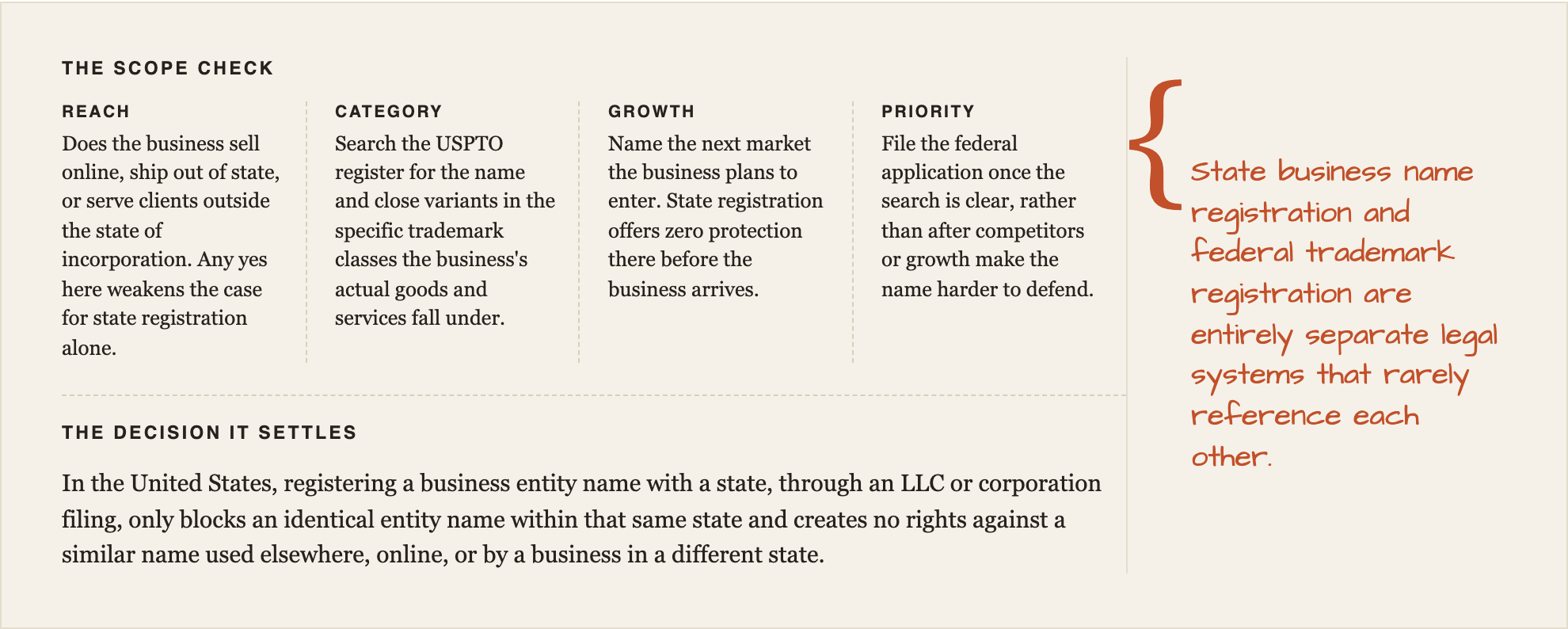
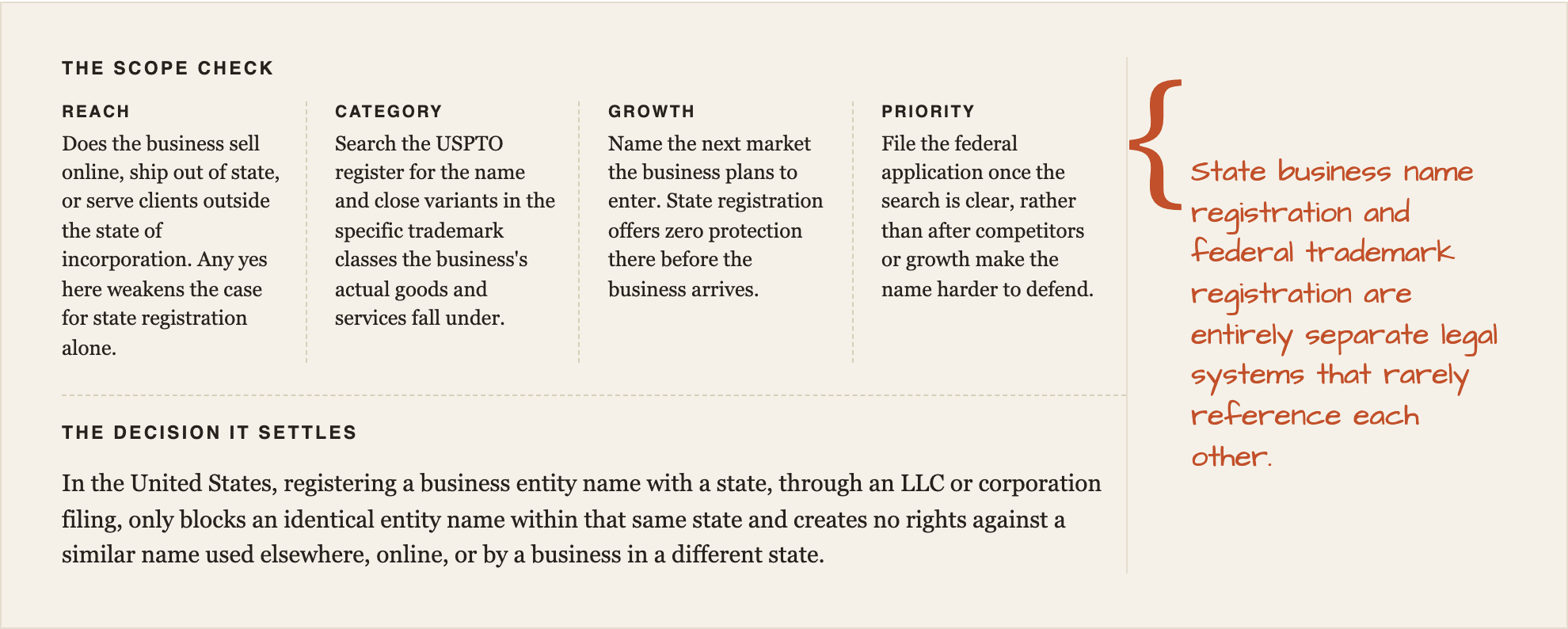
In the United States, registering a business entity name with a state, through an LLC or corporation filing, only blocks an identical entity name within that same state and creates no rights against a similar name used elsewhere, online, or by a business in a different state. Only a federal trademark, registered through the United States Patent and Trademark Office, creates nationwide exclusive rights, a legal presumption of ownership, and standing to sue in federal court. A business that plans to sell online, ship out of state, or operate under one name in more than one market needs a federal trademark search and filing; state registration alone leaves that name unprotected everywhere the business is not physically located.
Five conclusions
The argument, compressed.
- State business name registration and federal trademark registration are entirely separate legal systems that rarely reference each other.
- An LLC or corporation filing blocks an identical entity name within that one state only. It creates no protection against a similar name in another state or online.
- A federal USPTO trademark grants nationwide exclusive rights, legal presumption of ownership, and the right to sue in federal court, which state registration does not.
- A business that is genuinely local, tied to one city with no shipping and no out of state clients, may reasonably rely on state registration alone. Almost no business selling online meets that description for long.
- Federal trademark priority runs from the filing date. Waiting until a name has traction to file means a competitor who files first can outrank an earlier but unregistered user.
Working framework · 4 decisions
The scope check
Four questions, answered honestly about how the business actually operates rather than how it currently happens to be incorporated, decide whether state registration is enough or a federal trademark search is overdue.
Decision 01 / 04
Reach
Does the business sell online, ship out of state, or serve clients outside the state of incorporation. Any yes here weakens the case for state registration alone.
Two systems that rarely talk to each other
State business name registration and federal trademark registration are entirely separate legal systems, run by different authorities, testing different things, and in practice rarely cross-referencing each other. Registering an LLC or corporation with a state blocks an identical entity name within that state only; it provides no protection against a competitor using a similar name in a different state or online, where most small businesses now actually compete.
Each state runs its own entity name system, checking new filings against existing registered entities in that state alone. The federal government runs a separate trademark system through the USPTO, and the two registers do not automatically inform each other. A business can be lawfully incorporated in one state under a name that a different business, in a different state, already holds a live federal trademark for, and the state filing offers no defence against that conflict once it surfaces.
The US Small Business Administration's own guidance draws this distinction plainly: an entity name protects a business at the state level, while a trademark protects it federally. That is the whole difference, and it is the difference founders most often skip past on the way to opening a bank account.
The scope gap
State registration protects a name in one state. A federal trademark protects it everywhere the business might grow.
What federal registration actually adds
Federal trademark registration through the USPTO creates stronger protection than common law rights or state registration alone: nationwide exclusive rights to the mark for the registered goods and services, a legal presumption of ownership that shifts the burden of proof in a dispute, and standing to sue in federal court, which state registration does not confer.
This is not a distinction that matters only to large companies. The moment a small business takes online orders, ships out of state, or signs a client outside its home state, it is operating in commerce that state registration was never designed to cover, and a federal trademark becomes the mechanism that actually follows the business as it grows rather than staying fixed at its original state line.
The one case where state registration genuinely suffices is a business that is truly local: one city, no shipping, no out of state clients, and no near term plan to change that. That description covers fewer businesses every year as ecommerce and remote service delivery become the default rather than the exception.
Priority runs from filing, not from first use
A common founder assumption is that using a name first, in good faith, for years, establishes a stronger claim than a later trademark filing. Federal registration does not work that way: priority for the registered rights runs from the application's filing date in most disputes between registered marks, which means a competitor who files for a similar name after the original business started using it, but before that business gets around to filing, can end up with the stronger federal position.
This is precisely the scenario that catches growing businesses. A name is used informally for a year or two while the business proves itself, gains traction, and only then does trademark registration feel urgent enough to prioritise. By that point, the window in which the name could have been filed uncontested may already have narrowed, and the filing itself becomes a defensive scramble instead of a routine early step.
The businesses that avoid this run the USPTO search and file the application early, treating it as part of naming the business rather than as a later administrative task once growth makes it unavoidable.
- Search the USPTO Trademark Electronic Search System for the name and close variants before finalising it, not after.
- File in the specific classes for the business's actual current and reasonably near term goods and services.
- Treat the filing date as the real deadline. Waiting for perfect readiness usually means waiting past the point the name was still uncontested.
The decision this essay actually settles
State registration and federal trademark registration are not competing options where a business picks one; they serve different, non-overlapping purposes, and most businesses beyond the smallest, most local operations eventually need both. The state filing establishes the legal entity. The federal trademark protects the commercial name that entity trades under, wherever that trade actually reaches.
The cost of getting this sequence wrong is rarely a dramatic single event. It is usually a slow discovery, a customer mentioning a similarly named competitor in another state, a domain that turns out to already be trademarked, a cease and desist letter that arrives well after the brand has real customers attached to it. Each of those is cheaper to prevent with a search than to resolve after the fact.
For a business built around a distinctive name, treating the USPTO search as part of the naming decision itself, not a separate legal errand for later, is what actually protects the years of work that go into making that name mean something.
Before you use it
Questions that can change the recommendation.
Does registering an LLC give me trademark rights to my business name?
No. An LLC or corporation filing registers the legal entity name with a state and blocks only an identical entity name within that state. It creates no trademark rights, no protection in other states, and no defence if the name already infringes someone else's registered federal trademark.
If my business only operates in one state, do I need a federal trademark?
Possibly not yet. A business that is genuinely local, tied to one city or state, without shipping, online sales, or out of state clients, can reasonably rely on state registration for now. The moment any of those conditions change, which happens quickly for most growing businesses, the gap in state only protection becomes a real exposure.
How much does a federal trademark cost compared to the risk of skipping it?
A USPTO filing runs to several hundred dollars per class of goods or services, plus time for search and examination. Resolving a name conflict after a competing registration exists, through negotiation, opposition, or a rebrand, typically costs a multiple of that, before accounting for the lost brand recognition a forced name change discards.
Can I trademark a name that is already registered as an LLC in another state?
Potentially yes, since state entity registration and federal trademark registration are checked separately; an identical LLC name existing in another state does not automatically block a federal trademark application, though a search may surface that other business's unregistered common law rights as a separate consideration worth reviewing with a trademark specialist.
What is the first practical step before naming a new US business?
Search the USPTO Trademark Electronic Search System for the proposed name and close variants in the relevant goods and services classes, before finalising the name or beginning brand identity work, so that a conflict is caught while changing course still costs almost nothing.
Research record
What this guide draws from.
Each source note describes what the reference supports. Platform guidance, research findings and Branding Tatva's practical suggestions have different scopes.
- State Trademark vs Federal: When Local Businesses Should Upgrade
TrademarkEngine
Direct comparison of when state registration suffices versus when federal registration becomes necessary.
- If My Business Name Is Registered with the State, Do I Still Need a Trademark?
LegalZoom
Founder facing explanation of the gap between state entity registration and trademark protection.
- State vs Federal Trademarks: What's The Difference and Which Is Right for You
Arapacke Law
Legal comparison of the rights each registration type actually confers, including federal court standing.
- How Small Businesses Can Register a Trademark with the USPTO
TrademarkEngine
Process reference for the USPTO filing steps described in the framework.