When to rebrand: the signs that justify it, and the ones that fool you
The direct answer
Rebrand when the current brand actively blocks buyers: the name confuses or misleads, the business now serves a different market than the identity describes, the brand carries a reputation or legal problem, or the company has changed so much that the brand tells buyers the wrong story. Hold off when the real trigger is a slow quarter and the logo becomes the scapegoat, because new paint on an unclear position changes nothing. The honest test before spending is one sentence: who the brand is for and why they should choose it over the obvious alternative. If you can write that sentence and the visual brand simply fails to express it, you may have a rebrand worth doing. If you cannot write it, fix that first, because it costs a fraction of a rebrand and makes the visual work obvious.
Five conclusions
The argument, compressed.
- Rebrand when the brand actively blocks buyers, through a confusing name, an outgrown market, a reputation problem, or a story that no longer matches the business.
- Hold off when the real problem is slow sales and the logo is being blamed for a positioning or distribution issue it cannot fix.
- A rebrand spends accumulated memory. Doing it without cause resets recognition you already paid years to build.
- The one sentence test decides it: if you can name who you are for and what you are chosen over, and only the visuals fail to express it, a rebrand may be justified.
- If you cannot write that sentence, the gap is strategy, rather than design, and repositioning costs a fraction of a rebrand.
Working framework · 4 decisions
The four signs that actually justify a rebrand
Each of these is structural, which is what separates them from the softer triggers that feel urgent and change nothing. A serious advisor would support any one of them.
Decision 01 / 04
The name works against you
It confuses, misleads, limits, or collides with someone bigger. A name that fights the business is a structural reason, rather than a cosmetic one.
The question under the question
Most searches for whether to rebrand are really searches for whether the brand is why growth has stalled. Sometimes it is, and sometimes the brand is fine and the blame is misplaced.
Sorting the two is the whole task, because a rebrand aimed at the wrong problem spends a large sum and moves nothing, while leaving the real problem untouched. The signs below separate a brand that actively blocks buyers, which is worth fixing, from a brand that is merely the nearest thing to blame when a number disappoints.
The signs that justify it
A rebrand earns its cost when the brand structurally works against the business. The clearest case is a name that confuses, misleads, limits the company to something it has outgrown, or collides with a larger player, because a name is expensive to work around and a fair reason to change.
The second is an outgrown market: the business now serves different buyers than the brand describes, and the mismatch costs it recognition with the people it actually wants. The third is a reputation or legal problem the brand carries, where a clean break genuinely removes baggage. The fourth is drift: what the company has become and what the brand still promises have separated far enough that buyers arrive with the wrong expectation. Any of these is a reason a serious advisor would support.
What a rebrand actually spends
Recognition is accumulated memory, built over years of repetition. A rebrand spends that memory to buy a fresh start. With a real reason, the trade is worth it. Without one, you are paying to make your business less familiar.
The signs that fool you
The most common false trigger is a slow quarter. Sales dip, the mood turns, and the logo becomes the visible thing to blame, because changing it feels like action. Yet slow sales are far more often a positioning problem, a distribution problem, or a demand problem, and none of those is fixed by new paint.
Another false trigger is boredom: the founder has looked at the brand for years and craves novelty, while the buyer, who meets it far less often, was just beginning to remember it. A third is a competitor's rebrand prompting a reflexive one of your own. Before spending on any of these, name the actual problem in a sentence. If the sentence is about sales or a rival rather than about the brand structurally blocking buyers, the money belongs somewhere other than a rebrand.
- A slow quarter usually points at positioning, distribution, or demand, and new paint fixes none of them.
- Founder boredom arrives years before buyer fatigue, since the buyer meets the brand far less often than you do.
- A rival's rebrand is their reasoning, rather than yours.
The one sentence test
Before committing, write one sentence: who the brand is for, and why they should choose it over the obvious alternative. Two outcomes follow. If you can write it clearly and the only failure is that your visual brand does a poor job of expressing it, you may have a genuine rebrand worth doing, and the design has a real brief.
If you cannot write it, the gap is your position, rather than your logo, and repositioning is the work, at a fraction of a rebrand's cost. Once the position is clear, whether the visuals actually need changing usually answers itself. The test is uncomfortable precisely because it moves the question from taste, which is easy to debate, to strategy, which is harder to dodge.
Before you use it
Questions that can change the recommendation.
How do I know if I need a rebrand or just a refresh?
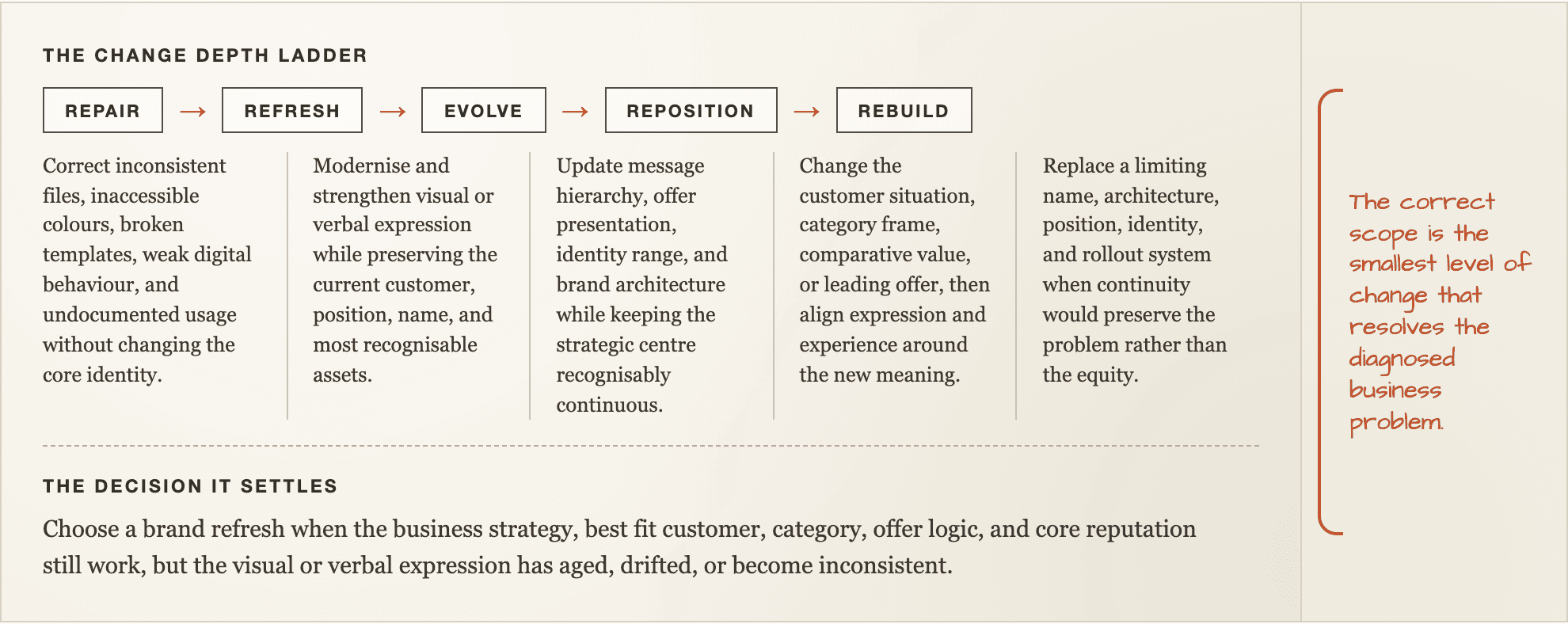
Ask whether the problem is the meaning or the look. If the brand means the wrong thing, through a confusing name, an outgrown market, or a story that no longer fits, that is a rebrand. If the meaning is right and only the visuals look dated or inconsistent, that is a refresh, which is cheaper and faster. The mistake is buying a full rebrand when a refresh was the job, or refreshing the paint when the meaning was the problem.
Is slow sales a good reason to rebrand?
Rarely on its own. Slow sales usually trace to positioning, distribution, or demand, and a rebrand fixes none of those. When sales dip, the logo is simply the most visible thing to blame, and changing it feels like progress while the real cause continues. Diagnose the actual problem in one sentence first; if it is about the market rather than the brand structurally failing, spend the money there.
Does rebranding hurt an existing customer base?
It can, because a rebrand spends the recognition those customers have built. Done with a real reason and a planned switchover, the trade is worth it and the base follows. Done without cause, or rolled out piecemeal so buyers meet the old brand in one place and the new one in another, it costs familiarity you already paid years to earn. The reason and the execution decide whether a rebrand strengthens the base or unsettles it.
What should I do before deciding to rebrand?
Write the one sentence: who the brand is for and why they should choose it over the alternative. If you can, and only the visuals fail to express it, a rebrand may be justified and the design has a brief. If you cannot, fix the position first, which is cheaper and often makes the visual question answer itself. Deciding this before spending is what separates a rebrand that works from an expensive coat of paint.