How to find a real differentiator in a crowded service market
The direct answer
A real differentiator comes from a meaningful choice in who the service is for, which situation it solves, how the work is performed, what tradeoff it accepts, or what proof it can demonstrate. The difference must change the customer experience or decision, survive competitor comparison, and remain believable in delivery.
Five conclusions
The argument, compressed.
- A differentiator must create consequence for the customer, rather than merely sound distinctive.
- The strongest differences often hide inside audience choice, process order, tradeoffs, access, or proof.
- Competitor language should be compared with competitor behaviour before a position is declared unique.
- A useful differentiator must be relevant, credible, defensible, and repeatable across touchpoints.
- The difference should guide service design, messaging, proof, and customer experience at the same time.
Working framework · 5 decisions
The consequence test
Five questions separate a real market difference from a phrase that belongs only inside the headline.
Decision 01 / 05
Choice
Identify the decision the business makes differently from plausible alternatives.
What a real differentiator is
A differentiator is a meaningful reason a specific customer should choose one service over plausible alternatives. It may come from specialisation, process, philosophy, access, format, proof, experience, or the tradeoff the business is willing to make.
The difference becomes useful when it changes something the customer values. A phrase can sound original while the offer, process, and result remain identical to the category. That kind of difference creates novelty in language and sameness in experience.
The practical test is simple: if the stated difference disappeared tomorrow, what would become worse, slower, riskier, less clear, or less suitable for the customer?
Differentiation rule
A real difference leaves fingerprints on the service. A decorative difference leaves fingerprints only on the copy.
Why crowded service markets sound the same
Service businesses often compete through reassuring claims: experienced, tailored, strategic, collaborative, results driven, and customer first. These qualities matter, yet they rarely create separation because credible competitors need them too.
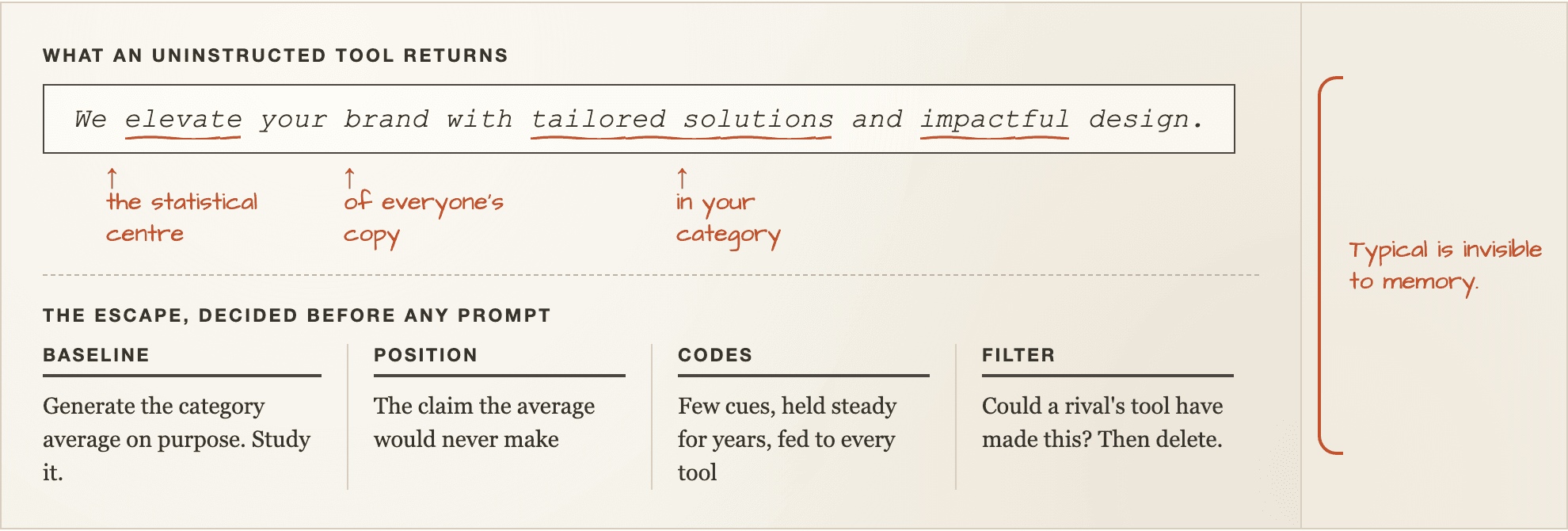
Sameness also grows from copying category language. Businesses study the leading firms, borrow their vocabulary, then adjust the tone. The words become polished while the comparison frame stays unchanged.
The market feels crowded partly because many businesses describe the category rather than the choice they make inside it.
Begin with the buying situation
A difference matters only in relation to a customer decision. Start by identifying the moment that makes the buyer ready to compare alternatives.
A founder preparing for investment evaluates a brand partner differently from a founder repairing inconsistent growth. A company entering a new category evaluates a consultant differently from a company improving execution inside an established one.
The same capability can become more relevant when attached to a precise situation. Situation creates the context in which one difference becomes valuable and another becomes irrelevant.
- What has changed inside the customer's business?
- What risk or frustration has become difficult to ignore?
- Which alternatives are they likely to compare?
- What would make one choice feel safer or more suitable?
Look inside the method before inventing the message
Many useful differentiators already exist inside the way the business works. They remain invisible because the website lists deliverables while the sales conversation contains the real reasoning.
Review how discovery happens, which questions receive unusual attention, what order the work follows, which decisions are delayed, what gets rejected, and how the customer participates.
A process becomes differentiating when its sequence or emphasis solves a customer problem better than the expected category approach.
- What do you examine before competitors usually begin producing?
- Which stage receives more depth or care in your process?
- What common shortcut do you refuse to take?
- What does the customer understand or experience differently because of that refusal?
Use tradeoffs to sharpen the difference
Every strong position contains a tradeoff. A business may choose depth over speed, senior access over a large delivery team, specialisation over breadth, or a rigorous diagnostic phase over immediate production.
Tradeoffs create credibility because they show the cost of the choice. A promise that offers every advantage to every customer usually reads as ambition rather than strategy.
Name the tradeoff honestly, then connect it with the customer who values the chosen side of the exchange.
Positioning clue
The thing a business is willing to sacrifice often reveals the thing it is genuinely built to protect.
Compare competitor behaviour, rather than slogans alone
Competitor websites can make every business appear more differentiated than it is. Compare offers, process, proof, pricing logic, access, delivery model, content, and customer experience as well as language.
A competitor may claim strategic depth while selling a highly standardised package. Another may use generic language while providing unusually direct senior access. Behaviour reveals where the market is truly similar and where opportunity exists.
Map the category around customer consequences. Which alternative is fastest, safest, deepest, most specialised, easiest to buy, most collaborative, or most proven? The gaps become clearer when comparison moves beyond adjectives.
Build proof around the differentiator
A difference becomes believable when evidence demonstrates the mechanism and consequence. Proof can include case study decisions, process artefacts, work samples, customer language, verified results, repeat engagements, or specialised knowledge.
The proof should match the claim. A promise about diagnostic depth needs evidence of diagnosis. A promise about founder access needs visible involvement. A promise about consistency needs connected touchpoints rather than one polished output.
Place evidence beside the difference in the website, proposal, and sales process. Separation without credibility creates intrigue. Separation with proof creates choice.
Test the differentiator before building the brand around it
Test the proposed difference with customers, prospects, collaborators, and people who understand the category. Ask what the claim means, why it matters, and which evidence they would need before believing it.
Avoid asking only whether the idea sounds good. Preference is easy to grant. Ask whether it changes comparison and whether another credible competitor could claim the same thing without changing its business.
A useful differentiator should pass four tests: relevance to the buying situation, credibility through proof, separation from alternatives, and durability across growth.
- Does the customer care about the consequence?
- Can the business demonstrate the claim today?
- Could a close competitor use the same statement unchanged?
- Can the difference guide decisions beyond one campaign?
- Will the position remain useful as the offer expands?
Translate the difference into the whole brand system
Once validated, the differentiator should shape more than the opening headline. It should influence the service menu, discovery questions, process, proof hierarchy, case studies, visual expression, content themes, and customer experience.
A business that differentiates through clarity should make the buying and onboarding experience unusually clear. A business that differentiates through depth should reveal thinking before asking for trust. A business that differentiates through speed should remove avoidable friction across the journey.
Consistency between claim and experience turns the differentiator into reputation. Repetition turns that reputation into memory.
Common false differentiators
Personal service is a weak differentiator when every small firm provides direct access. Quality is a threshold expectation rather than a position. Passion describes internal feeling, while customers choose through consequences.
A proprietary process becomes meaningful only when the process produces a visible difference. Industry experience becomes useful when it changes diagnosis, speed, risk, or the quality of decisions.
The goal is less about finding a sentence nobody has ever written and more about making a choice competitors are less willing or able to sustain.
Before you use it
Questions that can change the recommendation.
What is a good differentiator for a service business?
A good differentiator is relevant to a real buying situation, changes the customer experience or result, can be supported with evidence, and creates meaningful separation from plausible alternatives.
Is customer service a strong differentiator?
It can be when the service model contains specific and provable choices, such as direct senior access, response standards, or a distinctive collaboration process. The broad claim alone is rarely enough.
Can process be a brand differentiator?
Yes. A process can differentiate when its sequence, depth, participation, or tradeoffs create a consequence the customer values and competitors rarely provide.
How do I know whether a differentiator is unique?
Compare competitor behaviour as well as messaging, test whether another credible provider can make the same claim unchanged, and examine whether your evidence supports a distinct customer consequence.
Should a differentiator stay the same forever?
No. Review it when the audience, category, offer, evidence, or market changes. Preserve the central association long enough to build recognition while refining its expression through real learning.