What brand strategy costs in the United States, and what decides the price
The direct answer
Branding Tatva's published starting prices for United States projects are US$2,800 for a Foundation engagement, US$6,500 for a Full Brand System and US$1,500 per month for an ongoing Brand Partnership. Fees are quoted and invoiced in United States dollars. Price follows scope rather than hours: how many audiences the position has to hold, how much customer evidence already exists, how far identity and messaging have to reach, and how many decision makers have to agree. These are starting figures, and the proposal confirms the fee after the first conversation.
Five conclusions
The argument, compressed.
- Published starting prices for United States projects are US$2,800, US$6,500 and US$1,500 per month.
- Scope sets the price: audiences, existing evidence, system reach and the number of decision makers.
- A Foundation engagement settles the position and the first identity system.
- A Full Brand System rebuilds the language and the identity across the customer journey.
- The proposal confirms the fee after the diagnosis, and these figures are starting points rather than quotations.
Working framework · 5 decisions
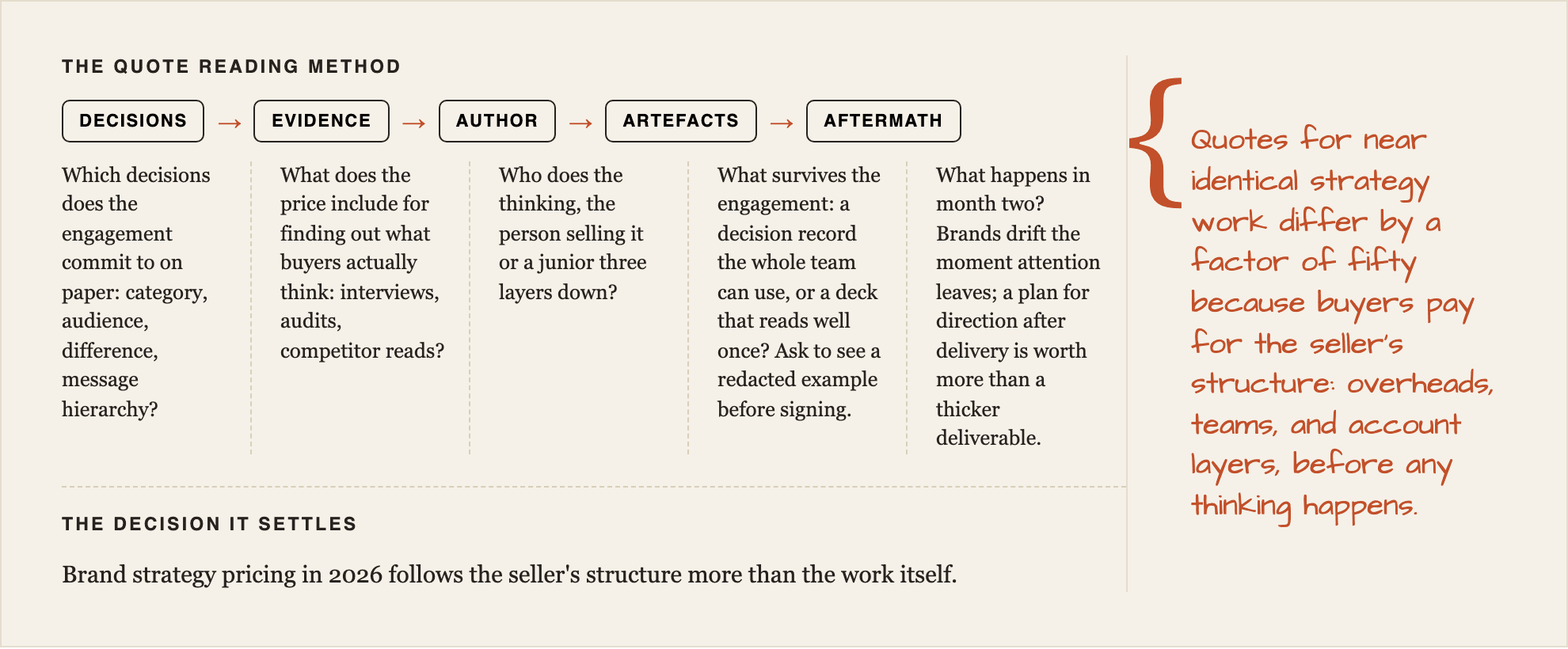
The quote reading method
Five questions that explain most of the difference between two United States proposals on the same brief.
Decision 01 / 05
Scope
Count the audiences the position has to hold and the offers it has to cover. Each additional audience adds discovery and testing work.
The three tiers and what each one settles
The Foundation engagement begins at US$2,800. It settles what the business should mean, who should choose it and which promise it can prove, then gives that decision a first identity system and a set of messaging starting points. It suits a founder with a credible offer and no settled market position.
The Full Brand System begins at US$6,500. It starts from what buyers already recognise, decides the stronger position, then rebuilds the language and identity around it across the customer journey. The Brand Partnership begins at US$1,500 per month for work that continues after the system exists, which is usually the point where consistency rather than design becomes the constraint.
What moves a United States quote
Four things move the figure more than any other. The first is the number of audiences the position has to hold, because a position that has to serve two buying groups costs more discovery than one. The second is the evidence already in hand: a business with recorded customer interviews and a year of enquiry data starts further along than one beginning from assumptions.
The third is reach. A position applied to a website and a set of proposals is a smaller system than one applied across service lines, several locations and a recruitment pipeline. The fourth is the number of decision makers, which is the variable founders underestimate. Approval by committee extends a timeline through revision rounds, and timelines carry cost.
- Audiences the position has to hold.
- Customer evidence that already exists in usable form.
- How far the identity and messaging system has to reach.
- How many people can approve or reopen the position.
Why the price is published at all
A published starting figure removes the first awkward exchange and shortens the shortlist. A buyer can decide whether the range suits the budget before either side spends an hour on a call, and a business that publishes a figure is making a claim it has to stand behind.
The figure also does a second job. It sets an expectation about scope. A buyer who reads that a Foundation engagement begins at US$2,800 arrives understanding that this is a decision engagement rather than a full campaign, which is exactly the conversation worth having first.
What sits outside the fee
The fee covers strategy, the identity direction and the written system. Three things sit outside it and are better handled by a specialist: legal clearance of a name, regulatory approval of a claim, and translation for a market that requires a second language. Each of those needs a professional who carries the liability for the answer.
Naming the boundary early protects the timeline as much as the budget. A name that has to be cleared legally is a decision with a legal dependency, and a claim that a regulator has to accept is a decision with a regulatory one.
How to compare two proposals on the same brief
Two proposals rarely differ by price alone, and the cheaper one is often cheaper because of what it leaves out. Read both against the same five questions, then compare what happens after handover, because a system nobody can apply is the most expensive version of the work.
The useful comparison is decisions per dollar rather than deliverables per dollar. A proposal that settles fewer decisions for the same fee leaves more unresolved work, and unresolved work is paid for later at a worse rate.
The question that reveals the scope
Ask which decisions the engagement settles and who applies them afterwards. The answer describes the real scope more accurately than any deliverable list.
Before you use it
Questions that can change the recommendation.
How much does brand strategy cost in the United States?
Branding Tatva's published starting prices for United States projects are US$2,800 for a Foundation engagement, US$6,500 for a Full Brand System and US$1,500 per month for an ongoing Brand Partnership. The proposal confirms the fee after the first conversation.
Are these figures fixed prices?
They are starting figures rather than quotations. Scope sets the final fee: the audiences the position must hold, the customer evidence already available, how far the system has to reach and how many decision makers have to agree.
Why is a price published instead of offered on request?
A published starting figure lets a buyer judge the range against the budget before either side spends time on a call, and it sets an expectation about scope at the same moment.
Does the fee include legal clearance of a name or regulatory approval of a claim?
It does not. Legal clearance, regulatory approval and translation for a market that requires a second language sit outside the engagement and belong with a specialist who carries the liability for that answer.
Research record
What this guide draws from.
Each source note describes what the reference supports. Platform guidance, research findings and Branding Tatva's practical suggestions have different scopes.
- Brand Strategy and Systems: package scope and published starting prices
Branding Tatva
The published price book these figures are read from, including currency by market.
- What brand strategy costs, and what decides the price
Branding Tatva
The same method applied across markets, including the tier logic this guide narrows to the United States.