Brand strategy vs brand identity: the decisions and the evidence
The direct answer
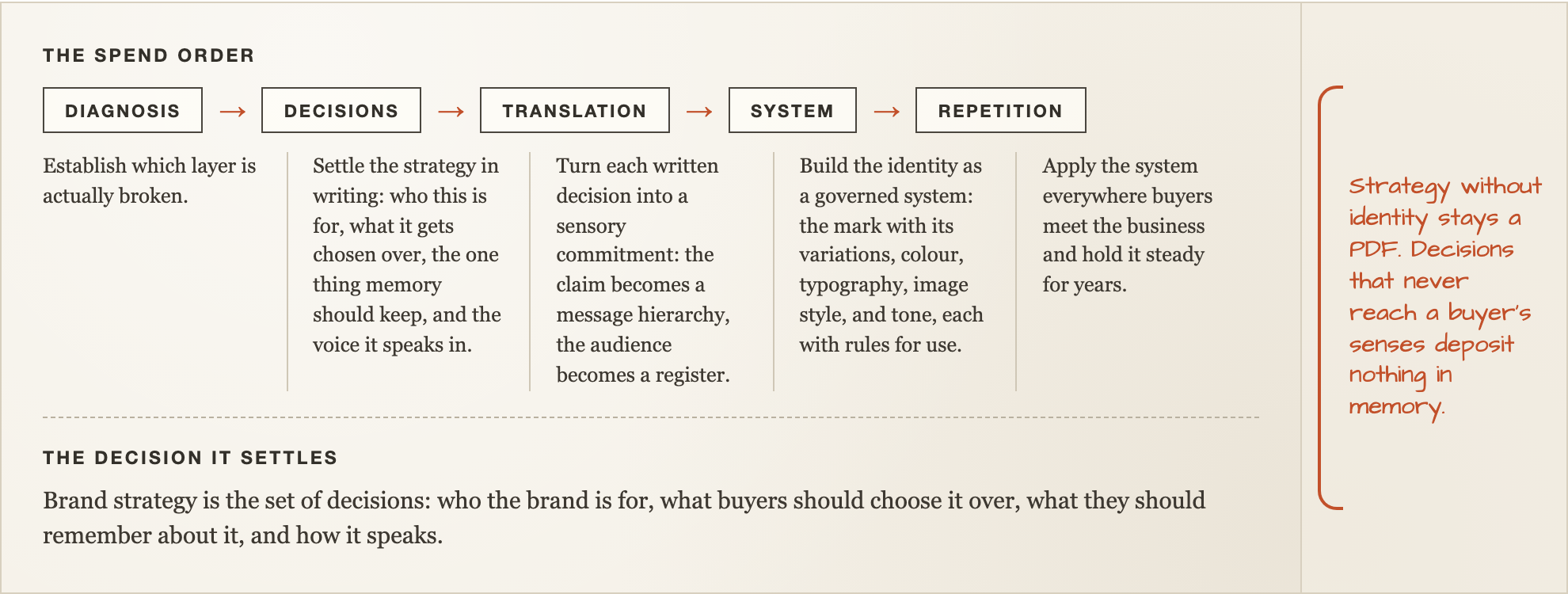
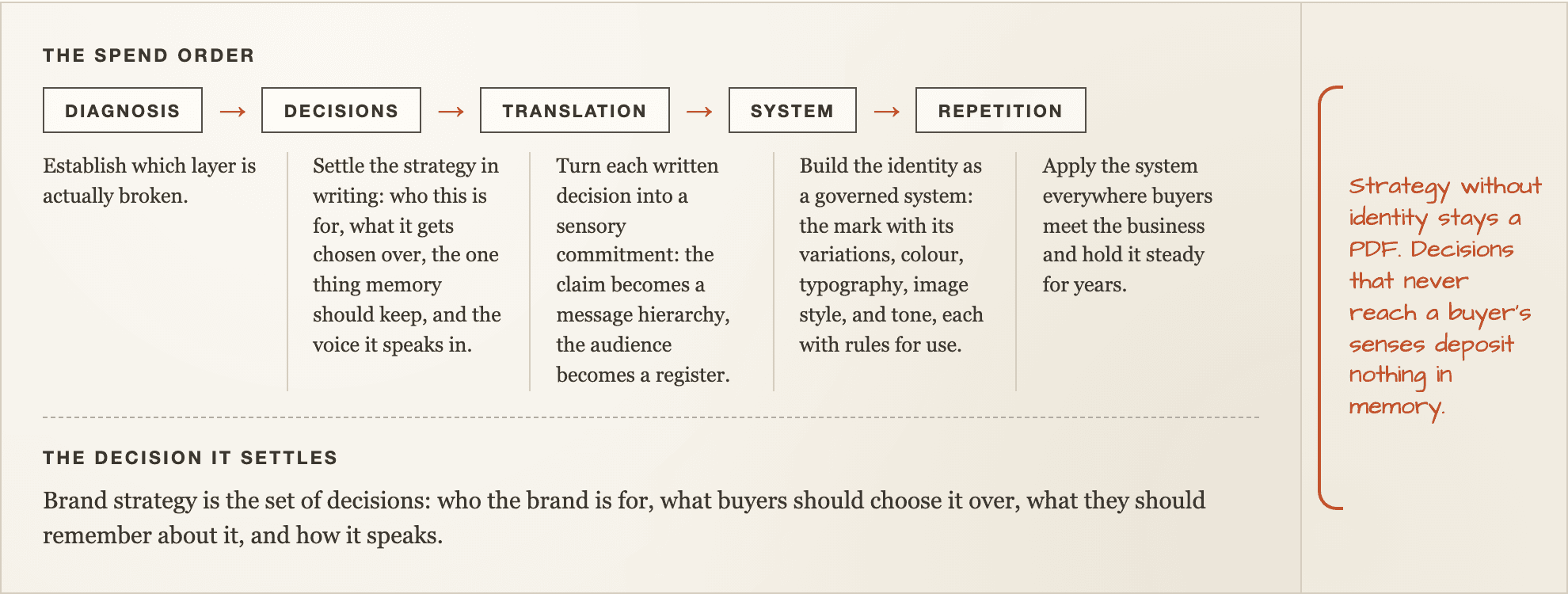
Brand strategy is the set of decisions: who the brand is for, what buyers should choose it over, what they should remember about it, and how it speaks. Brand identity is the visible system that carries those decisions: name, logo, colour, typography, tone, and imagery, governed by rules. Strategy without identity stays a document nobody meets; identity without strategy is decoration, attractive and interchangeable. Buy them in that order, because identity built first hardens guesses into expensive artwork.
Five conclusions
The argument, compressed.
- Strategy is the decisions; identity is what makes them visible. The definitions take one sentence, and the industry blurs them because the blur sells.
- Identity built without strategy is decoration: attractive, competent, and interchangeable with any competitor who hired the same designer.
- Strategy without identity stays a PDF. Decisions that never reach a buyer's senses deposit nothing in memory.
- The order of spend matters more than the definitions: decisions first, then the system that carries them, then years of repetition.
- A logo is one distinctive asset among several. Colour, tone, and consistency usually do more recognition work than the mark itself.
Working framework · 5 decisions
The spend order
Five stages put strategy and identity in their working order. Each one exists to protect the money spent at the next, which is why skipping an early stage quietly wastes every later one.
Decision 01 / 05
Diagnosis
Establish which layer is actually broken. Buyers who meet the business and stay unable to say what makes it different have a strategy gap; buyers who can say it while the materials all look and sound different have an identity gap.
Why the confusion exists
Ask five people in the branding trade where strategy ends and identity begins and the answers will disagree, which is odd for an industry that charges by the layer. Some of the blur is honest: the two feed each other, and small studios genuinely deliver both. Some of it is commercial: a logo project resells at several times the price when the proposal calls it a brand strategy engagement.
The cost of the blur lands on the buyer. Founders arrive believing they need a rebrand when the strategy is what failed, or pay for months of strategy when their decisions were fine and their materials were simply inconsistent. The wrong diagnosis wastes the whole budget, and the two problems have opposite symptoms.
So the distinction deserves one plain sentence each. Brand strategy is the set of decisions about meaning: audience, alternative, memory, voice. Brand identity is the visible and audible system that carries those decisions to a buyer's senses. Everything else in this essay follows from keeping those two sentences separate.
The plain version
Strategy is the decisions. Identity is what makes the decisions visible.
What strategy actually decides
A finished brand strategy answers four questions in writing. Who is this for, precisely enough that someone is excluded. What does the buyer choose it over, named as the real alternative rather than a flattering one. What single association should memory keep, chosen because a memory holds one thing per brand, rarely more. And how does it speak, so that every future writer sounds like the same author.
The test of each answer is sacrifice. A positioning that would sit comfortably on a competitor's website is a description, and descriptions cost the same as positions while doing none of the work. Deciding to be the accountant for restaurant owners means accepting the lost generalist enquiries; the acceptance is the strategy.
None of this requires a designer, which is why strategy can be bought alone, first, and relatively cheaply. It produces a short document, and the document's entire value depends on what happens to it next.
What identity actually carries
A buyer never meets a strategy. They meet a website, an invoice, a proposal, a profile photo, a sentence in a feed. Identity is the system that makes every one of those encounters deposit the same memory: the name and mark, the colour that becomes yours through repetition, the typography, the image style, the tone that survives three different writers.
The research on distinctive assets is blunt about how this works: recognition accrues to cues repeated without variation, and colour and tone usually carry more of the load than the logo. A brand is recognised at a distance by its purple or its way of opening a sentence long before any mark resolves. This is why the rules matter more than the artefacts, and why a folder of files with no usage rules decays into inconsistency within a year.
Identity work is genuinely design work, and good design is worth paying for. The claim here is narrower: the same design executes brilliantly or wastefully depending entirely on whether decisions preceded it.
- Count your distinctive assets honestly: which cues would a customer recognise with the name covered?
- Check the rules exist: could a new freelancer apply the identity correctly from the guidelines alone?
- Check the voice: read the site and the latest proposal aloud. One author, or several companies wearing one logo?
The order is the argument
Identity built without strategy produces decoration. The work can be attractive, professional, and expensive, and it remains interchangeable, because unmade decisions leave the designer aiming at taste. Taste converges: the same references, the same tools, the same tasteful sameness across the category. A rebrand that changes how everything looks while changing nothing about what the brand means resets recognition to zero and buys silence in return.
Strategy without identity fails more quietly. The decisions sit in a document, correct and inert, while the materials buyers actually meet keep depositing the old associations. A strategy that never reaches the senses is indistinguishable, commercially, from no strategy at all.
So the order of spend, when budget forces the choice: diagnosis, then decisions, then the system, then repetition. Money spent downstream of the break always leaks. The one exception is honest triage: a business whose decisions are sound but whose surfaces are chaos should buy identity discipline first, because that is where its break actually sits.
The waste pattern
Money spent downstream of the broken layer leaks. Diagnose the layer before pricing the fix.
Buying each one well
Buying strategy means buying a diagnosis and a set of argued decisions. The warning signs are proposals that open with deliverables, timelines under two weeks, and any pitch that prescribes a rebrand before studying the business. The right questions expose them fast: what problem do you think we have, and what evidence says so.
Buying identity means buying a system with rules, and the package contents reveal the seller. A quote listing a logo, business card, and letterhead is selling artefacts; a package that includes the message hierarchy, the usage guidelines, and templates for the materials your buyers actually meet is selling the system. The guidelines document is the least glamorous deliverable and the one that decides whether the rest survives contact with daily use.
Both can come from one practitioner or two different ones, and either works when the order holds. What fails is the collapsed version: a single engagement that starts sketching the logo in week one, with the strategy backfilled to justify whatever the sketches became.
Where the money compounds
The spend that actually builds a brand is the least photogenic one: applying the same system, everywhere, for years. Strategy is a one time cost that occasionally needs revisiting when the market moves. Identity is a one time cost plus discipline. Repetition is the compounding layer, and it is nearly free, which is why it gets skipped.
This is also the honest answer to how much of the budget each layer deserves. For a small service business, the decisions and the system together are weeks of work each; the repetition is the rest of the decade. A brand that changes its look twice in three years has paid for identity three times and owns the recognition of a brand that paid once.
The essay's argument compresses to a spending rule. Decide once, build the system once, then spend the long tail of effort refusing to vary it. Every question about strategy versus identity is eventually a question about protecting that refusal.
Before you use it
Questions that can change the recommendation.
Can a small business skip brand strategy and just get a logo?
A small business can skip the strategy document, and it still makes the strategy decisions, just implicitly and by accident, through whatever the designer assumes. Writing the four answers first (who this is for, what it replaces, what memory should keep, how it speaks) takes days, costs little, and turns the same design budget into aimed work instead of tasteful guessing.
Is a logo the same thing as a brand identity?
A logo is one asset inside the identity system, alongside colour, typography, tone of voice, and image style. Research on distinctive assets consistently finds the surrounding cues carry more recognition than the mark itself: a brand is known by its colour and its way of speaking at distances where no logo resolves. Pay for a competent, distinctive mark once, then invest in using the whole system without variation.
How should a limited budget split between strategy and identity?
Diagnose first, because the split follows the break. When buyers struggle to say what makes the business different, weight the budget toward strategy and apply the decisions to existing materials. When the decisions are clear and the surfaces are inconsistent, weight it toward the identity system and its guidelines. Splitting evenly by default usually means underfunding the layer that was actually broken.
Can the same person do both strategy and identity?
Yes, and many independent practitioners do, including this practice on the strategy side with design partners on the system side. The safeguard is sequence rather than headcount: the decisions get written and agreed before anything visual begins. The failure mode is a single engagement where design starts in week one and the strategy gets written afterwards to fit it.
When does identity need redoing while the strategy stays?
When the system stops carrying the decisions: the materials have drifted into inconsistency, the typography fails on the channels buyers now use, or the visual language has become the category's default and lost its distinctiveness. That is an identity refresh with the strategy held constant, and it should conserve every cue that still triggers recognition, because those cues are paid for and the replacements start at zero.
Research record
What this guide draws from.
These sources establish the research principles used in this guide. Branding Tatva's framework is the practical application of that evidence to service businesses and founders leading their own brands.
- Conceptualizing, measuring, and managing customer based brand equity
Journal of Marketing, Kevin Lane Keller
The foundational model of brand knowledge as associations in buyer memory, which is what strategy decides and identity deposits.
- Building distinctive brand assets
Oxford University Press, Jenni Romaniuk
The Ehrenberg Bass measurement work behind the claim that colour, tone, and repeated cues carry recognition beyond the logo.
- The long and the short of it: balancing short and long term marketing strategies
IPA, Les Binet and Peter Field
The effectiveness evidence for why repetition and consistency compound while frequent reinvention resets the account.