Brand voice guidelines writers can actually use
The direct answer
Useful brand voice guidelines translate abstract traits into observable writing behaviours. Define the relationship the brand creates with the reader, choose a small set of verbal principles, turn each principle into specific do and avoid rules, document vocabulary and sentence patterns, show examples across real channels, and separate stable voice from situational tone. The guide should help two different writers make similar decisions without copying one fixed script.
Five conclusions
The argument, compressed.
- Voice traits become useful only when they change an editing decision.
- Define the reader relationship before choosing adjectives such as warm, bold, or expert.
- Separate stable voice principles from tone changes caused by context, emotion, and channel.
- Examples and counterexamples teach a voice faster than long lists of adjectives.
- A voice system should include vocabulary, rhythm, metaphor boundaries, proof language, and governance.
Working framework · 5 decisions
The usable voice stack
Five layers turn verbal identity from personality adjectives into a repeatable writing system.
Decision 01 / 05
Relationship
Define how the brand should relate to the reader: guide, peer, challenger, host, specialist, or another deliberate role.
Why most voice traits fail writers
Words such as warm, bold, human, expert, and playful describe intentions but rarely tell a writer what to change in a sentence. Several brands can use the same adjectives while sounding entirely different.
A useful guideline connects a trait with behaviour. Warm might mean acknowledge the customer's context before giving advice. Expert might mean explain the observation before naming the theory. Bold might mean state the recommendation without defensive filler.
If a trait cannot guide an edit, it belongs in the mood board rather than the writing system.
Define the reader relationship first
Voice emerges from the relationship a brand wants to create. A teacher explains. A peer shares judgement. A challenger creates productive friction. A host reduces anxiety. A specialist makes complexity legible.
Choose the relationship according to positioning, customer expectations, and the service experience. Then define what the relationship should never become. A challenger can become combative. A specialist can become obscure. A warm host can become overfamiliar.
This boundary creates a more useful voice than a list of flattering personality words.
Write three to five behavioural voice principles
Phrase principles as actions writers can remember. Lead with the observation. Prefer concrete nouns to decorative adjectives. Make the next decision visible. Use metaphor to clarify rather than perform. Let evidence carry confidence.
Each principle should include why it matters, what it looks like, and what drift looks like. The combination creates a distinct verbal pattern without forcing every sentence into one mould.
Separate voice from tone
Voice is the relatively stable verbal character. Tone adjusts that character to the situation. A proposal, payment reminder, celebratory launch, apology, and insight article should feel related while carrying different emotional weight.
Create a tone matrix using dimensions that actually change: urgency, warmth, formality, density, humour, and directness. Define how those dimensions move in common scenarios.
This prevents teams from inventing a new brand personality every time the context changes.
Document micro rules that shape recognition
Small repeated decisions create verbal distinctiveness. Define preferred sentence length ranges, paragraph rhythm, headline construction, punctuation habits, contractions, first- and second person usage, terminology, numbers, calls to action, and how proof is introduced.
Avoid turning the guide into a grammar police manual. Focus on choices that affect clarity, character, or recognition.
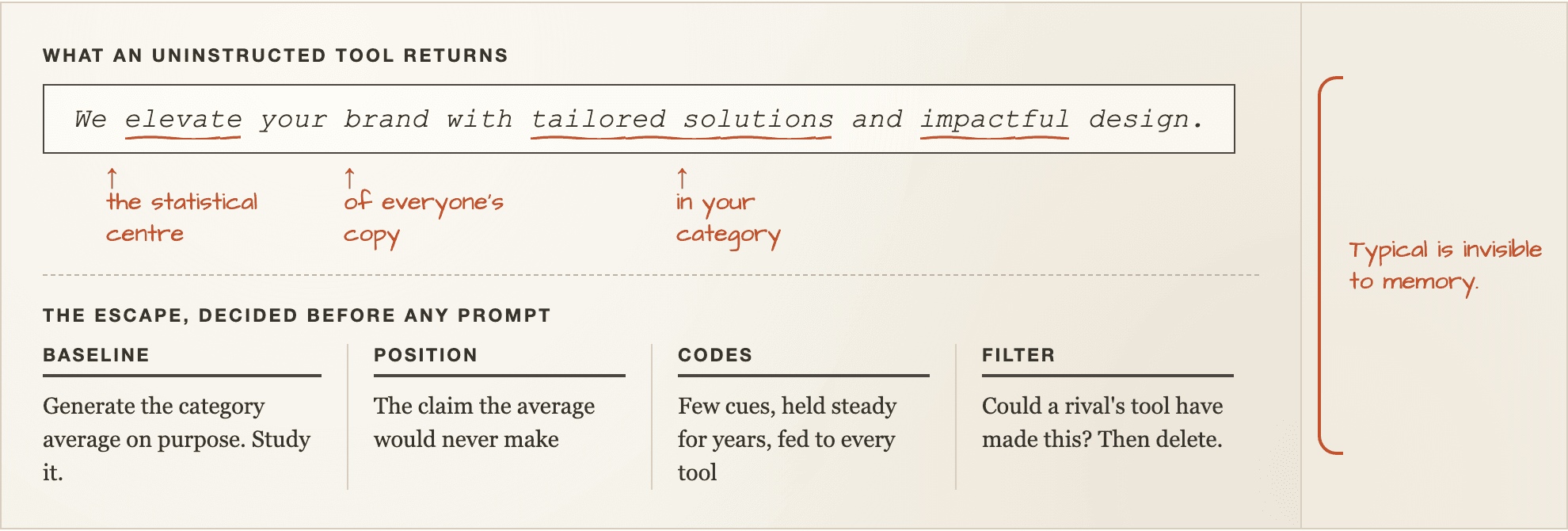
Include forbidden shortcuts where they matter: inflated superlatives, empty urgency, vague claims, jargon without explanation, or metaphors that conflict with the brand's conceptual world.
Build a vocabulary system instead of a word bank
A useful vocabulary guide separates category terms, ownable phrases, preferred words, technical language, customer language, and words that create the wrong expectation.
Explain when each group is useful. Customer language can improve recognition of the problem. Technical vocabulary can signal depth when explained clearly. Ownable phrases can build memory through disciplined repetition.
The goal is controlled consistency, rather than inserting the same branded words into every paragraph.
Teach the voice through before and after examples
Show a weak generic version, the edited brand version, and a short note explaining the decision. Examples make abstract rules visible and help writers transfer the principle to new situations.
Use real channels: homepage opening, service description, sales email, proposal introduction, social post, case study, error message, and follow up note. A voice that works only in campaign headlines is incomplete.
Create a voice edit that takes five minutes
Give writers a short final pass that checks relationship, clarity, distinctiveness, evidence, and rhythm. The checklist should catch the most common drift without slowing production into bureaucracy.
Ask: does this sound like our relationship with the reader, is the main point visible, are claims supported, does any language belong equally to every competitor, and can one sentence be simplified without losing meaning?
A compact edit ritual does more for consistency than a document with fifty pages that nobody opens.
Govern voice through examples, never commandments
Assign an owner for the voice system and collect strong examples as the brand publishes. Update guidance when repeated edge cases appear, rather than rewriting the whole system every quarter.
When several writers are involved, review samples together and explain decisions. Calibration builds shared judgement more effectively than correcting finished copy in isolation.
Preserve the core relationship and principles while allowing vocabulary and examples to evolve with the business.
Before you use it
Questions that can change the recommendation.
What should brand voice guidelines include?
Include the reader relationship, three to five behavioural principles, do and avoid rules, tone variations, vocabulary guidance, sentence and rhythm conventions, examples, counterexamples, and a simple governance process.
What is the difference between brand voice and tone?
Voice is the relatively stable verbal character of the brand. Tone adjusts that voice according to context, emotion, urgency, audience, and channel.
How many brand voice traits should a company have?
Three to five well defined behavioural principles are usually more useful than a long list of traits. Each one should change how a writer edits.
How do you keep multiple writers on brand?
Use behavioural rules, channel examples, a short edit checklist, shared calibration sessions, and a living library of approved examples rather than relying on adjectives alone.
Can AI follow brand voice guidelines?
Yes, when the guidelines contain observable rules, examples, prohibited patterns, vocabulary, context, and priorities. Human review is still important for judgement, factual accuracy, and situations the guide fails to anticipate.