Your MCA company name protects less than you think: company name vs trademark in India
The direct answer
In India, a company or LLP name approved by the Ministry of Corporate Affairs is part of incorporation under the Companies Act, 2013 or the LLP Act, 2008. It reserves the name against other incorporations and is not a trademark registration. A trademark registered with the Registrar of Trade Marks under the Trade Marks Act, 1999 gives the registered proprietor the exclusive right to use the mark for the goods or services it is registered for, and the right to sue for infringement; registration lasts ten years and can be renewed. Government fees under the First Schedule to the Trade Marks Rules, 2017 are charged per class: ₹4,500 for online filing by an individual, a startup or a small enterprise and ₹9,000 for all other applicants, with physical filing at ₹5,000 and ₹10,000; renewal is ₹9,000 per class online. MCA name approval can be refused where a name conflicts with an existing company name or a registered trademark, and approval does not itself create trademark rights. Figures checked October 2026; confirm with IP India before filing. This is general information rather than legal advice.
Five conclusions
The argument, compressed.
- MCA name approval is part of incorporation. It reserves the name against other companies and LLPs and creates no trademark.
- A registered trademark gives the exclusive right to use the mark for its registered goods and services, and the right to sue for infringement.
- Government fees are per class: ₹4,500 online for an individual, startup or small enterprise, ₹9,000 for everyone else. Renewal is ₹9,000 per class online.
- A sole proprietor or partnership can trade under a name without touching the MCA register at all, so an MCA search finds only a fraction of the businesses using a name.
- Registration runs for ten years and renews. The search belongs before the logo rather than after the launch.
Working framework · 3 decisions
The three register check
Three places to look before a name goes on a sign, a website or a clinic door. Each answers a different question, and clearing one says nothing about the others.
Decision 01 / 03
MCA name search
Is the name available for a company or LLP? This answers an incorporation question. Proprietorships and partnerships trading under the name are invisible here.
What MCA name approval does
When you incorporate a company or an LLP, the Ministry of Corporate Affairs approves the name as part of the process. The approval reserves that name against other incorporations. The MCA checks the name against existing company and LLP names and may refuse a name that is identical or too similar to one already registered, or to a registered trademark, under the naming rules made under the Companies Act.
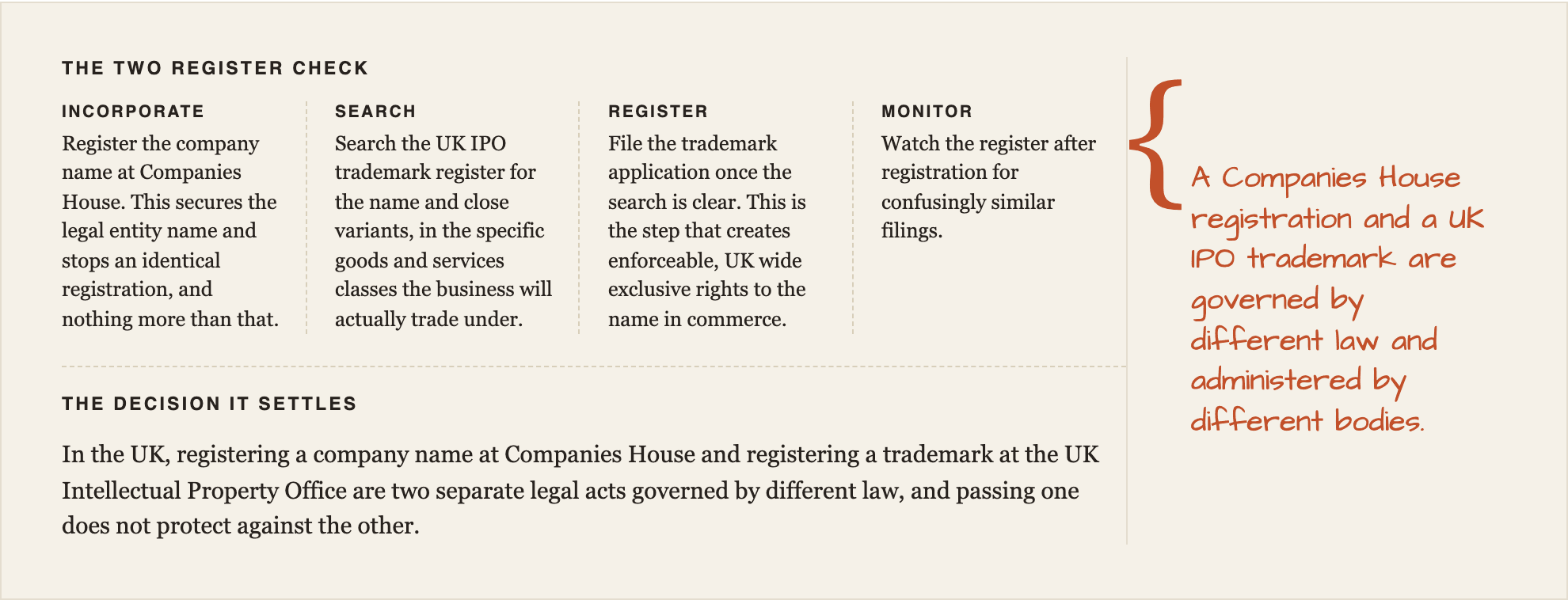
That is a registration safeguard rather than a brand right. Approval means a company can be formed under the name. It says nothing about who may trade under the name as a brand, and it creates no right to stop anyone doing so.
The gap is wider in India than founders expect because so many businesses never touch the MCA register. A sole proprietorship or a partnership trades under a name with no incorporation at all, so an MCA search shows only a fraction of the businesses using a given name.
The short version
MCA answers whether a company can be formed under the name. The Trade Marks Registry answers who owns it. Only the second answer stops a competitor.
What a registered trademark adds
A trademark is registered with the Registrar of Trade Marks under the Trade Marks Act, 1999. Registration gives the registered proprietor the exclusive right to use the mark in relation to the goods or services it is registered for, and the right to obtain relief for infringement. Registration runs for ten years and can be renewed for further ten year periods.
The right is tied to classes of goods and services, and the government fee is charged per class. The First Schedule to the Trade Marks Rules, 2017 sets the application fee on Form TM A at ₹4,500 per class for online filing by an individual, a startup or a small enterprise, and ₹9,000 per class for all other applicants. Physical filing costs ₹5,000 and ₹10,000. Renewal on Form TM R is ₹9,000 per class online.
A trademark attorney's fees sit on top of that. For a service business the attorney conversation is mostly about classes and about whether to file the name in a regional script as well as in English, since a mark registered in one script gives no automatic coverage of another.
- Application, online, individual or startup or small enterprise: ₹4,500 per class.
- Application, online, all other applicants: ₹9,000 per class.
- Physical filing: ₹5,000 and ₹10,000 respectively.
- Renewal, online: ₹9,000 per class.
- Term: ten years, renewable. Figures from the First Schedule as published by IP India, checked October 2026.
Where the registers collide
The MCA naming rules do consider registered trademarks, which is a better position than some countries offer. The rules still leave two gaps. A name can clear the MCA check and sit close to a mark that is applied for but unregistered, or to a mark in a different spelling or script. And a business trading under a name as a proprietorship holds no MCA registration for the MCA to check against.
The reverse case is the quiet one. A clinic or firm trades for years under a name it never registered as a trademark. A competitor files for it. The first business is now arguing prior use against a registration certificate, at its own cost, and the Act's protection for prior users is a defence to be proved rather than a right to be shown.
Everything built on the name is what the mistake costs: the signage, the website, the reviews, the recognition. That is why the search belongs before the logo.
Names that are hard to register
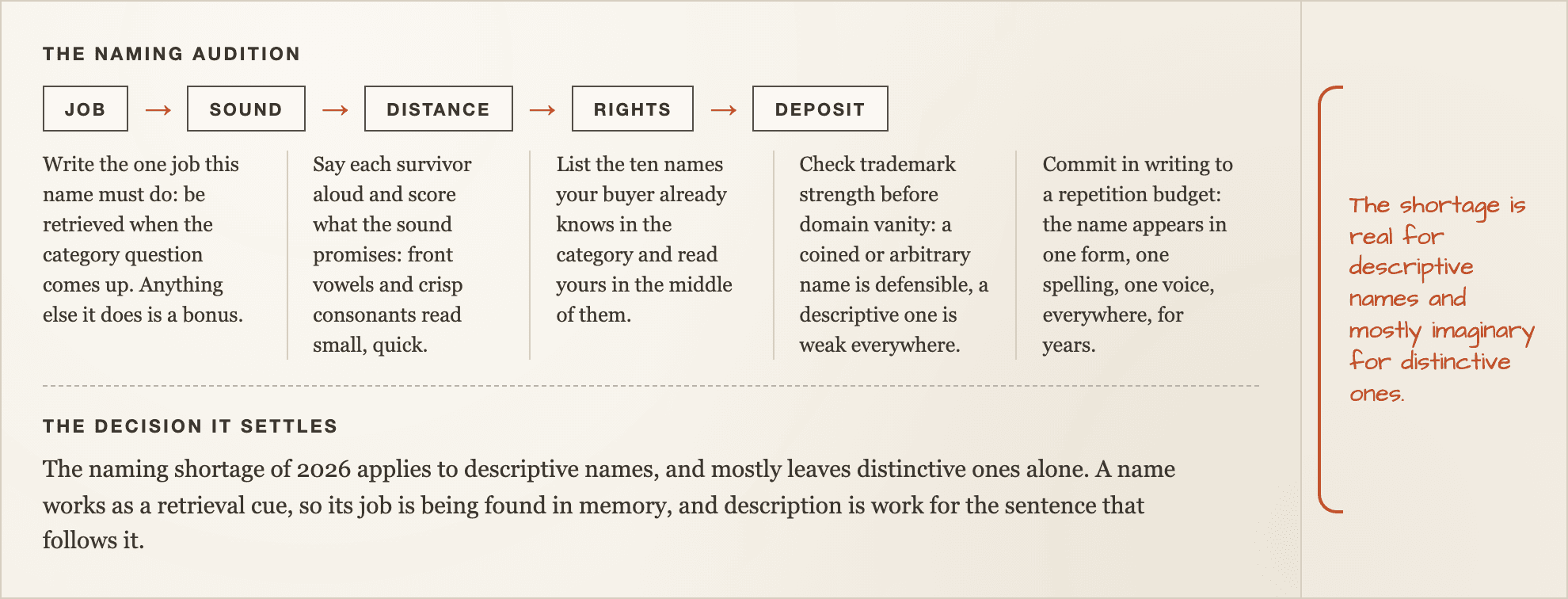
A trademark has to distinguish your goods or services. Names that describe them, such as Delhi Dental Care or Reliable Accounting Services, are the hardest to register because other traders need those words, and they are the hardest to remember for the same reason. The legal test and the brand test point the same way.
A coined word, an unexpected pairing or a founder's name with a distinctive device tends to clear more easily and to be recalled more easily. Naming is a positioning decision first: the name that is yours to own is usually the one that says something only you would say.
The order to work in
Shortlist three names before anyone designs a logo. Run each one through the three register check. Drop any name with a close match on the trademark register in your classes, whatever the MCA search says.
File the trademark in the classes you sell in today and the one you expect to enter next, and decide with your attorney whether a regional script filing is worth the second fee. Then incorporate under the name and register the domain.
In that order, the name on the door is one you already know you can keep. Searches, clearance and filing belong with a trademark attorney; the decision about which name is worth owning belongs with you.
Before you use it
Questions that can change the recommendation.
Does registering a company with the MCA protect my brand name?
No. MCA name approval is part of incorporation and reserves the name against other companies and LLPs. It is not a trademark registration and gives no exclusive right to use the name as a brand. For that, register a trademark under the Trade Marks Act, 1999.
How much does trademark registration cost in India in 2026?
The government fee on Form TM A is ₹4,500 per class for online filing by an individual, a startup or a small enterprise, and ₹9,000 per class for all other applicants. Physical filing costs ₹5,000 and ₹10,000. Renewal is ₹9,000 per class online. Attorney fees are separate. Figures from the First Schedule to the Trade Marks Rules, 2017, checked October 2026.
How long does an Indian trademark last?
Ten years, renewable for further ten year periods under the Trade Marks Act, 1999.
Does the MCA check trademarks when approving a name?
The naming rules under the Companies Act allow the MCA to refuse a name that is identical or too similar to a registered trademark. The check leaves gaps: pending applications, different spellings and scripts, and businesses trading as proprietorships with no MCA record. Search the trademark register yourself before relying on MCA approval.
Should I register the name in Hindi or a regional language as well?
A trademark registered in one script gives no automatic coverage of the same name in another. Whether a second filing is worth the fee depends on where and to whom you sell; it is a question for your trademark attorney.
What does brand strategy cost for an Indian business?
At Branding Tatva the Foundation engagement starts at ₹85,000 for Indian projects. Its published scope includes discovery and positioning, audience and purpose definition, a core visual identity, starter brand guidelines and launch messaging direction. Trademark searches, clearance and filing sit outside that scope and belong with a trademark attorney.
Research record
What this guide draws from.
Each source note describes what the reference supports. Platform guidance, research findings and Branding Tatva's practical suggestions have different scopes.
- Forms and official fees: First Schedule to the Trade Marks Rules, 2017
Office of the Controller General of Patents, Designs and Trade Marks (IP India)
TM A application fees by applicant category and filing mode, and TM R renewal fees. Checked October 2026.
- Trade Marks Act, 1999
India Code
Section 25 (ten year term and renewal) and section 28 (rights conferred by registration).
- Companies (Incorporation) Rules, 2014, rule 8
Ministry of Corporate Affairs
The naming rules under which a company name may be refused for conflict with an existing name or a registered trade mark.