Customer testimonials in UK marketing: the evidence, permission and disclosure the CAP Code expects
The direct answer
Under the CAP Code a UK business may use customer testimonials and endorsements, with conditions. It must hold documentary evidence that each testimonial is genuine and keep contact details for the person or organisation who gave it (rule 3.47); it must have permission to use it (rule 3.50), with limited exceptions for accurate quotes from published sources; the testimonial must relate to the product advertised and stay in context (rule 3.48); and any claim inside it must avoid misleading (rule 3.49). A marketer may never pose as a consumer (rule 2.3), and a commercial interest behind a testimonial, such as the speaker being an investor or director, is material information the ad must disclose, as the ASA ruled against Zoe and Huel in 2024. Trust marks, quality marks and claims of approval or membership need the authorisation behind them (rule 3.52). Health professionals and celebrities may never endorse medicines (rule 12.18). Signed and dated statements, emails from verifiable addresses with order history, and payment records have all satisfied the ASA; quotes from unverifiable addresses alone have failed.
Five conclusions
The argument, compressed.
- Genuine means two things: a real person, and words that reflect what they said. Hold evidence for both, plus contact details.
- Permission is required before a testimonial appears, and the ASA has ruled against marketers who could show none.
- A commercial interest behind a testimonial, such as an investor or director speaking as a fan, is material information the ad must disclose.
- Testimonials must relate to the product advertised and stay in context; edited footage and borrowed reviews have failed.
- Trust marks and claims of approval, membership or regulation need the authorisation behind them.
Working framework · 5 decisions
The believable proof check
Five checks for every quote, review and badge on a website or in an ad.
Decision 01 / 05
Evidence
Keep the original: a signed and dated statement, or the email with the customer's order history or payment record attached.
Genuine, and permitted
Rule 3.47 requires documentary evidence that a testimonial or endorsement is genuine, unless it is obviously fictitious, and contact details for whoever gave it. CAP splits genuine into two parts: the quote comes from a real person, and it reflects what they said. Hike Footwear failed in 2024 with no evidence and no contact details for the testimonials in three Facebook ads. Branshaws passed in 2023 with written testimonies, signed, mostly dated, with contact details, and the ASA added that stock images beside genuine testimony were acceptable.
Signed statements are one route. Emails with the customer's address and order history satisfied the ASA (Monark, 2013), as did a combination of email addresses, order numbers and payment system data matching the reviews (Swann, 2020). Emails from unverifiable addresses alone fall short, though a provable company address has been accepted (de Verde, 2013). Rule 3.50 requires permission before a testimonial is featured; marketers who could show none have lost (Easylife, 2020; Conservatory Outlet, 2013), and quoting a published source still needs evidence the quote is accurate.
The short version
Keep the original, keep permission, keep the quote about this product, and say if the speaker has a stake.
Context, and the badges beside the quotes
Rule 3.48 requires testimonials to relate to the product advertised, in context. Simmer cut footage from a rival's Dragons' Den appearance to look as though it had been endorsed (2024). A review of one track was used for a whole album (Atlantic Records, 2011). Testimonial photos showing another company's product suggested the testimonials were other than genuine (Airbrush, 2026). Altering old testimonials to fit a renamed business, or carrying an employee's praise over from a past employer, has also been ruled against.
Rule 3.52 bars trust marks, quality marks and claims of approval, endorsement or authorisation without the authorisation behind them, with the terms met. A rehab referral service used the Care Quality Commission mark while unregistered (2024); several energy firms implied government endorsement with crown logos and GOV.UK wording (2024); a counselling service claimed BACP accreditation it could show no evidence of (2025); and a currency firm implied FCA regulation (2024). Rule 3.53 bars false claims of signing a code of conduct.
- Works: A dated, signed quote about the service on the page, with the customer's consent on file and a note that they are a client of three years.
- Works: "Our investor Jane Smith on why she backed us", with the relationship in the headline.
- Fails: A founder's friend quoted as a customer with no record of a purchase.
- Fails: A regulator's logo in the footer of a business it has never approved.
Proof as positioning
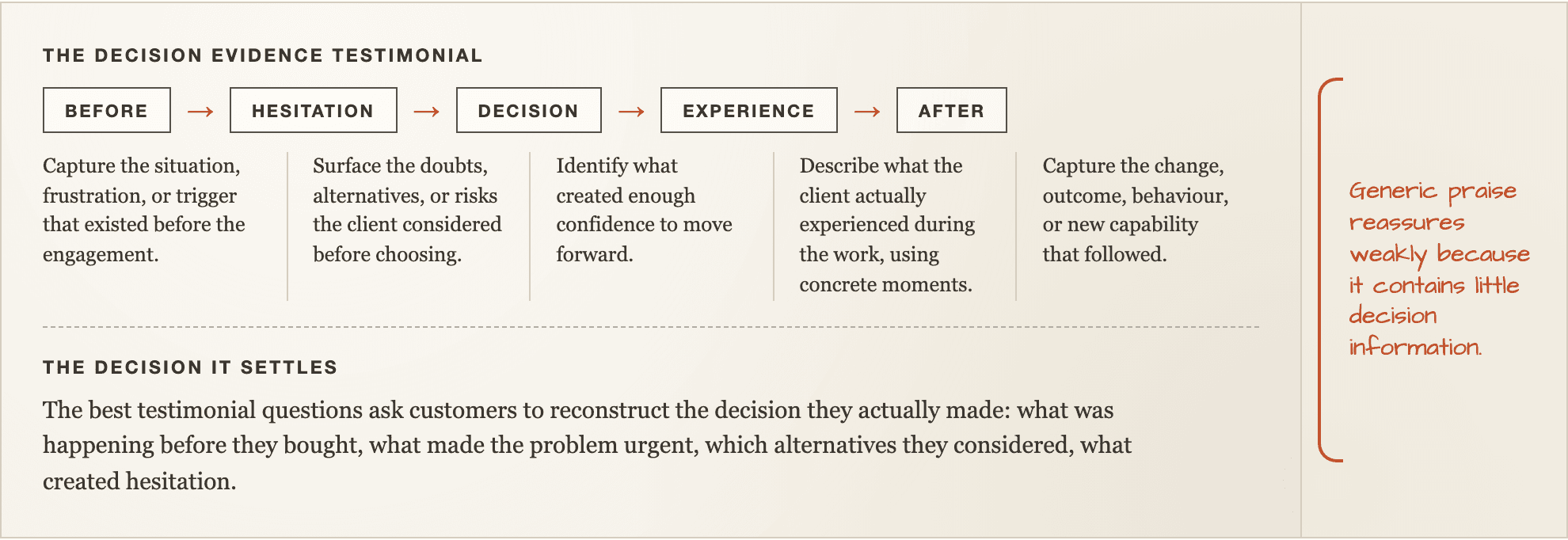
The rules describe the minimum, and the minimum also happens to be what a careful buyer wants: a named person, a real situation, a result that matches the service on the page. A testimonial that says which client the business suits does more positioning work than ten that say the team was lovely.
The businesses that struggle with rule 3.47 are usually the ones whose testimonials were never specific enough to need a record. Specific praise comes with its own evidence attached.
Before you use it
Questions that can change the recommendation.
What evidence do I need to use a customer testimonial in the UK?
Documentary evidence that it is genuine and contact details for the person who gave it, under CAP Code rule 3.47. A signed and dated statement works, as does the original email with the customer's order history or payment record. Quotes from unverifiable addresses alone have been ruled insufficient.
Do I need permission to publish a testimonial?
Yes. Rule 3.50 requires permission before a testimonial is featured, and the ASA has ruled against marketers who could show none. Accurate quotes from published sources have limited exceptions, but still need evidence the quote is genuine and accurate.
Does an investor or director have to be identified when quoted?
Yes. In 2024 the ASA ruled against Zoe and Huel because quotes from Steven Bartlett read as customer testimonials while his roles as investor and director were material information the ads left out.
Can I show a regulator's or association's logo on my site?
Only with the authorisation behind it and its terms met. Rule 3.52 bars trust marks, quality marks and claims of approval or membership without authorisation, and the ASA has ruled against misuse of CQC, government, BACP and FCA references.
What does brand strategy cost in the UK?
At Branding Tatva the Foundation engagement starts at £1,950 for UK clients. Its published scope includes discovery and positioning, audience definition, a core visual identity, starter brand guidelines and launch messaging direction. Legal review of individual testimonials is outside the scope.
Research record
What this guide draws from.
Each source note describes what the reference supports. Platform guidance, research findings and Branding Tatva's practical suggestions have different scopes.
- Testimonials and endorsements
Committee of Advertising Practice
AdviceOnline updated 21 September 2026. Rules 2.3, 3.47 to 3.53 and 12.18, and the Hike Footwear, Branshaws, Monark, Swann, de Verde, Easylife, Zoe, Huel, Simmer, Airbrush, Action Rehab and Stockport Counselling rulings.