What brand strategy costs in the UK, and what the price rules require
The direct answer
Branding Tatva publishes three starting prices in pounds: a Foundation engagement from £1,950, a Full Brand System from £4,500, and an ongoing Brand Partnership from £1,100 a month. The figures are starting points, and the proposal confirms the fee once scope is settled. The United Kingdom regulates how a price is stated rather than whether one may be published. The advertising codes require quoted prices to include non optional taxes and charges, forbid misleading by omission, undue emphasis or distortion, require instalments to sit beside the total price, and treat a "from" claim as one that must not exaggerate the availability of the cheaper option. A published starting price is therefore a statement with rules attached rather than a lead capture device.
Five conclusions
The argument, compressed.
- A Foundation engagement starts at £1,950, a Full Brand System at £4,500, and a Brand Partnership at £1,100 a month, all in pounds.
- The advertising codes require a quoted price to include non optional taxes and charges rather than leaving them to be discovered later.
- Price statements may mislead through omission, undue emphasis or distortion, so a headline figure with the conditions hidden elsewhere breaks the rule.
- A from claim has to be genuinely available rather than a route to a more expensive conversation.
- Scope decides the final fee, and the practice states what moves it rather than implying every project costs the same.
Working framework · 4 decisions
What decides a UK quote
Four inputs move the fee, and everything else is packaging.
Decision 01 / 04
Which professional body sits over the claims
A regulated practitioner carries an advertising code on top of the general rules, so the messaging framework has to be written inside those limits from the start.
The three tiers
A Foundation engagement begins at £1,950 and settles the decisions the rest depends on: who the work is for, what it is chosen over, and the single idea the identity and the language carry.
A Full Brand System begins at £4,500 and adds the build, including the visual identity in use and a messaging framework with written examples.
A Brand Partnership begins at £1,100 a month and keeps the system current, which matters most where the offer or the rules around it move within the year.
What the price rules require
The United Kingdom starts from the proposition that a price statement is a claim, and a claim is judged on the impression it creates rather than on the intention behind it. The advertising codes set out what that means in practice for a service that quotes figures.
A quoted price has to include non optional taxes, duties, fees and charges that apply to all or most buyers, so a figure that grows once VAT or a mandatory fee appears is the wrong figure to lead with. A price statement may mislead through omission, undue emphasis or distortion, and it has to relate to the service actually depicted rather than to a different one. Where instalments are quoted, the total price and the instalment frequency have to appear as prominently as the instalment itself.
The rule that matters most for a starting price is the one about availability. A from claim has to be a genuine entry point rather than a signpost to a more expensive conversation, and the codes say directly that such claims may not exaggerate the availability or the amount of benefit a buyer is likely to obtain. Publishing a low figure that no real engagement ever matches is the pattern the rule is aimed at.
The reader test
Read the published figure as a buyer would, with nothing else on the page. If the conditions that raise it would change their decision, those conditions belong beside the number.
What sits outside the fee
Three things sit outside the brand work. Trade mark clearance and filing belong to a chartered trade mark attorney. Regulatory or professional body approval of a claim belongs to the regulator or the body. Website build and media production are separate engagements with separate budgets.
Stating the boundary is part of pricing honestly, because it stops the fee absorbing work it was never sized for and tells the client what to budget alongside the engagement.
Comparing two proposals
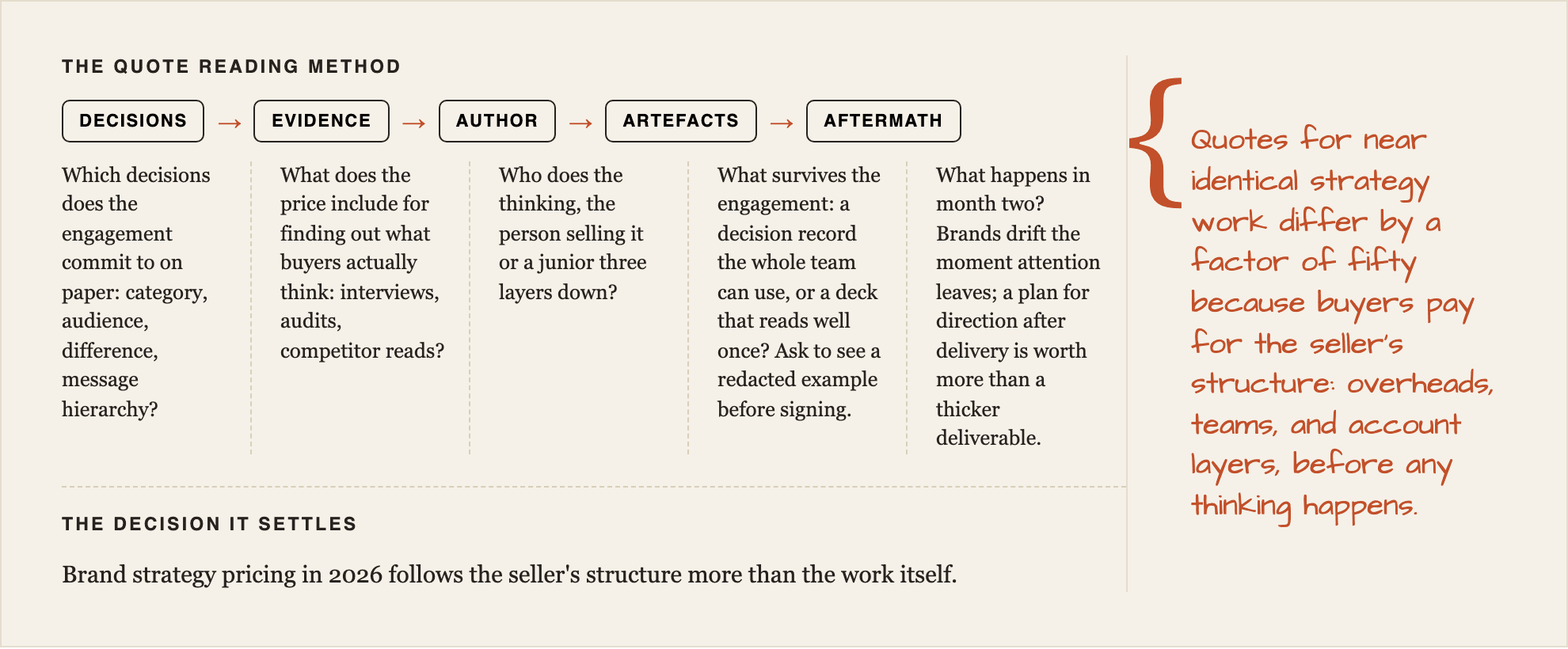
Two United Kingdom proposals at the same headline figure are rarely the same job. Compare what each delivers at the end and who does the work, because a fee that pays for a senior name and delivers a junior one is the most common gap in this market.
Then compare what each assumes the client supplies. The lowest proposal often carries the largest hidden cost, and it arrives in the hours a team spends turning a deliverable into something it can actually use.
Before you use it
Questions that can change the recommendation.
How much does brand strategy cost in the UK?
Branding Tatva publishes three starting prices in pounds: a Foundation engagement from £1,950, a Full Brand System from £4,500, and an ongoing Brand Partnership from £1,100 a month. Scope decides the final fee, confirmed in the proposal.
Do the quoted prices include VAT?
The advertising codes require a quoted price to include non optional taxes, duties, fees and charges that apply to all or most buyers, so a figure that grows once tax appears is the wrong figure to lead with. The proposal states the position that applies to the client.
What does the code say about a from price?
That it may not mislead by exaggerating the availability or the amount of benefit a buyer is likely to obtain. A from figure has to be a genuine entry point rather than a route to a more expensive conversation.
Does the fee cover trade mark clearance or regulatory approval?
No. Trade mark clearance and filing belong to a chartered trade mark attorney, and approval of a claim belongs to the regulator or professional body. The fee covers the brand work, and the boundary is stated in the proposal.
Research record
What this guide draws from.
Each source note describes what the reference supports. Platform guidance, research findings and Branding Tatva's practical suggestions have different scopes.
- Section 3, misleading advertising
Advertising Standards Authority and Committee of Advertising Practice, broadcast code
Rules 3.3.3 on the total price, 3.18 on misleading by omission, undue emphasis or distortion, 3.19 on non optional taxes, 3.21 on instalments, and 3.24 on from claims. The section also records that the ASA takes Chapter 1 of Part 4 of the Digital Markets, Competition and Consumers Act 2024 into account. Read on 8 October 2026.