Trading name or company name: what a UK business may call itself, and what it must display
The direct answer
In the UK a limited company has one registered name at Companies House, which must usually end in Limited or Ltd, cannot be the same as an existing company name, cannot be offensive, and cannot contain a sensitive word or imply a connection with government without permission. It may trade under a different business name, often called a trading name, and GOV.UK's rules for that name are short: it must leave out Limited, Ltd, LLP, plc and their long forms, and it too needs permission for sensitive words. A trading name is registered nowhere and gives no exclusive right; if it is too similar to another company's name or trade mark, a complaint can force a change. Whatever name a business trades under, it must show its company name on all documents, publicity and letters, and on business letters, order forms and websites it must also show the registered number, the registered office address, the part of the UK where it is registered, and the fact that it is a limited company. A sign showing the company name must be displayed at the registered office and wherever the business operates, except a home.
Five conclusions
The argument, compressed.
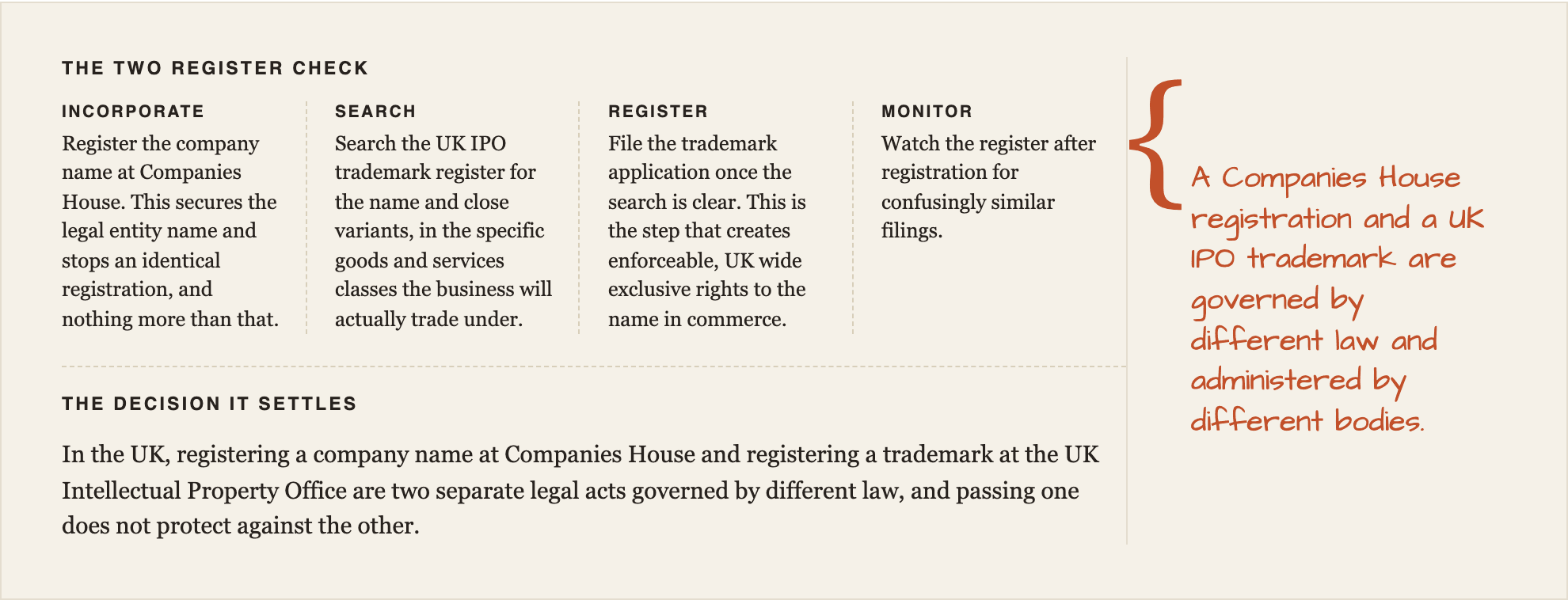
- A registered company name is protected only against identical or same as registrations at Companies House. Trade mark rights are separate.
- A trading name is free to adopt, must leave out Limited, Ltd, LLP and plc, and gives no exclusive right at all.
- Sensitive words and anything implying a government connection need permission in both kinds of name.
- Business letters, order forms and websites must show the registered name, number, office address, country of registration and limited status.
- A company name sign is required at the registered office and every place of business except a home.
Working framework · 5 decisions
The two name check
Five checks before a brand name goes on the sign, the site and the stationery.
Decision 01 / 05
Register
Search the Companies House register for same as and too like names before settling on either name.
Two names, two jobs
The registered name is the company's legal identity. GOV.UK sets the rules: it cannot be the same as another registered company's name, it must usually end in Limited or Ltd (or the Welsh Cyfyngedig or Cyf for a company registered in Wales), it cannot be offensive, and it cannot contain a sensitive word or expression, or suggest a connection with government or local authorities, without permission.
Same as covers more than exact matches. Names that differ only by certain punctuation, special characters, a word similar in appearance or meaning, or a word commonly used in UK company names count as the same: GOV.UK's example is that Hands UK Ltd and Hand's Ltd are the same as Hands Ltd. A too like name can be challenged after registration, and Companies House will say what to do if it agrees with a complaint.
A trading name, which GOV.UK calls a business name, is the name the public sees. The rules are brief: it must leave out Limited, Ltd, limited liability partnership, LLP, public limited company and plc, and it needs permission for sensitive words. It is registered nowhere.
The short version
The registered name is protected against copies on one register. The trading name is protected by nothing but a trade mark you file separately.
What neither name protects
Both GOV.UK pages carry the same warning: if a name is too similar to another company's name or trade mark, you may have to change it if someone complains. Registering a company name gives no exclusive right to use it in trade, and a trading name gives none at all.
That is why the brand decision and the legal decision come apart. The name a business wants to be known by needs a trade mark search and, usually, an application, whichever way the company is registered.
What every company website and letter must display
Trading under another name changes nothing here. GOV.UK requires the company's name on all company documents, publicity and letters. Business letters, order forms and websites must also show the registered number, the registered office address, where the company is registered (England and Wales, Scotland or Northern Ireland), and the fact that it is a limited company, usually by spelling out the full name including Limited or Ltd.
If directors' names are included, all of them must be listed. If share capital is shown, the amount paid up must be stated. Invoices follow their own rules.
A sign showing the company name must be displayed at the registered office address and wherever the business operates, legible at any time rather than only when open. A business run from home is exempt from the sign at home.
- Footer line that works: "Brightwater Studio is a trading name of Brightwater Design Limited, registered in England and Wales, company number 01234567, registered office 1 Example Street, Leeds LS1 1AA."
- Missing most often: the country of registration and the registered office address.
The brand view
A trading name is where the brand lives, so choose it for memory and distinctiveness, then protect it with a trade mark. The registered name can stay plain; nobody chooses a plumber for the Limited company behind the van.
The disclosure line belongs in the footer of every page and the foot of every letter, written once and never varied. It costs nothing, meets the rule, and tells a cautious customer that a real company stands behind the name.
Before you use it
Questions that can change the recommendation.
Can a UK company trade under a different name?
Yes. A limited company may trade under a business name different from its registered name, provided the trading name leaves out Limited, Ltd, LLP, plc and their long forms and contains no sensitive words without permission. The company's registered details must still appear on documents, letters and the website.
Does registering a company name protect it?
Only against identical or same as registrations at Companies House. It gives no exclusive right to use the name in trade, and a trade mark owner can still complain. Protection in trade comes from a registered trade mark.
What must a UK limited company show on its website?
The company's registered name, its registered number, its registered office address, where it is registered (England and Wales, Scotland or Northern Ireland), and the fact that it is a limited company. The same applies to business letters and order forms.
Do I need a sign with my company name?
Yes, at the registered office and at every place where the business operates, legible at any time. A business run from home is exempt from the sign at the home.
What does brand strategy cost in the UK?
At Branding Tatva the Foundation engagement starts at £1,950 for UK clients. Its published scope includes discovery and positioning, audience definition, a core visual identity, starter brand guidelines and launch messaging direction. Trade mark searches and filing are outside the scope and belong with a trade mark attorney.
Research record
What this guide draws from.
Each source note describes what the reference supports. Platform guidance, research findings and Branding Tatva's practical suggestions have different scopes.
- Set up a private limited company: choose a company name
GOV.UK
Same as and too like names, sensitive words, and the rules for trading names.
- Running a limited company: signs, stationery and promotional material
GOV.UK
The sign requirement and what business letters, order forms and websites must show.