How to market a therapy practice in Ontario when testimonials are off the table
The direct answer
Under CRPO Standard 6.2, registered psychotherapists in Ontario may only advertise in ways that are truthful, accurate, factual and verifiable. The standard rules out requesting, soliciting or using testimonials, comparisons with other practitioners, superlatives such as "best" or "leading", promises of results that cannot be delivered, and appeals to fear, and it applies to the practice name, website and social media as well as paid ads. A practice still has plenty to work with: a precise statement of who it helps, practitioner training a client can check, a visible process and fee, and the same description on every directory and profile. That combination builds trust through evidence, which is exactly what the College asks for.
Five conclusions
The argument, compressed.
- CRPO Standard 6.2 covers every public message meant to influence a client's choice, including the practice name, the website, directory profiles and social media.
- Testimonials are ruled out completely: requesting them, soliciting them, and using them. Client consent changes nothing.
- Superlatives, comparisons, claims of uniqueness, promises of results that cannot be delivered and appeals to fear are ruled out. Review each statement against the actual standard.
- Standard 6.2.6 makes the registrant responsible for advertising other people produce, so a marketer or brand consultant has to work inside the standard too.
- Specificity is the compliant substitute for social proof. A precise description of who you help, backed by training a client can verify, persuades more than a reassuring adjective ever did.
Working framework · 5 decisions
The verifiable trust check
Five checks for any page, profile or post a practice publishes. Each one replaces a banned shortcut with evidence a client can confirm for themselves.
Decision 01 / 05
Specific
Name the client situation you serve best in one sentence. "Therapy for nurses after night shifts" replaces "compassionate care", and it needs no superlative to work.
What Standard 6.2 covers, in plain terms
CRPO defines advertising broadly: any message in public media intended to influence a person's choice of practitioner. That includes the business name itself, the practice website, paid and in kind promotions, directory listings and social media. If a prospective client can read it while deciding, the standard applies to it.
The rules inside it are short. Advertising has to be truthful, accurate, factual and verifiable (6.2.1). Registrants do without testimonials entirely, and the standard words this as never requesting, soliciting or using them (6.2.2). Promises of results that cannot be delivered, comparisons, superlatives, claims of uniqueness and appeals to fear are ruled out (6.2.4). Paid ads must be recognisable as ads (6.2.5). An area of practice can only be advertised with verifiable training behind it (6.2.7). And advertising has to make clear whether it concerns psychotherapy or some other service the practice sells (6.2.8).
This guide covers registered psychotherapists under CRPO. Psychologists in Ontario answer to the College of Psychologists and Behaviour Analysts, and social workers to their own college, so a mixed group practice should check each profession's rules for the clinicians it lists.
The short version
If a sentence asks the reader to trust you because of someone else's praise, a comparison or a superlative, it belongs outside an Ontario psychotherapy practice's marketing.
Why most therapy marketing advice fails in Ontario
Generic advice for therapists is written for markets with looser rules. Collect reviews, feature client stories, call yourself the leading trauma specialist in the city, run ads that name the fear a client is carrying. In Ontario each of those moves runs straight into Standard 6.2.
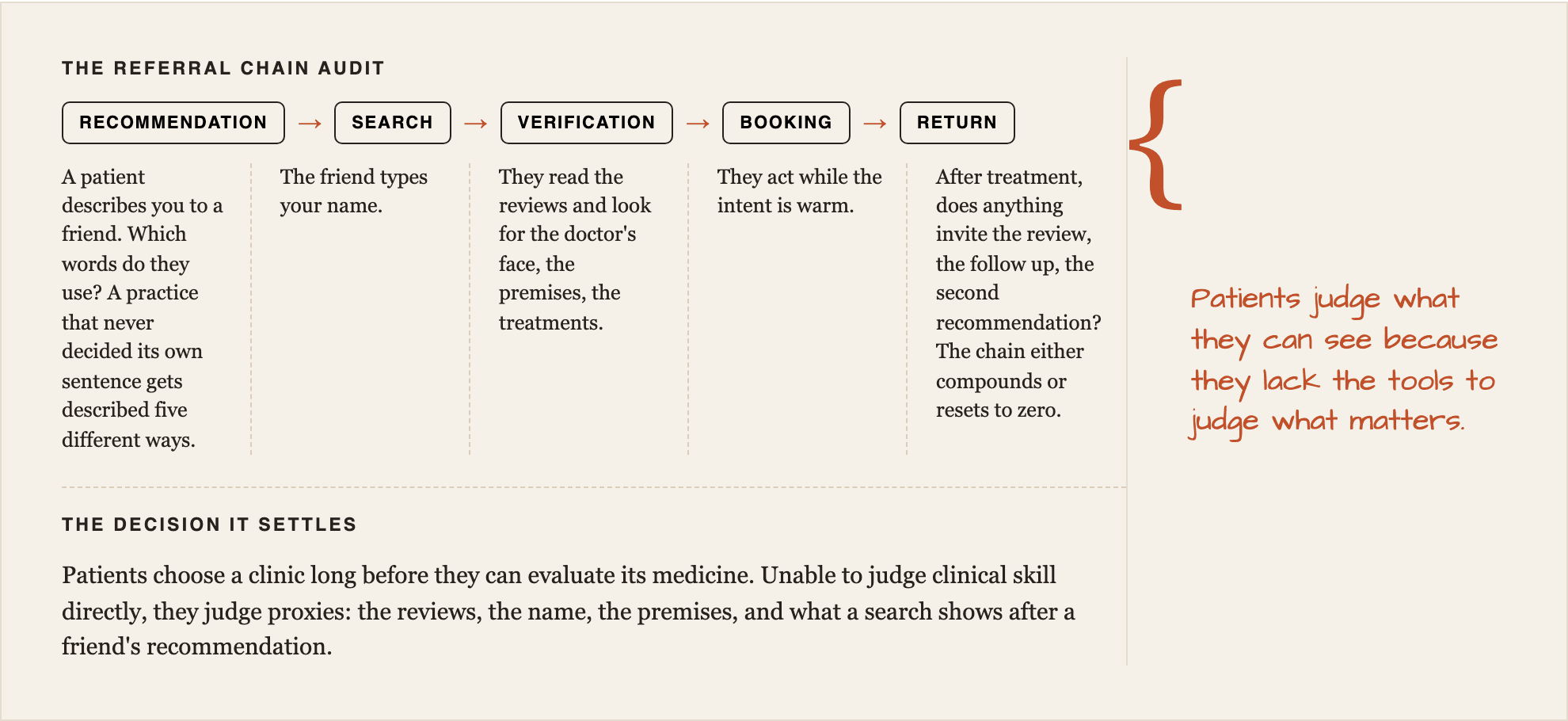
The quieter problem is what practices fall back on once the shortcuts are gone: a stack of safe adjectives. Compassionate, client centred, inclusive, evidence based. Every one of those words is permitted, and every practice in Toronto, Ottawa and Hamilton already uses them. A referred client who looks you up reads the same four words on five sites and has nothing left to choose with.
So the real constraint is positioning. A practice that can say precisely who it serves and why its clinicians are trained for that work has very little need for a testimonial. A practice without that sentence is left with no message once the testimonials go.
Reviews, practice names and the people you hire
Reviews are the area practices ask about most. The standard rules out requesting, soliciting or using testimonials, and it counts reviews as a form of testimonial. A client may still post a Google review on their own; asking for it, embedding it on your site or sharing it on your social accounts turns it into your advertising. Reading the current standard, and asking the College when a case feels unclear, is the safe habit.
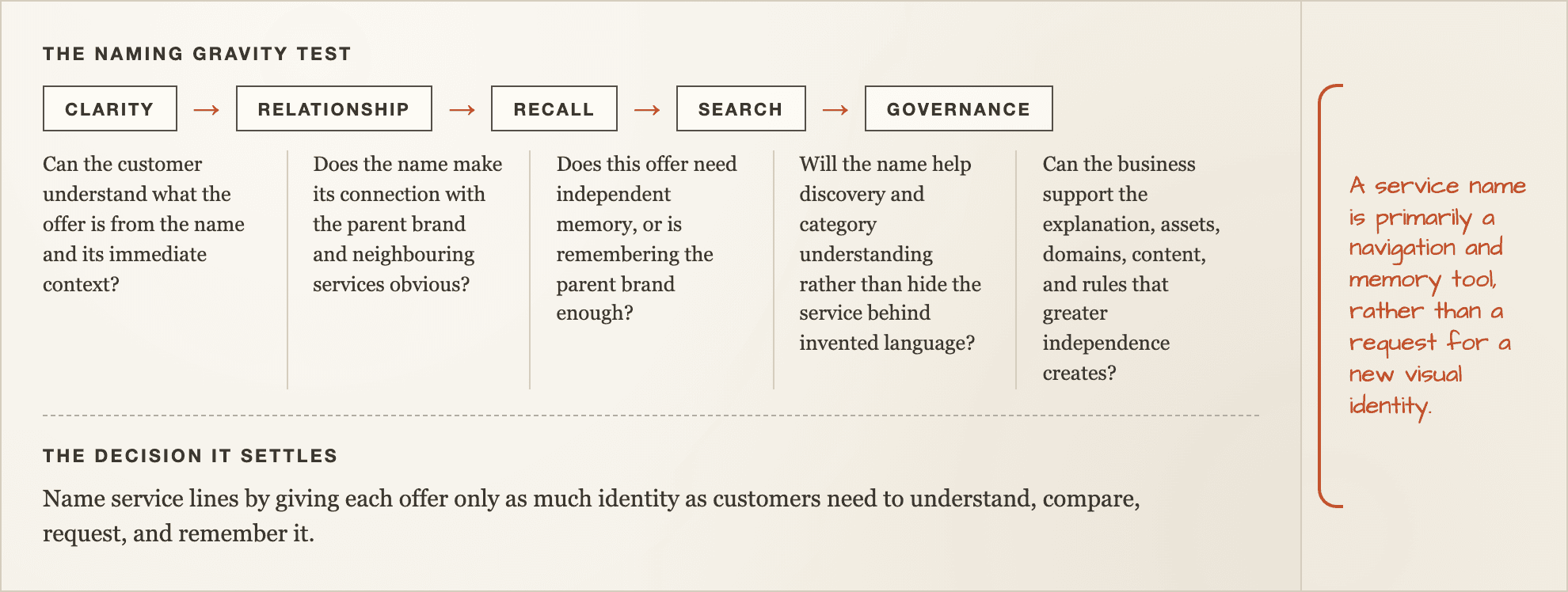
The practice name sits inside the standard too, because CRPO lists business names as advertising. A name built on a superlative or an outcome the practice cannot deliver needs review against the standard. A place, person or idea is not an automatic safe harbour: the full name must still be truthful, verifiable and compliant with Ontario business naming law. CRPO's naming guidance explains the registrant's identification requirements.
Standard 6.2.6 matters most for any practice that pays for marketing. Registrants must take reasonable steps to make sure advertising produced by others, including employers and consultants, meets the College's requirements. Any agency or brand consultant who proposes testimonial carousels or "Ontario's best" headlines is offering you their risk. Give them the standard before they write anything.
Where to start this month
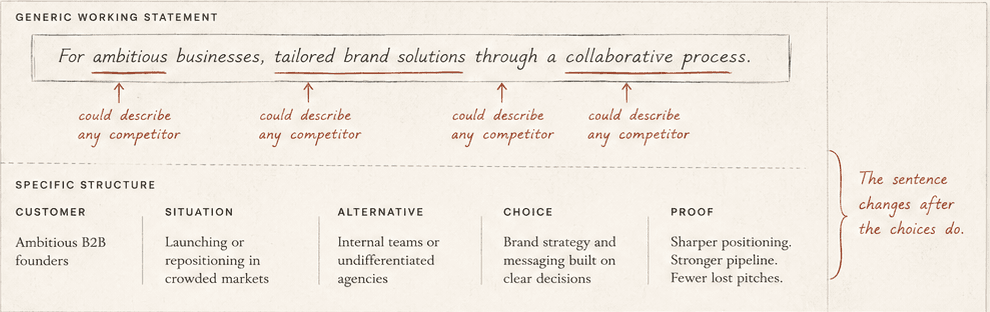
Start with an audit. Open the homepage, every clinician bio and the three directory profiles that send the most enquiries. Mark every superlative, comparison, promise that cannot be delivered, testimonial and fear appeal. Then mark every sentence that could appear unchanged on a competitor's site. The first list is the compliance work; the second is the positioning work, and it usually turns out to be longer.
Then write the one sentence: who the practice helps best and what changes for them. Put it where the first sentence on the homepage is now and echo it on every profile. Most practices find that once this sentence exists, the rest of the site gets easier to write and easier to keep inside the standard.
Before you use it
Questions that can change the recommendation.
Can a registered psychotherapist in Ontario use client testimonials?
Under CRPO Standard 6.2.2, registrants do without testimonials altogether: they never request, solicit or use them in advertising. Client consent makes no difference to that rule, and the standard's definitions treat reviews and ratings as a form of testimonial.
Can I ask clients to leave a Google review?
Asking for a review counts as soliciting a testimonial, which Standard 6.2.2 rules out. A client who posts one independently has made their own choice, yet embedding or sharing that review in your marketing would amount to using it. Check the current standard and contact CRPO when a situation is unclear.
Can I call myself a specialist or the best therapist in my city?
Superlatives and comparisons are ruled out by Standard 6.2.4, so "best" and "leading" are off the page. You can advertise an area of practice when you hold verifiable training in it, under Standard 6.2.7, and naming that training is more persuasive anyway.
Does Standard 6.2 apply to my website and social media, or only to paid ads?
It applies to all of them. CRPO defines advertising as messages in public media intended to influence a person's choice, and it names business names, websites and social media alongside paid promotion.
What does brand strategy cost for a therapy practice in Canada?
At Branding Tatva the Foundation engagement starts at CA$3,200. Its published scope includes discovery and positioning, audience and purpose definition, a core visual identity, starter brand guidelines and launch messaging direction. Any clinician bio system or review of directory copy must be agreed in the written proposal; regulatory approval is not included. The registrant remains responsible for advertising, and CRPO should resolve uncertain interpretations.
Research record
What this guide draws from.
Each source note describes what the reference supports. Platform guidance, research findings and Branding Tatva's practical suggestions have different scopes.
- Standard 6.2: Advertising
College of Registered Psychotherapists of Ontario
The full advertising standard, including definitions of advertising, testimonial, review and superlative.
- Naming Your Practice & Professional Corporation Information
College of Registered Psychotherapists of Ontario
Practice names must meet Standard 6.2 and Ontario law; registrants must also identify themselves as required by the College.