How to position a consulting business without narrowing it too far
The direct answer
To position a consulting business, choose a specific customer situation, a clear category frame, a recognisable point of view, and proof that supports the way you solve the problem. Narrow the reason clients choose you rather than reducing every future engagement to one rigid deliverable.
Five conclusions
The argument, compressed.
- A consulting position should narrow the buying reason before it narrows every possible scope of work.
- Customer situation is often more useful than industry alone when defining a consulting niche.
- A strong point of view explains why your method produces a different decision or experience.
- Proof should demonstrate judgement, diagnosis, and consequence rather than listing credentials alone.
- The position should guide the website, offer architecture, content, referrals, and sales conversations.
Working framework · 5 decisions
The consulting position compass
Five decisions create enough precision for the market to understand the consultancy while preserving room for the work to respond to real client needs.
Decision 01 / 05
Situation
Define the moment, tension, or transition that makes the client ready to seek help.
What consulting positioning means
Consulting positioning is the set of choices that helps a buyer understand when to think of the consultancy, what category to place it in, why its judgement differs, and which evidence makes the claim credible.
The work is harder for consultants because the service often changes shape around the client. One engagement may involve diagnosis, another strategy, another facilitation, and another implementation support. A position therefore needs to create clarity without pretending every assignment is identical.
The strongest position usually defines a stable buying reason and point of view while allowing the exact scope to adapt.
Positioning rule
Narrow the reason a client chooses you before narrowing every way you are allowed to help them.
Why consultants resist positioning
Consultants often fear that specificity will exclude valuable work. That fear grows when past engagements arrived through referrals and each one looked different on the surface.
Breadth can feel commercially safer inside the business because it preserves optionality. Outside the business, the same breadth transfers the sorting work to the buyer. A prospect has to decide which of many capabilities applies, how they connect, and why this consultant should be remembered.
Positioning does create a tradeoff. The useful tradeoff is between being generally capable and being specifically retrievable in a relevant situation.
1. Choose the customer situation
Industry is one way to narrow a consultancy, but it is only one of several. A customer situation can create sharper relevance across several industries.
A consultancy may become relevant when a founder led business is preparing to scale, when a professional services firm has outgrown referral only growth, when a new leadership team needs alignment, or when several offers have accumulated without a clear market story.
The situation should be observable and commercially meaningful. It needs to describe a moment when the cost of remaining unchanged becomes visible enough to support a buying decision.
- What usually happens shortly before a client contacts you?
- Which problem creates urgency rather than mild interest?
- What has the client already tried?
- Which internal transition makes outside judgement valuable?
- Which situations repeatedly produce your strongest work?
2. Choose the category frame
The category frame helps the buyer compare the consultancy with something familiar. Strategy consultant, brand consultant, organisational adviser, fractional executive, and specialist studio create different expectations even when parts of the work overlap.
Choose a frame that makes the core value easy to understand and matches the way buyers budget, search, and evaluate alternatives. An invented label can feel distinctive while creating explanation debt.
The category can stay familiar while the position inside it becomes specific. Clarity rarely requires creating a category no buyer already understands.
3. Build a point of view with consequence
A consulting point of view explains why you diagnose the problem differently or make a different first move. It turns experience into a choice rather than a collection of opinions.
A useful point of view changes the engagement. You may believe that messaging problems begin in positioning, that operating friction should be mapped before technology changes, or that leadership alignment must precede a new growth plan.
Connect the belief with a customer consequence. The point of view becomes valuable when the buyer can see how it reduces risk, improves clarity, or changes the quality of the decision.
Difference test
If removing the point of view leaves the process unchanged, it is probably a content theme rather than a true positioning choice.
4. Prove judgement rather than competence alone
Consulting buyers are purchasing judgement under uncertainty. Credentials and experience can establish baseline competence, while stronger proof shows how the consultant thinks and what that thinking changes.
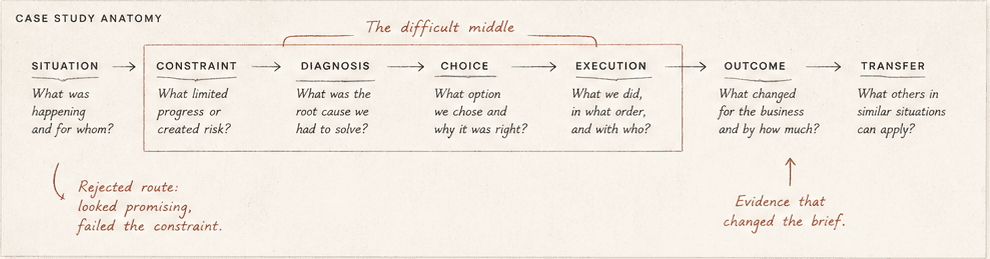
Case studies should reveal the initial assumption, the diagnostic finding, the decision made, and the consequence. Process notes can show how ambiguity becomes a sequence. Frameworks can demonstrate the distinctions used during the work.
The proof should match the position. A consultancy positioned around complex transitions needs evidence of navigating transitions rather than a general collection of polished deliverables.
- Show the question behind the assignment.
- Explain what the client originally believed.
- Reveal the diagnosis or reframing.
- Name the decision that followed.
- Describe the result with enough context to remain credible.
5. Design expansion logic
A focused position can support several services when those services solve different stages of the same customer situation. Diagnosis, strategy, facilitation, implementation support, and advisory retainers can all belong to one position if their relationship is clear.
Create one leading offer that makes the position concrete. Then organise adjacent services by what becomes necessary before, during, or after that engagement.
Expansion should feel like depth around a central problem rather than a return to an unstructured capability list.
Write the consulting position in plain language
Begin with an internal statement containing the customer situation, category, point of view, consequence, and proof. Keep it useful for decisions before trying to make it elegant.
One working structure is: We help this kind of client during this situation by providing this category of help. Unlike common alternatives, we begin with or believe this, because it changes this important outcome.
The customer facing version can become shorter. The internal version should remain detailed enough to guide offers, website hierarchy, case study selection, and content.
Apply the position across the consultancy
On the homepage, lead with the situation and category before introducing every service. On service pages, show how each offer contributes to the central movement. In case studies, select examples that reinforce the same buying reason.
Content should repeatedly illuminate the situation, point of view, and decisions the consultancy wants to own. Referral language should give partners a simple trigger for recognising the right opportunity.
Sales conversations should test fit against the position rather than treating every enquiry as equally suitable.
Common consulting positioning errors
The first error is defining the niche only by industry even when the strongest pattern sits in a business transition or customer situation.
The second is listing a broad audience followed by an even broader capability set. The combination creates reach in theory and weak recognition in practice.
The third is using a provocative point of view that has no effect on the method. The language sounds differentiated while the experience remains conventional.
The fourth is hiding breadth instead of organising it. Clients may still need several capabilities. The position should explain why they belong together.
The fifth is changing the position after a few weeks because some enquiries fail to match immediately. Recognition needs repetition and evidence before it becomes dependable.
Before you use it
Questions that can change the recommendation.
Does a consultant need to choose one industry?
No. A consultant can position around a recurring customer situation, business transition, type of decision, or specialist problem that appears across several industries.
Will positioning reduce consulting opportunities?
A position can make some opportunities less central, but it also makes the consultancy easier to understand, remember, refer, and compare. Existing capabilities can remain available when they support the same central problem.
What is the difference between a consulting niche and positioning?
A niche defines where the consultancy concentrates, such as an industry, audience, or problem. Positioning also defines the category, point of view, difference, proof, and meaning the consultancy wants customers to remember.
How specific should consulting positioning be?
It should be specific enough for the right buyer to recognise their situation and understand why the consultancy fits, while broad enough to support the real range of work required to solve that situation.
How often should a consulting position change?
Review it when the audience, offer, market, or business direction changes materially. Refine the language through evidence while giving the central position enough time to build recognition.