What a brand identity package includes, and what the cheap ones leave out
The direct answer
A complete brand identity package has three layers. The decisions layer records the strategy the design must carry: positioning summary, message hierarchy, tone of voice. The system layer is the visible identity: the logo suite with its variations, colour with exact codes, licensed typography, image style, and the rules for each. The application layer proves the system on the surfaces buyers actually meet, from website and proposal templates to social formats, delivered as editable source files with full ownership transferred. A quote missing a layer is selling artefacts, and artefacts drift into inconsistency within a year.
Five conclusions
The argument, compressed.
- One phrase covers a tenfold range of contents. Compare packages by layer, never by price, because the missing layer is where the money leaks.
- The decisions layer comes first: positioning, message hierarchy, and tone are what the design must carry. A package without them buys taste.
- The system layer is rules as much as artefacts: a logo suite, colour codes, licensed type, and image style, each with instructions for use.
- The application layer is where identity survives contact with reality: templates for the surfaces your buyers actually meet, in editable files you own.
- Cheap packages omit quietly: guidelines, font licences, source files, and the message layer. Each omission returns later as an invoice.
Working framework · 5 decisions
The three layer checklist
Read any identity quote against these five checkpoints, in order. A serious studio can point to every line of its proposal and say which layer it serves; a thin package goes silent after the second checkpoint.
Decision 01 / 05
Decisions on paper
A positioning summary, a message hierarchy, and a tone of voice definition, written before any visual work. These pages are what separates aimed design from tasteful guessing, and their absence is the single most reliable marker of a decorative package.
One phrase, a tenfold range of contents
A brand identity package can mean a logo with a colour swatch, and it can mean a governed system that runs every surface a business owns for a decade. Both arrive under the same phrase, quoted anywhere from a few hundred to many tens of thousands, which makes the phrase itself useless for comparison.
The confusion serves the seller. A buyer who compares prices across incomparable contents will usually anchor on the middle quote and assume the contents converge. They diverge wildly, and the divergence is invisible until months later, when the first proposal needs writing and the package turns out to contain adjectives where the message hierarchy should be.
So compare contents, layer by layer, before comparing a single price. The three layers below are the whole anatomy; every legitimate line item in any identity quote belongs to one of them.
The plain version
Compare packages by layer, never by price. The missing layer is the future invoice.
Layer one: the decisions the design must carry
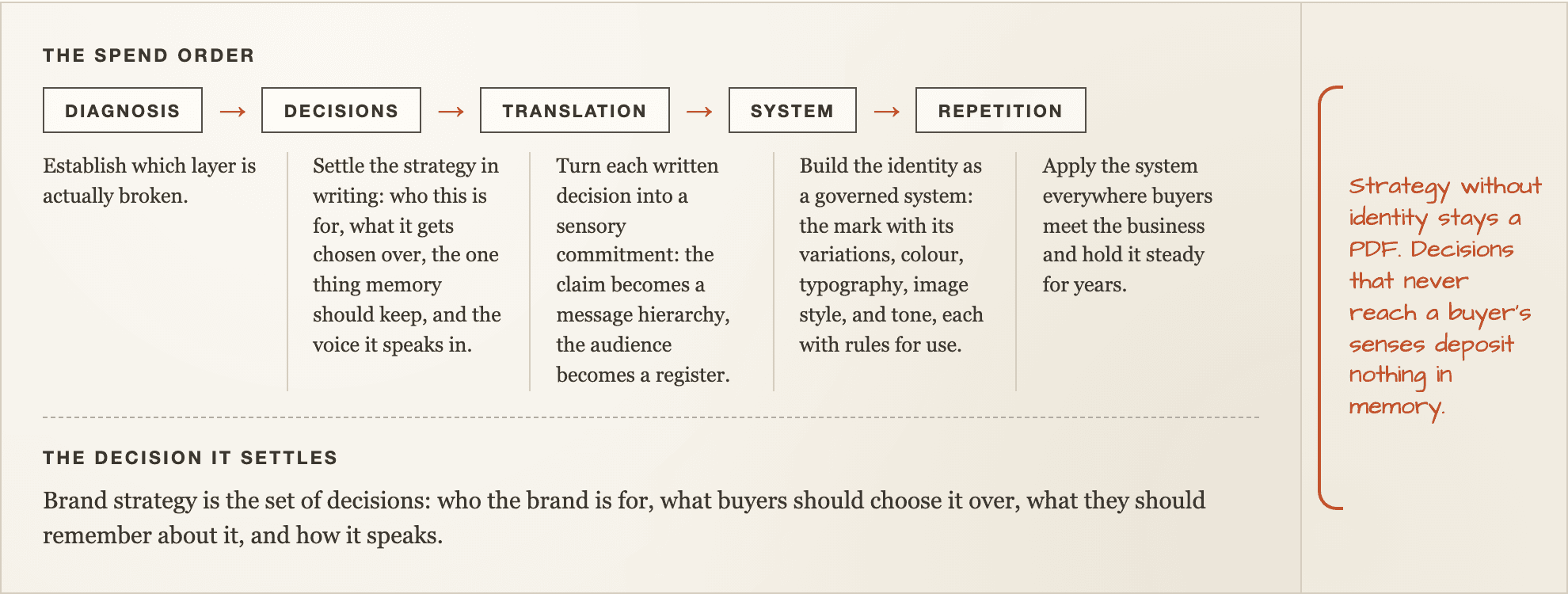
An identity exists to deposit a chosen association in buyer memory, which means someone has to choose the association. The decisions layer records that choice: a one page positioning summary, a message hierarchy ordering what gets said first, second, and rarely, and a tone of voice that keeps three different writers sounding like one author.
Studios skip this layer for an honest reason: it is thinking rather than drawing, and many design shops sell drawing. The result is design aimed at taste, and taste converges across the category until ten competitors share one aesthetic. The strategy vs identity guide in this library makes the full argument; the short version is that unmade decisions get made anyway, by the designer, by accident.
A package can legitimately import this layer rather than produce it, when a strategy document already exists. What a serious package can never do is proceed without it.
Layer two: the visible system and its rules
This is the layer everyone pictures: the logo suite with primary mark, secondary lockups, and an icon version, each with clear space, minimum sizes, and behaviour on light, dark, and photographic backgrounds. Colour specified in exact codes for screen and print. Typography chosen and licensed, with the licence documented, because an unlicensed font on a growing business is a legal letter waiting to be posted.
Around the mark sit the assets that do most of the remembering: the image style, the illustration or iconography language, and the written register. Distinctive asset research is consistent on this point: a brand is recognised by its colour and its way of speaking at distances where no logo resolves, so the surrounding system earns more recognition per rupee, pound, or dollar than another round of logo revisions.
The test of this layer is rules. A folder of beautiful files with no usage instructions decays into inconsistency within a year, one well meant improvisation at a time. Artefacts plus rules is a system; artefacts alone is decoration with a deadline.
- Logo suite: primary, secondary lockups, icon, clear space, minimum sizes, background behaviour
- Colour: exact values for screen and print, with hierarchy and accessibility contrast noted
- Typography: display and body families, licensed, with fallbacks for email and documents
- Image and illustration style, defined with examples of yes and no
- Verbal identity: tone, vocabulary, and the sentences the brand would never say
Layer three: application, where identity meets a buyer
A buyer never meets a style guide. They meet a website, a proposal, a social post, an invoice, an email signature. The application layer proves the system on those exact surfaces and hands over templates, so the identity survives the moment the studio leaves and the Tuesday afternoon someone needs a deck by five.
Which applications belong in the package depends entirely on where your buyers actually encounter you, which is why a fixed application list in a quote deserves a question. A clinic needs signage and appointment materials; a consultancy needs proposals and a deck; a product business needs packaging. Paying for the seller's standard list instead of your buyer's actual surfaces is the most common form of quiet waste in this layer.
Handover completes the layer: editable source files, organised exports in every format a printer or developer will ask for, guidelines a new freelancer could follow unsupervised, and the intellectual property assigned to you in writing on final payment. Every one of those items has a market of businesses discovering, years later, that it was missing.
What the cheap packages leave out
A low quote is rarely dishonest; it simply omits, and the omissions follow a pattern. Knowing the pattern turns any quote into a readable document: whatever is absent from the list below is what the price bought its way out of.
- The decisions layer entirely, so the design aims at taste and the messaging stays unwritten
- Usage rules and guidelines, so consistency depends on memory and goodwill
- Font licences, leaving the business using type it has no right to
- Editable source files, making every future change a fresh invoice to the original studio
- The application templates, so the beautiful system meets reality unassisted
- Written transfer of intellectual property, leaving ownership ambiguous exactly when the business becomes worth arguing over
Reading a quote before signing it
Put any proposal through three questions. Which layer does each line item serve, and is any layer empty? What exactly arrives at handover, named as files and formats rather than outcomes? And what happens when something needs changing in month eight, at whose cost, in whose files?
Sellers comfortable with those questions tend to run complete packages; the selection guide in this library covers the wider vetting. Sellers who answer with adjectives are quoting decoration, and decoration is only cheap until the day it has to work.
The working test
Every line item names its layer, every deliverable names its file format, and every future change names its owner. Anything vaguer is priced to disappoint.
Before you use it
Questions that can change the recommendation.
How much does a brand identity package cost?
The honest range runs from a few hundred for a logo folder to well past fifty thousand at large agencies, and the layers explain the spread. A complete three layer package from an independent studio or strategist typically starts in the low thousands: published starting figures at this practice sit at £1,950 in the UK, $2,800 in the US, and CA$3,200 in Canada. The pricing guide in this library breaks the tiers down; the rule here is simpler, which is to price contents rather than the phrase.
Does a small business really need brand guidelines?
Smaller businesses need them more, because the applying hands change more often: the founder today, a freelancer next quarter, an agency next year. Guidelines are how the identity survives that turnover. They can be short, ten well chosen pages beat a hundred ceremonial ones, but the rules for logo, colour, type, and voice belong in writing from day one.
What file formats should the handover include?
Vector originals of every mark in editable form, plus organised exports: SVG and PDF for print and web, PNG at usable sizes with transparent backgrounds, and favicon formats. Colour values for screen and print, the licensed font files or the licence references, and the source files for every template. The single most expensive omission is editable sources, because it ties every future change to the original studio's calendar and rates.
Can I buy the logo now and the rest of the package later?
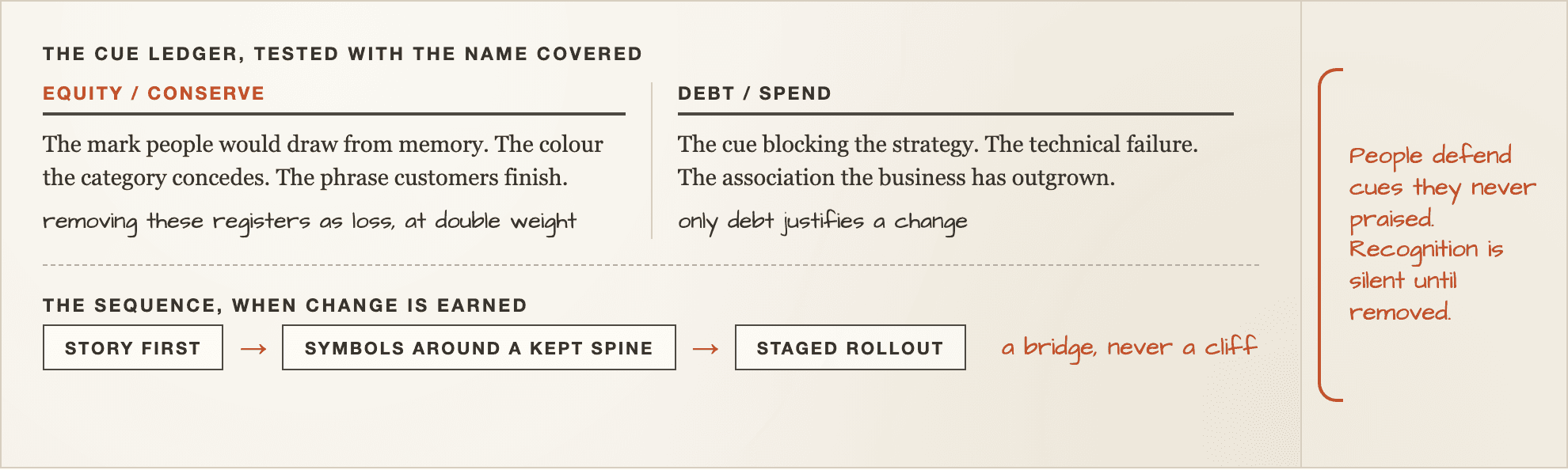
Sequence matters more than scope. Buying the decisions layer first and the design later works well, and staging the application templates by need is ordinary practice. The staging that fails is a logo bought before any decisions exist, because the mark then hardens guesses about positioning into artwork, and the later layers inherit the guesswork at full price.
What questions expose a thin package before I pay?
Ask which strategy inputs the design will follow and where they come from. Ask for the deliverables list as named files and formats. Ask what the usage guidelines cover and how long they are. Ask who owns the work and when ownership transfers. Ask what a change in month eight costs. Five answers, and the quote has told you which layers exist and which were priced away.