How to create brand guidelines: a style guide your whole team can actually use
The direct answer
Brand guidelines are the written rules that keep a brand consistent once more than one person applies it. A useful set has five parts: the position and the one idea the brand exists to make memorable, the logo with its variations and the rules for its use, the colour palette with where each colour belongs, the typography with a clear hierarchy, and the tone of voice with examples of the brand speaking well and badly. The test of good guidelines is whether a new hire or a freelancer can apply the brand correctly from the document alone, without asking. Guidelines built as a showcase of finished work fail that test; guidelines built as decisions a stranger can repeat pass it, and repetition is the entire source of recognition.
Five conclusions
The argument, compressed.
- Guidelines exist to make a brand repeatable by people who were never in the room when it was designed. That single job decides what belongs in them.
- Lead with the position and the one memorable idea, because every visual rule downstream should serve it. A style guide with rules and no reasoning is followed loosely.
- Show the brand speaking and looking wrong, alongside right. Boundaries teach faster than examples of perfection.
- The best guidelines read like instructions a busy person can follow in a hurry, rather than a portfolio of finished art.
- Keep them living. A guideline nobody updates becomes a guideline everybody works around, and the workarounds are where consistency dies.
Working framework · 5 decisions
The five parts of a guidelines document that works
Each part answers a question someone will have at speed, with the designer unavailable. Written in this order, the reasoning arrives before the rules it governs.
Decision 01 / 05
The idea
The position and the one thing the brand wants remembered, stated first, so every rule below has a reason.
What guidelines are for, and why most miss it
A brand is recognised because it is repeated, and it is repeated correctly only when the people applying it know the rules. Guidelines are that rule book. The common failure is to build them as a showpiece, a gallery of the finished identity, admired once and never opened again.
A showcase answers the question what does the brand look like. A working guideline answers a more useful question: what do I do when I have to make this poster, this email, this slide, and the designer is unavailable. Build for the second question and the document earns its place.
Start with the idea, before any rule
Open the document with the position and the single idea the brand exists to make memorable, because every rule that follows should serve it. A colour rule with no reason gets bent under deadline pressure. A colour rule that a reader understands as protecting the one thing the brand wants remembered gets kept.
This is also the part that separates guidelines from a template: a template lists what to do, guidelines explain what the doing protects, and people follow rules they understand far more faithfully than rules they merely receive.
The reason test
For each rule, a reader should be able to answer why it exists in one sentence. A rule with no findable reason is a preference, and preferences are the first thing a rushing person overrides.
The visible rules, written to be followed
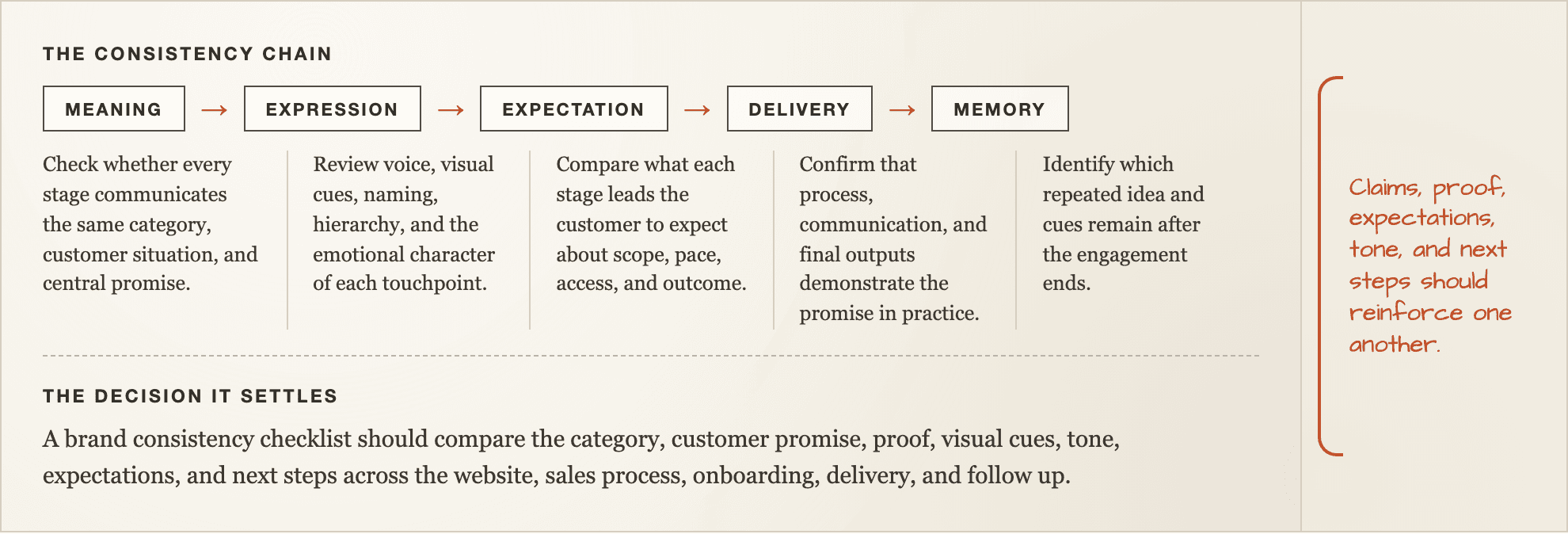
The logo section needs its variations, its clear space, its minimum size, the backgrounds it may sit on, and the treatments it is refused, such as stretching, recolouring, or adding effects. The colour section gives each colour a role, a lead and its supports, rather than a flat row of swatches that leaves everyone guessing which one dominates.
The typography section shows a real heading, subhead, and paragraph set correctly, because people copy examples faster than they parse specifications. Throughout, the useful move is to show the wrong version beside the right one. A boundary teaches faster than an ideal, and a team that has seen the brand applied badly recognises the mistake before it ships.
Voice belongs in the guidelines too
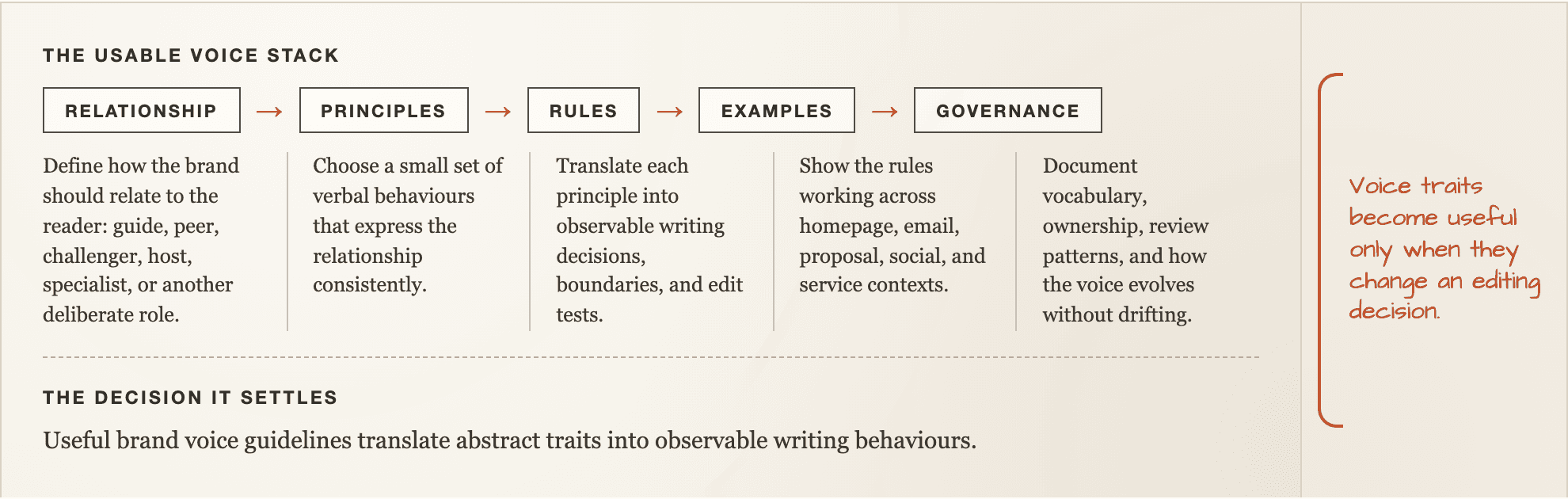
Most guidelines stop at the visual and leave the words to chance, which is why so many brands look like one company and read like three. Give voice its own section: a short description of how the brand sounds, a few words it favours and a few it avoids, and two or three before and after pairs showing the same sentence written off brand and then on brand.
The pairs do the teaching. A writer who sees a generic sentence become a branded one learns the voice in a way no adjective list delivers.
Keep them living, or watch them decay
A guidelines document is a product, rather than a monument, and it decays the moment it stops matching reality. When the brand adds a surface, a new channel, a product line, a partnership, the guidelines should gain the rule for it, or people will invent their own and the inventions will diverge.
Assign the document an owner, review it when the brand changes, and keep it somewhere the whole team reaches without asking. A guideline that lives in one person's drive is a guideline that quietly stops being used, and an unused rule book is indistinguishable from no rule book at all.
- Give the document a named owner, rather than shared custody nobody exercises.
- Add the rule when the brand gains a surface, before anyone invents their own.
- Store it where the whole team reaches it without asking permission.
Before you use it
Questions that can change the recommendation.
What should brand guidelines include?
Five parts: the position and the one idea the brand wants remembered, the logo with its variations and usage rules, the colour palette with a role for each colour, the typography with a hierarchy and real examples, and the tone of voice with before and after pairs. The unifying test is whether someone who has never met the brand can apply it correctly from the document alone.
How long should brand guidelines be?
As long as they need to be followed, and no longer. A small service business is usually served by a focused document a reader finishes in one sitting, rather than a hundred page brand book that impresses in a pitch and goes unread in practice. Length is a cost if it buries the rules people actually reach for. Favour clarity and findability over volume.
Do I need guidelines if it is just me?
Sooner than you expect, yes. The day you hire a freelancer, a virtual assistant, or a first employee, the brand starts being applied by someone who was never in your head, and that is the day drift begins. Writing the rules while it is still only you is far easier than reconstructing them later from a dozen inconsistent versions.
What is the difference between a brand guideline and a style guide?
In practice the terms are used interchangeably, and both describe the document of rules that keeps a brand consistent. Some teams use style guide for the narrowly visual rules and brand guidelines for the fuller document that also carries the position and the voice. The label matters far less than the content: whichever word you use, include the reasoning and the voice, rather than the visuals alone.