Branding an Ontario dental clinic inside the RCDSO advertising rules
The direct answer
RCDSO requires factual dental advertising and prohibits testimonials, superiority or uniqueness claims, favourable-result expectations, fear appeals and incentive programs. Unless otherwise specified, an advertised fee is an inclusive maximum for all patients. Ads referring to an area of practice, procedure or treatment must identify general-practitioner or specialist status. The guidelines also prohibit third-party fees tied to the amount of business obtained through advertising.
Five conclusions
The argument, compressed.
- RCDSO rules out testimonials, plus any statement that can only be verified by a person's feelings or views.
- Wording that implies higher quality, such as "state of the art", counts as a superiority claim.
- Giveaways, contests, draws and free services are banned, which removes the usual new patient offer.
- Unless otherwise specified, the inclusive advertised fee, including laboratory costs, is the maximum for all patients regardless of insurance or awareness of the ad.
- Marketing contracts paid by the amount of business a campaign produces count as prohibited fee sharing, so check how your agency is paid.
Working framework · 5 decisions
The dental clinic brand check
Five questions to run against the website, signage and social accounts before any campaign launches.
Decision 01 / 05
Proof
Remove testimonial widgets and patient quotes from advertising. Replace them with verifiable service, hours and access information; check credential restrictions before publishing bios.
What the guidelines rule out
RCDSO's advertising guidelines are short and specific. Advertising may include no testimonials and no statement that can only be verified by a person's personal feelings or views. It may make no claim of superiority or uniqueness, and the College names phrases such as "state of the art" as examples of wording that suggests higher quality. It may make no statement that suggests favourable results or appeals to the public's fears. And it may run no incentive programs: giveaways, contests, draws, free products and free services are all out.
That list removes most of what generic dental marketing sells. Review widgets, "Hamilton's favourite dentist", the free whitening offer for new patients, the referral draw. An Ontario clinic copying a US dental playbook is copying a compliance problem.
Fees, specialists and the agency contract
Dental fees may be advertised with conditions. Unless otherwise specified, the stated fee includes all related services and laboratory costs and is the maximum for all patients, including those unaware of the ad or covered by insurance. Any stated limitation still needs a clear, truthful explanation; it is not permission to mislead.
When an advertisement refers to an area of practice, procedure or treatment, it must identify whether the dentist is registered as a general practitioner or specialist and, for a specialist, the registered specialty. Do not imply specialist status through the way a general dentist's services are presented.
RCDSO prohibits a third-party fee related to the amount of business obtained through an advertising or marketing campaign. Review the actual payment terms of lead or booking arrangements with the College or counsel rather than treating every marketing contract as equivalent.
Read the contract
If your marketer earns more when you book more patients, that payment structure needs checking against RCDSO's fee splitting rule.
What a dental brand can explain
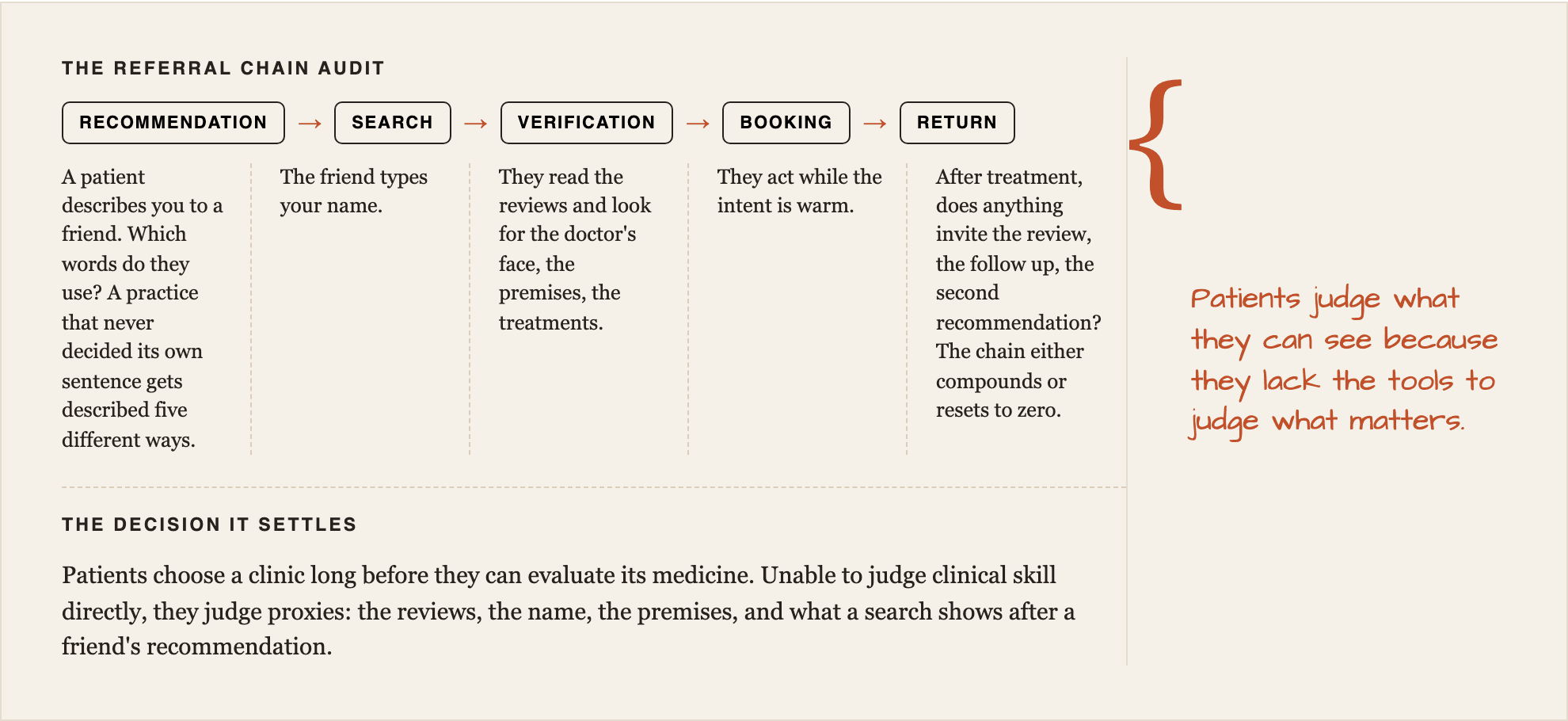
Patients choose a dentist on proxies they can observe: the name, the premises, the ease of booking, what a search shows after a friend's recommendation. Every one of those proxies is fully available under RCDSO's rules. What disappears is borrowed praise; what remains is the clinic's own evidence.
So the brand work moves to specificity and consistency. Say which patients the clinic is built around, families with young children, anxious adults, people who need evening appointments. Publish the facts that matter to that group: hours, accessibility, languages spoken, how a first visit works, the published fee for a check up. Make the name, the signage, the Google profile and the website tell the same story, so a referred patient who checks two places finds the same clinic twice.
A clinic that does this has no need for a review carousel. Its brand is the reason the friend recommended it, written down.
- One sentence naming the patients the clinic is built around.
- A first visit page: what happens, how long it takes, what it costs.
- Dentist bios with accurate registration status and permitted qualifications; do not add continuing-education claims or unrelated degrees prohibited by the guidelines.
- Identical clinic description across website, Google Business Profile and directories.
Before you use it
Questions that can change the recommendation.
Can Ontario dentists use Google reviews or testimonials on their website?
RCDSO's advertising guidelines rule out testimonials and any statement that can only be verified by a person's feelings or views, so reviews and patient quotes belong off the clinic's website and social accounts.
Can a dental clinic in Ontario offer free whitening or a new patient special?
Dental incentives such as giveaways, contests, draws and free products or services are prohibited. Fee advertising is conditional: unless otherwise specified, the inclusive advertised fee is the maximum for all patients, and every claim must remain truthful.
Can I describe my clinic's technology as state of the art?
RCDSO names "state of the art" as an example of wording that implies higher quality, which its guidelines prohibit. Describe what the equipment does for the patient in factual terms instead.
Is a pay per lead dental marketing agency allowed in Ontario?
RCDSO prohibits paying a third party a fee related to the amount of business obtained through an advertising or marketing campaign. Payment tied to leads or bookings falls in that territory, so review the contract and ask the College if it is unclear.
What does brand strategy cost for a dental clinic in Canada?
At Branding Tatva Foundation starts at CA$3,200 and Full Brand System at CA$7,500. The proposal confirms the actual design and strategy scope; legal clearance, regulatory approval and custom clinician bios are not included unless separately agreed where appropriate. The registrant must confirm applicable requirements.
Research record
What this guide draws from.
Each source note describes what the reference supports. Platform guidance, research findings and Branding Tatva's practical suggestions have different scopes.
- Advertising Guidelines
Royal College of Dental Surgeons of Ontario
Testimonials, superiority, incentives, fees, specialist disclosure and fee sharing rules.
- Practice Advisory: Professional Advertising
Royal College of Dental Surgeons of Ontario